

Overview
The React Pivot Table is a feature-rich React pivot grid component designed to organize and summarize business data in a cross-table format. It offers key functionalities such as data binding, drill-up and drill-down, Excel-like filtering and sorting, editing, Excel and PDF export, built-in aggregations, field lists, and calculated fields. Additionally, it supports loading large volumes of data without performance degradation through row and column virtualization.
Interact with a live React Pivot Table
Runs in-browser. No installation required.
Why choose the Syncfusion React Pivot Table?
High performance
The Pivot Table is optimized for fast-paced performance. It efficiently loads and processes millions of records, making it ideal for real-time analytics and high-volume enterprise applications.
Seamless data binding
Bind data seamlessly from local and remote sources The Pivot Table supports JSON and CSV formats, service protocols such as OData and RESTful APIs, SQL databases (MySQL, Microsoft SQL Server, PostgreSQL, Oracle), NoSQL systems (MongoDB, Elasticsearch), and cloud data warehouses like Snowflake.
Integration with charts
Render a pivot chart using the same pivot values, and seamlessly switch between table, chart, or both. Choose from over 20 chart types to visualize aggregated data quickly.
AI-assisted development
Build powerful data summarization experiences faster with the agentic UI builder and Syncfusion agent skills. Generate pivot layouts, aggregations, grouping, and drill-down analytics with minimal manual effort.
Attractive, customizable themes
Create modern UI experiences using built-in themes like Fluent, Tailwind CSS, Bootstrap, Material, and Fabric. Developers can also customize styles using the online Theme Studio tool to match branding and application designs.
Globalization and localization
Enable users from different locales to work with the component easily by formatting dates, currency, and numbering based on regional preferences. The component provides accurate representation and a localized user experience.
AI-Powered Analytics for Faster insights
The AI‑powered React Pivot Table accelerates self-service analysis through natural language commands. Instead of manually configuring every field and setting, users can focus on the question they need answered. Commands such as “Show me sales by region and quarter” or “Calculate revenue per unit sold” are instantly understood and executed, making this especially useful for guided analytics, internal BI experiences, and faster time to insight.
React Pivot Table Code example
Get started with the React Pivot Table using a few simple lines of HTML and JSX code example as demonstrated below. Also explore our React Pivot Table example that shows you how to render and configure a Pivot Table in React.
import { PivotViewComponent, type IDataOptions } from '@syncfusion/ej2-react-pivotview';
import './App.css';
import { pivotData } from './datasource';

function App() {
    const dataSourceSettings: IDataOptions = {
        columns: [{ name: 'Year', caption: 'Production Year' }, { name: 'Quarter' }],
        dataSource: pivotData,
        formatSettings: [{ name: 'Amount', format: 'C0' }],
        rows: [{ name: 'Country' }, { name: 'Products' }],
        values: [{ name: 'Sold', caption: 'Units Sold' }, { name: 'Amount', caption: 'Sold Amount' }]
    }
    return (<PivotViewComponent id='PivotView' height={350} dataSourceSettings={dataSourceSettings}></PivotViewComponent>);
};
export default App;
export const pivotData = [
{ 'Sold': 31, 'Amount': 52824, 'Country': 'France', 'Products': 'Mountain Bikes', 'Year': 'FY 2015', 'Quarter': 'Q1' },
{ 'Sold': 51, 'Amount': 86904, 'Country': 'France', 'Products': 'Mountain Bikes', 'Year': 'FY 2015', 'Quarter': 'Q2' },
{ 'Sold': 90, 'Amount': 153360, 'Country': 'France', 'Products': 'Mountain Bikes', 'Year': 'FY 2015', 'Quarter': 'Q3' },
{ 'Sold': 25, 'Amount': 42600, 'Country': 'France', 'Products': 'Mountain Bikes', 'Year': 'FY 2015', 'Quarter': 'Q4' },
{ 'Sold': 27, 'Amount': 46008, 'Country': 'France', 'Products': 'Mountain Bikes', 'Year': 'FY 2016', 'Quarter': 'Q1' }
];Classic layout
The classic (tabular) layout is designed to enhance data visibility by presenting information in a traditional table format. In this layout, each row label is displayed distinctly at various levels across separate columns, ensuring clarity and better organization. This structured approach simplifies the analysis of datasets, making it easier to interpret relationships and trends within the data through a detailed, organized, and user-friendly table format.


Pivot charts
The React pivot chart can easily be integrated with pivot data rendered independently. The component includes support for plotting more than 20 chart types. The end-user experience is greatly enhanced with a set of user-interaction features such as drill up, drill down, zoom, pan, crosshairs, trackball, events, selection, and tooltip. Highly interactive field list options are available for generating reports from the relational data dynamically.
Virtual scrolling
Large amounts of data can be divided and displayed in the rows and columns of the current viewport using the virtual scrolling feature. Users can navigate to a desired view by scrolling the vertical and horizontal scrollbars.

Paging
Large amounts of data can be divided and displayed page by page with the paging feature. The pager UI allows users to navigate to a desired page using the navigation buttons or an input text box. Row and column pager sizes can be changed independently at runtime. Furthermore, users can toggle the position of the row and column pagers, modify their visibility, and visualize them using a compact view mode.
Pivot Table field list and group fields
The React Pivot Table field list and group fields options are automatically populated with fields from the bound data source. They allow end users to drag, filter, and sort fields, and create pivot reports at runtime.


OLAP data binding
The Pivot Table can be connected to an OLAP cube, and its result can be visualized in both tabular and graphical formats.
Defer layout update
Users can refresh the component on demand instead of during every UI interaction.

Drill down and drill up
The built-in drill-down (expand) and drill-up (collapse) capabilities visualize data in detailed views and abstract views, respectively. By default, the data is displayed in a grouped manner.
Editing and updating
Users can create, read, update, and delete operations for raw data at runtime and update their changes to the underlying data source, reflecting the information in all corresponding cells. The Pivot Table control supports various edit modes such as inline, dialog, batch, and column edit through an interactive UI.

Filtering
Built-in member filters and Excel-like filters with advanced filtering options can be used to filter and view data as required. It is also possible to filter data programmatically in the Pivot Table.

Member filtering
Filtering members in a pivot table allows users to filter data displayed based on values in the row or column axes.

Label filtering
Use Excel-like filtering options in column and row headers based on label text, dates, or numbers.

Value filtering
Use Excel-like filtering options in column and row headers based on grand total values.
Sorting
Users can use sorting to order rows and columns based on labels or values.

Header sorting
Order column and row header text either in ascending or descending order.

Column sorting
Column sorting, also known as value sorting, orders the column values either in ascending or descending order. It is performed by clicking the header of the column to be sorted.

Custom sorting
Arrange field headers in column and row axes according to the user-defined order.
Aggregation
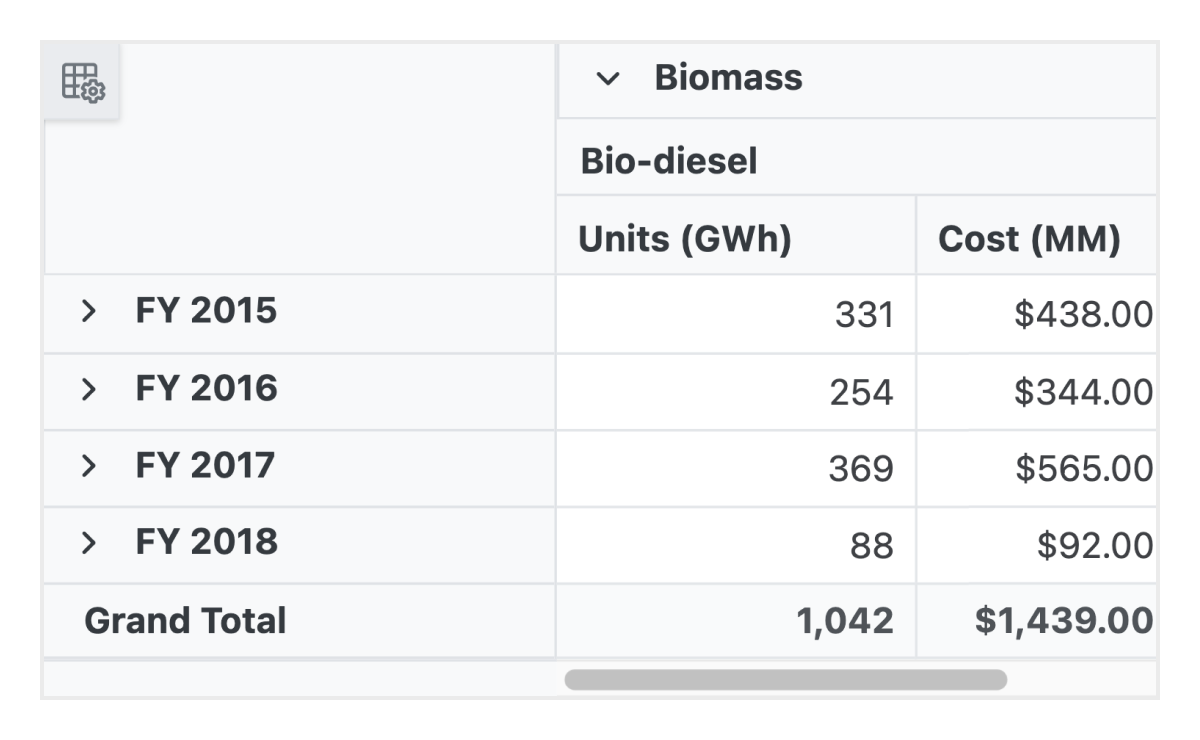
Users can perform calculations on a group of values using the aggregation option. By default, values are added together. The other aggregation types are average, minimum, maximum, count, distinct count, product, index, population standard deviation, sample standard deviation, population variance, sample variance, running totals, percentage of running totals, difference from, percent of difference from, and percent of grand total.
Calculated fields
Calculated or unbound fields generate unique fields with users’ calculated values by executing a simple, user-defined formula.


Drill through
The drillthrough feature easily obtains a list of raw items for a particular value cell or summary cell.
Totals
Subtotals and grand totals are calculated automatically by the pivot engine inside the control and displayed in the Pivot Table to help users make decisions more quickly. Also, users can show or hide subtotals and grand totals for rows and columns.


Conditional formatting
Users can define conditions that, when met, format font style, text color, background color, and font size for values and summary cells.
Number and date formatting
Number and date formatting help transform the appearance of the actual cell values.


Grouping dates and numbers
The Pivot Table control automatically groups dates and numbers, so the date type can be formatted and displayed based on year, quarter, month, day, and more. The number type can be grouped by range, such as 1–5 or 6–10.
Frozen headers
Users can freeze row and column headers to compare them with cell values.

Columns and rows

Resize
Change column width at runtime by simply dragging the rightmost boundary of the column header. A scroll bar will appear when the content width exceeds the control width.

Reorder
Users can reorder columns either through user interaction or programmatically. Simply dragging and dropping a column header into the desired column position will reorder the columns.

Hyperlinks
Users can add hyperlinked text to a cell to redirect to external resources. The control allows them to perform custom operations programmatically.


Tooltips
A tooltip provides basic information about a cell while hovering over it with the pointer.

Cell templates
With cell templates, users can easily add features like images, checkboxes, and text nodes to any cell.

Toolbars
A toolbar enhances user interaction and provides access to frequently used features. These features include new report, save report, save as report, rename report, delete report, report list, show grid, show chart, show or hide totals, export reports, and more.
Exporting
Export the React Pivot Table data to Excel, PDF, and CSV formats. Users can also customize the exported document by adding header, footer, and cell properties like type, style, and position programmatically.

Export to native Excel PivotTable
Users can export the Syncfusion Pivot Table directly to Microsoft Excel’s native PivotTable format, not just as a static table or flattened data. This ensures that all interactive features are preserved, allowing users to fully utilize Excel’s PivotTable functionalities.
Key advantages:
- Native Excel PivotTable: Exports to the actual PivotTable format used by Excel, preserving rows, columns, values, and filters.
- Fully interactive in Excel: Continue to sort, filter, expand/collapse groups, and modify field lists just like in your original pivot.
- Reusable layout: Save time by exporting your configured pivot layout for future use or easy sharing.
Optimized for mobile devices

Touch support
All features will work on touch devices easily. Features such as drilling up, drilling down, filtering, sorting, and report manipulation can be done on the fly.

Responsiveness
The responsive design allows the control to be viewed on various devices.
Accessibility

Keyboard navigation
The Pivot Table ensures that every cell is keyboard accessible. Major features like sorting, selection, and editing can be performed using keyboard commands alone; no mouse interaction is required. This helps create highly accessible applications using this component.

Right to left (RTL)
The Pivot Table supports RTL rendering, allowing the text and layout to be displayed from right to left.
AI-assisted development
Build feature-rich React Pivot Table experiences faster
Accelerate analytical dashboard development with Syncfusion AI tools that turn requirements into fully configured pivot tables and data summarization experiences with minimal manual setup.
Agentic UI builder
Turn prompts into ready-to-use UI screens, layouts, and workflows with Syncfusion React components.
Example prompt Create a financial analytics dashboard with pivot tables and drill-down functionality.
Agent skills
Accelerate development with Syncfusion AI agent skills for faster implementation and integration.
Example prompt Generate a React pivot table with drill-down support, calculated fields, and export options.
MCP Server
Accelerate development with AI that generates, configures, and troubleshoots component code directly in your IDE.
Example prompt Show how to bind OLAP data to the Syncfusion React Pivot Table.
Not sure how to create your first React Pivot Table? Our tutorial videos and documentation can help.
I’d love to watch it now I’d love to read it nowFrequently Asked Questions
Why should you choose the Syncfusion Essential Studio React Pivot Table component?
The Syncfusion React Pivot Table offers:
A high-performance pivot engine and virtualization that help load large volumes of data quickly.
Support for both relational and OLAP data sources. The relational data source can use input data via JSON, RESTful services, OData services, and WCF services, and more.
A grid and chart can be used to organize and summarize pivot data.
Easily filtered, sorted, aggregated, and grouped pivot data.
Drill down and up functionality for viewing detailed or abstract data.
Seamless interaction and editing capabilities.
Simple configuration and APIs.
- Support for all modern browsers.
- A touch-friendly and responsive UI.
Expansive learning resources such as demos and documentation to get started quickly with the component.
Where can I find the Syncfusion® React Pivot Table demo?
You can find our React Pivot Table demo here.
What is the React Pivot Table and how is it used?
The Syncfusion React Pivot Table is a fast and feature-rich component for analyzing large business data. It lets you rearrange data across rows, columns, values, and filters to create interactive summaries. It supports aggregation, sorting, filtering, drill operations, calculated fields, exporting, and chart integration for building modern analytics dashboards.
How do I connect the React Pivot Table to REST APIs or dynamic data?
Fetch JSON data from REST APIs and assign it to dataSourceSettings. Alternatively, use the url property or data manager to bind remote data directly. The Syncfusion Pivot Table supports relational data binding, making it easy to work with dynamic or real-time datasets.
How does the React Pivot Table handle large datasets?
The Syncfusion Pivot Table handles large datasets by using row and column virtualization along with an optimized internal engine.
How do I export React Pivot Table results to Excel, CSV, or PDF?
The Syncfusion React Pivot Table includes built-in export support for Excel, CSV, and PDF formats.
What is the difference between the React Pivot Table and Data Grid?
The Pivot Table focuses on multidimensional analysis and aggregated summaries. The Data Grid focuses on row-level data management, editing, and CRUD operations. Each component serves a different purpose and fits different scenarios.
Can I download and utilize the Syncfusion React Pivot Table component for free?
No, this is a commercial product and requires a paid license. However, a free community license is also available for companies and individuals whose organizations have less than $1 million USD in annual gross revenue, 5 or fewer developers, and 10 or fewer total employees
How do I get started with the Syncfusion React Pivot Table component?
A good place to start would be our comprehensive getting started documentation.
How do I build a React Pivot Table with drag-and-drop fields?
Enable the field list or grouping bar to allow users to drag and drop fields at runtime. When these features are enabled, users can move fields between rows, columns, values, and filters without requiring additional code. These options can be configured under PivotViewComponent and dataSourceSettings.
How can I implement drill-down and drillthrough in the React Pivot Table?
These features are built in and can be customized through events when needed.
How do I add calculated fields or custom formulas in the React Pivot Table?
Configure calculated fields using calculatedFieldSettings for custom KPIs and advanced metrics.
How do I integrate the React Pivot Table with charts?
The Syncfusion React Pivot Table includes built in pivot chart support. By enabling the pivot chart and configuring displayOption, you can switch among table, chart, and combined views, with both staying synchronized as filters, sorting, and drill actions change.
How do I enable filtering, sorting, grouping, and customization in the React Pivot Table?
The Pivot Table provides built-in, Excel-like filtering, sorting, grouping, and field configuration via the UI and dataSourceSettings.
Trusted by the world’s leading companies

Our Customers Love Us




Transform your applications today by downloading our free evaluation version.
No credit card required. | 862K+ downloads
Syncfusion React Pivot Table resources


 Figma download


Explore all Syncfusion React components
Explore over 140+ React UI components featuring established, and production-ready controls built for modern web app development.
-
SMART COMPONENTSGRIDSDATA VISUALIZATIONDROPDOWNSFILE VIEWERS & EDITORSBUTTONSINTERACTIVE CHATINPUTSNAVIGATIONNOTIFICATIONS
Standalone UI SDKs
Integrate the DataGrid, Chart, Scheduler, Gantt, Rich Text Editor, File Manager, and Diagram UI components into applications to enable rich interaction and visualization, delivering a seamless user experience.
Document Solutions
Integrate the PDF Viewer, DOCX Editor, Spreadsheet Editor, and document-processing libraries into the React applications to enable a smooth user experience.