

Transform your applications today by downloading our free evaluation version
Overview
The WinForms Docking Manager control provides an interface to create Visual Studio-like dockable windows in your applications. Dock panels support interactions like docking, floating, tabbing, auto hiding, and grouping document tabs. The control allows users to resize, move, and change the behavior of windows to create a layout that suits various development models.
Different kinds of docking windows
Dockable windows can be dragged anywhere by users. They can be floated around the screen, pinned, and unpinned. As in Visual Studio, the Docking Manager control offers different kinds of windows:
- Docking windows
- Floating windows
- Tabbed windows
- Pinnable windows
- Tabbed MDI windows

Restrict docking
Restrict windows from docking at specific sides of a target or at specific edges of a form. Also customize the dock hint visibility so that they are shown only on horizontal, vertical, or specific sides.

Resizing windows
Users can utilize this interactive WinForms Docking Manager to resize windows by using a splitter between them. Resizing can be restricted within a minimum and maximum limit.

Redock to previous location
Built-in redock support saves the previous state of dock or float windows and moves the windows back to the state when the caption is double-clicked.

Scroll tabs
The Docking Manager in WinForms can arrange groups of dock, float, and auto hide tabs. When the space is not sufficient to display all the tabs, users can view the tabs outside the viewport by scrolling or clicking the scroll buttons.

Docking guides
Docking hints are displayed to indicate valid drop locations for docking panels while dragging the float window. Customize the appearance of the dock hints with built-in styles.

Context menu
The WinForms Dock panels can be moved to different states using built-in context menu that appears when the caption is right-clicked. Improve the end-user experience by adding custom context menu entries.
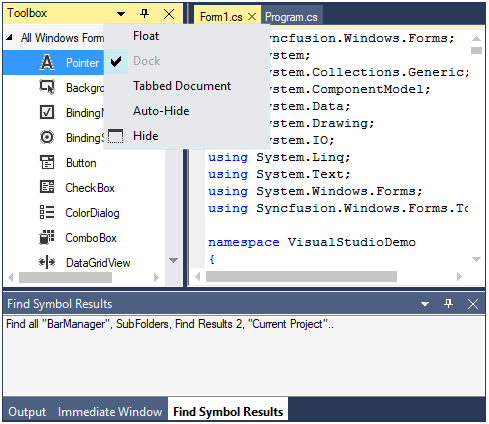
Hide caption
Hide the visibility of a dock window caption dynamically.
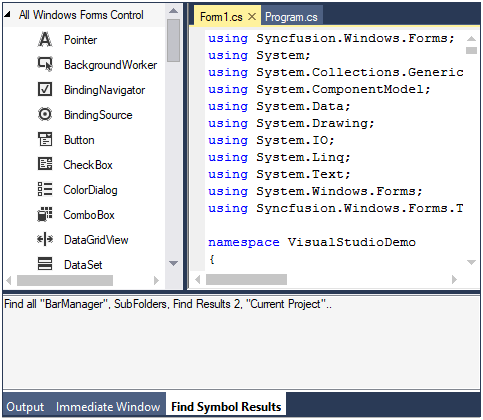
MDI forms
The WinForms Docking Manager displays each document as a separate window within the client area. This allows users to work on more than one document at the same time and seamlessly switch back and forth between docked windows and MDI forms.

Tab groups
The Docking Manager in Windows Forms supports grouping relevant documents into separate tab groups and allows tab group creation in both horizontal and vertical orientations. This helps users display multiple open documents, similar to MDI windows.

Save and restore
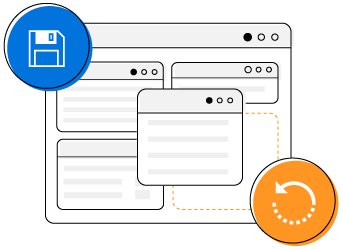
Built-in serialization options support saving a dock layout in different formats on closing, and restoring it on opening the application.
Complex docking layout
Visual Studio like WinForms Docking control allows users to create nested docking layouts with docked windows inside other docked windows or directly dock windows to the main form.

Linked docking
Easily drag child windows from one docking manager to another by linking different docking managers.

Style
The WinForms Docking Manager with a rich UI provides built-in themes like Office-style, Blend, Metro, and Visual Studio.

Localization
The WinForms Dock control supports localization to translate static text to any supported language.

Right to left
A right-to-left (RTL) direction setting is available for users working with languages like Hebrew, Arabic, or Persian.

WinForms Docking Manager control Code Example
Easily get started with the WinForms Docking Manager control using a few simple lines of C# code example as demonstrated below. Also explore our WinForms Docking Manager Example that shows you how to render and configure the WinForms Docking Manager.
using Syncfusion.Windows.Forms.Tools;
namespace WindowsFormsApplication1
{
    public partial class Form1 : Form
    {
          DockingManager dockingManager1 = new DockingManager();
          CaptionButtonsCollection ccbpanel1 = new CaptionButtonsCollection();
          Panel explorer = new Panel();
          Panel output = new Panel();
          public Form1()
          {
               InitializeComponent();
               this.dockingManager1.HostControl = this;
               this.dockingManager1.SetEnableDocking(explorer, true);
               this.dockingManager1.SetEnableDocking(output, true);
               this.dockingManager1.SetDockLabel(explorer, "Solution Explorer");
               this.dockingManager1.SetDockLabel(output, "Output");
               this.dockingManager1.DockControl(output, this, DockingStyle.Left, 100);
               this.dockingManager1.DockControl(explorer, this, DockingStyle.Right, 100);
               this.dockingManager1.CaptionButtons.Add(new CaptionButton(CaptionButtonType.Close, "CloseButton"));
               this.dockingManager1.CaptionButtons.Add(new CaptionButton(CaptionButtonType.Pin, "PinButton"));
               this.dockingManager1.CaptionButtons.Add(new CaptionButton(CaptionButtonType.Menu, "MenuButton"));
               ccbpanel1.MergeWith(this.dockingManager1.CaptionButtons, false);
               this.dockingManager1.SetCustomCaptionButtons(this.explorer, ccbpanel1);
               this.dockingManager1.SetCustomCaptionButtons(this.output, ccbpanel1);
          }
    }
}
Not sure how to create your first WinForms Docking Manager? Our documentation can help.
I’d love to read it now120+ WINDOWS FORMS CONTROLS
ALL CONTROLS
CONVERSATIONAL UI
DATA VISUALIZATION
INPUT CONTROLS
NAVIGATION
DIALOGS & NOTIFICATION
LAYOUT
LISTS & DROPDOWN
CALENDAR
MISCELLANEOUS
FILE VIEWERS & EDITORS
BUTTONS
Standalone UI SDKs
Integrate the DataGrid, Chart, Scheduler and Diagram UI components into applications to enable rich interaction and visualization, delivering a seamless user experience.
Document Solutions
Integrate the PDF Viewer, DOCX Editor, Spreadsheet Editor, and document-processing libraries into the WinForms applications to enable a smooth user experience.
Frequently Asked Questions
Why should you choose Syncfusion WinForms Docking Manager?
Syncfusion WinForms Docking Manager provides the following features:
Create Visual Studio-inspired dock window interfaces with float, dock, auto hide, and tabbed state.
- Save layout information on closing and restore them on opening the application.
- Allows users to interactively resize, move, and change the behavior of windows to create a layout based on their needs.
- Build complex, large-scale applications with a bunch of features with customization options.
- One of the best WinForms Docking Manager in the market that offers feature-rich UI to interact with the software.
- Simple configuration and API.
- Touch friendly and responsive.
Extensive demos and documentation to learn quickly and get started with WinForms Docking Manager.
Where can I find the Syncfusion WinForms Docking Manager demo?
You can find our WinForms Docking Manager demo on
GitHub location.
Can I download and utilize the Syncfusion WinForms Docking Manager for free?
No, this is a commercial product and requires a paid license. However, a free community license is also available for companies and individuals whose organizations have less than $1 million USD in annual gross revenue, 5 or fewer developers, and 10 or fewer total employees.
How do I get started with Syncfusion WinForms Docking Manager?
A good place to start would be our comprehensive getting started documentation.
Our Customers Love Us
Having an excellent set of tools and a great support team, Syncfusion® reduces customers’ development time.Here are some of their experiences.

Excellent experience with Syncfusion!
Syncfusion is a product that makes life easier! I use it to create Blazor applications (server side and webassembly) and the controls speed up development a lot. Furthermore, if needed, it is possible to ask for direct support that is never long in coming!

Andrea Scarpante,

Sydea srl
The complete component set
It is the most complete component set available. Also very handy is the fact that there is a community edition, this gives me the opportunity to test thing at home without buying a separate license.

Johan Visser,

H and T Pawnbrokers
See Real Success Stories
Developers around the world trust Syncfusion’s Essential Studio to simplify complex projects and speed up delivery. With a vast library of UI controls, powerful SDKs, and reliable support, Essential Studio helps teams build enterprise-ready applications with confidence.
Read Our Customer StoriesIndustry
Software development
75% Cost reduction
50% Faster development
Industry
Utilities (oil and gas)

450+ hours saved
Streamlined processes and hours of development effort saved.

Advanced, flexible features
Empowered users through robust and versatile functionality.
Industry
Software and technology
1000+ of hours saved
Accelerated development with enterprise-ready UI components.

Efficient file management
Streamlined workflows with document libraries without building them from scratch.
Industry
Software and technology

2 Years of delay avoided
Two years of delays prevented with proactive planning.

On-time delivery
Projects delivered on schedule using trusted controls.
Industry
IT services and IT consulting

Improved performance
Large datasets handled with easy customization and quick debugging.

Highly customizable
Plug-and-play controls with quick template integration.
Industry
Professional services
Instant access
Quick availability of features and resources.
Reduced dependencies
Fewer dependencies for faster development.
Rated by users across the globe
Syncfusion Windows Forms Resources
Learning
 Documentation
 Documentation


Awards
Greatness—it’s one thing to say you have it, but it means more when others recognize it. Syncfusion® is proud to hold the following industry awards.