React Evaluation Guide
Table of contents
React Tree Grid - Evaluation Guide
Evaluate the Syncfusion React Tree Grid for Enterprise Adoption
Tree Grids are designed to manage complex hierarchical data, including bills of materials, organizational structures, file and asset hierarchies, multilevel financial reports, and supply-chain networks. This guide presents the provided technical evidence in a structured evaluation framework while preserving hierarchy-loading requirements, integration capabilities, performance characteristics, security considerations, tables, and supporting references.
Begin with the evaluation framework and expand into relevant technical topics only when required to assess the specific hierarchy use case under review.
Quick evaluation framework
Evaluate in this order to ensure that unsupported runtimes, hierarchy models, or security boundaries are identified early, before proceeding with advanced customization.
| Order | Evaluation area | What to assess | How to verify | Decision impact |
|---|---|---|---|---|
| 1. | Runtime fit | Frameworks, React versions, SSR model, and browsers | Match the target environment to the compatibility tables and verify every stated condition. | An unsupported runtime can stop the evaluation early. |
| 2. | Build and application fit | Build tools, package formats, hierarchy model, state, theming, and CI/CD | Install in the real repository and run the production build and test pipelines. | Reveals integration work before deeper product testing. |
| 3. | Data and API fit | Adaptors, back ends, authentication, editing, templates, and APIs | Connect a production-shaped hierarchy and implement one representative workflow. | Shows whether the Tree Grid fits existing service and application boundaries. |
| 4. | Performance fit | Virtualization, infinite scrolling, load-on-demand, server operations, and live updates | Reproduce expected depth, width, expansion, update, and interaction patterns on target hardware. | Determines whether the chosen configuration meets workload needs. |
| 5. | Security and procurement fit | Hierarchy authorization, CSP, deployment, export, audit, and compliance evidence | Validate runtime behavior with DevTools and review the cited assurance documents. | Clarifies what the component provides and what the application must enforce. |
| 6. | Final decision | Conditions, limitations, evidence, and unresolved risks | Record pass, conditional pass, or fail for every mandatory area. | Prevents feature breadth from hiding a critical architectural mismatch. |
AI integration and responsibility
The Tree Grid can host application-level AI experiences through custom renderers, toolbar extensions, and event hooks. For example, the AI-assisted hierarchy generation demo shows how an application can use AI to create and structure hierarchical data for display within the Tree Grid.
AI responsibility boundary: The Tree Grid enables AI integration through application-managed services. Applications retain responsibility for security, data governance, and auditing.
1
Architecture compatibility
Evaluate how well the Tree Grid integrates with the application’s existing architecture, including rendering patterns, build processes, state management, styling approach, browser support, and testing infrastructure. This helps ensure the component can be adopted without requiring major architectural changes.
Framework and runtime compatibility
Verify compatibility with the target React version, rendering model, browser requirements, and runtime environment before implementation.
Framework and environment support
The Tree Grid works consistently across supported web environments and does not require environment-specific configuration.
| Deployment Environment | Coverage |
|---|---|
| React 18/19 SPA | Supported and works with standard configuration. |
| Next.js App Router | Supported. Requires client component usage with documented guidance. |
| Next.js Pages Router | Fully supported. Stable on all Pages Router versions. |
| Vite SPA | Fully supported. Integrates as a standard package dependency. |
| Remix | Fully supported. Client-side hydration behavior is documented and reliable. |
| Gatsby SSG | Fully supported. Has static generation and hydrates correctly at runtime. |
| Electron | Supported. Runs inside Electron's renderer process as a standard React component. |
| Micro-Frontend (Module Federation) | Supported. Declare as a shared singleton at the shell level; one version loads across all teams. |
| Micro-Frontend (Single-SPA) | Supported. Runs as a standard, client-rendered React component inside Single-SPA. |
| Preact | Fully supported. The Tree Grid works via Preact's React-compat compatibility layer. |
System requirements for all supported environments are documented.
React version compatibility
Ensure that the application’s React version meets the minimum requirements for the selected Syncfusion release. Review the release history when planning upgrades or migrations.
| React Version | Syncfusion Minimum Version | Approximate Release Year | Coverage |
|---|---|---|---|
| React 16 | Syncfusion v16 | 2018 | Fully supported and documented in the current release. |
| React 17 | Syncfusion v18 | 2020 | Fully supported and documented in the current release. |
| React 18 | Syncfusion v20 | 2022 | Fully supported and documented in the current release. |
| React 19 | Syncfusion v29 | 2024 | Confirmed compatible in the latest release notes. |
| React Strict Mode | No minimum version constraint. | — | Fully compatible. No double-invoke or duplicate state mutation issues in development Strict Mode. |
| Organization-pinned React version | N/A | — | No peer dependency conflicts. The Tree Grid consumes the host application's React version. |
| Future React major version planning | Reviewable in release history. | — | Historical adoption pace across React 17 - 18 - 19 provides evidence-based upgrade planning. |
When upgrading React, keep all @syncfusion packages at or above the mapped minimum. The source describes historical adoption of React 17, 18, and 19. Evaluators should verify future versions in current release documentation.
SSR and server component integration
The Tree Grid supports integration with the Next.js App Router through a documented client-component boundary and server-driven data loading for hierarchical datasets. It also supports Streaming SSR, React Suspense, Incremental Static Regeneration (ISR), and Edge runtime deployments.
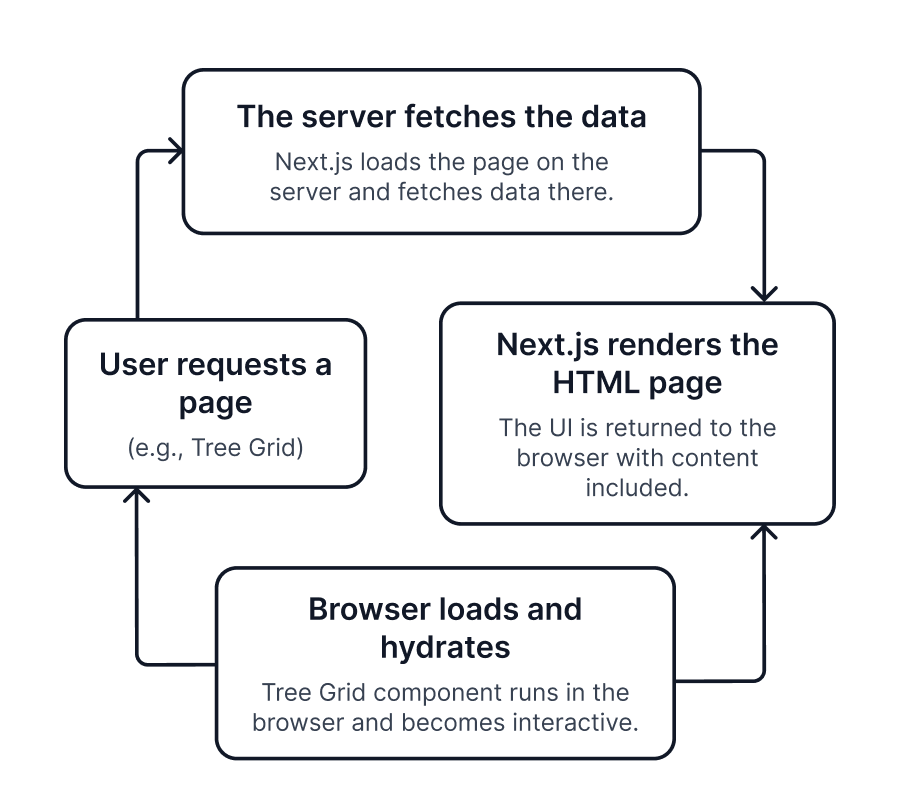
- Data-driven loading: The required hierarchy data can be prepared and delivered for the initial render, ensuring the Tree Grid initializes with the data needed for the initial view.
- Hydration boundary: Place the Tree Grid inside a client component to avoid hydration mismatches in the App Router.
- Streaming SSR: The Tree Grid can be rendered within a React Suspense boundary while initial data is streamed from the server.
- Incremental Static Regeneration: The Tree Grid hydrates correctly on ISR-generated pages without requiring additional Tree Grid-specific configuration.
- Edge runtime: No Node.js-only dependencies prevent deployment in Edge runtime environments.
Browser and runtime support
Use the versioned browser matrix for release and procurement planning. Modern browsers are supported, while Internet Explorer requires the documented Promise polyfill.
| Browser Runtime | Coverage |
|---|---|
| Chrome (latest) | Fully supported |
| Firefox (latest) | Fully supported |
| Safari (latest) | Fully supported |
| Microsoft Edge (latest) | Fully supported |
| Opera (latest) | Fully supported |
| Internet Explorer 11+ (EOL – June 2022) | Supported when the ES6 Promise polyfill is added, as noted in the documentation. |
Build, package, and module compatibility
Confirm that the Tree Grid fits the existing build and modular-delivery model without proprietary tooling.
Build compatibility
The Tree Grid integrates with standard npm and ESM build pipelines without proprietary plugins, helping optimize production bundles by including only the required feature modules.
| Environment / Toolchain | Support and condition |
|---|---|
| Webpack | Fully supported. Works as a standard npm/ESM React package with no custom plugins required. |
| Vite | Fully supported. ESM-compatible, integrates without configuration. |
| Turbopack | Supported via ESM export. Core rendering and data binding validated by Syncfusion under Turbopack's production pipeline. No Turbopack-specific plugin required. Teams should verify their own CSS strategy and SSR/Suspense configuration. |
| Nx / Turborepo (Monorepo) | Fully supported. Standard npm dependency declaration; no custom executors, generators, or monorepo-specific configuration required. |
TypeScript Strict Mode ("strict": true) |
Fully compatible. All public APIs, props, and event signatures are fully typed; no @ts-ignore suppressions required for standard usage. |
| Next.js (App & Pages Router) | Supported. Client-component usage where needed. |
| Create React App (legacy — deprecated) | Supported for existing projects. For new projects or migrations, Vite is the recommended replacement. The Tree Grid's Vite integration guide applies directly with no Tree Grid-level changes required. |
Package distribution and module support
The package supports both modern and legacy module-loading approaches. Organizations with module governance policies or internal registry requirements can inspect the distributed package contents to verify compliance.
| Module Format | Support | Notes |
|---|---|---|
| ESM | Fully supported | Ships as the primary format (dist/es6). Used by default in Vite, Next.js, and Webpack 5 builds. |
| CJS (CommonJS) | Supported | Compatible with legacy Node toolchains, Jest, and CommonJS-based module loaders such as RequireJS and SystemJS. |
| UMD | Fully supported | Available as dist/[package-name].umd.min.js. Loadable in browsers via script tag, AMD, and CommonJS loaders. |
Inspect the published package structure on the npm package page.
Micro-frontend and module federation compatibility
Configure Syncfusion Tree Grid as a shared dependency in micro-frontends to avoid duplicate package loading and version conflicts across modules.
| Micro-Frontend Scenario | Coverage |
|---|---|
| Multiple Tree Grids on the same page | Each instance maintains independent state with no cross-instance interference. |
| Module Federation shell (Webpack) | Shared dependency configuration is documented. Prevents bundle duplication and version conflicts across micro-apps. |
| Vite Module Federation | Supported via @originjs/vite-plugin-federation — shared singleton configuration applies identically to Webpack MF. |
| Lazy-loaded route (React.lazy) | Compatible. No special configuration required. |
Application architecture integration
Determine whether Tree Grid can be adopted within the existing application structure with minimal effort.
State management neutrality
The application remains responsible for hierarchy state, query state, mutations, and cross-component coordination. Tree Grid data enters through props and user actions return through events.
Hierarchical Data Model Support
Tree Grid supports both self-referential records and nested child collections, allowing existing data models to be used without major changes.
Theming and design system integration
Check whether the required brand system can be reproduced through built-in themes, CSS variables, Sass, CSS Modules, or Theme Studio.
- 22 built-in themes including Fluent 2, Material 3, Bootstrap 5.3, and Tailwind 3.
- Design token-ready via CSS variables; themes stay current across version upgrades without source patching.
- Theme Studio generates exportable SCSS/CSS that can be maintained independently within the project.
| CSS Strategy | Coverage |
|---|---|
| CSS custom properties / design tokens | Supported. The Tree Grid exposes CSS variables for design token overrides. |
| Sass / SCSS variable override | Supported. Themes are built in SCSS and customizable through Theme Studio. |
| CSS Modules | Supported. Preventing global style conflicts. |
| Runtime multitenant theme switching | Partially supported, CSS file or class swaps work for basic scenarios; full brand customization requires Theme Studio. |
| Dark mode | Built-in dark variants for all themes with no custom CSS required. |
| Theme Studio | Supported. Exports SCSS/CSS without touching component source code. |
| Brand / design system alignment | Supported. CSS variables and SCSS tokens cover typography, color, and spacing alignment. |
CI/CD and testing compatibility
Confirm that the Tree Grid can be built, tested, and deployed through existing engineering workflows without requiring specialized tooling or infrastructure.
CI/CD pipeline compatibility
Tree Grid-dependent features can run in the same CI/CD infrastructure used by the rest of a React application. No separate test environment or Tree Grid-specific polyfill is required for the listed tools.
Testing framework compatibility
Choose tools that match the existing test pyramid and verify representative interactions, not only initial rendering.
| Testing Tool | Compatibility | Notes |
|---|---|---|
| Jest | Fully supported | Blog reference |
| Vitest | Fully supported | Works with jsdom and happy-dom environments |
| React Testing Library | Fully supported | Standard DOM queries work. No vendor-specific selectors needed. |
| Cypress | Fully supported | E2E tests run against Tree Grid interactions without custom configuration. |
| Playwright | Fully supported | Tree Grid elements accessible via standard locators. |
| Storybook | Supported | Tree Grid renders correctly for visual regression testing. |
Try live demo and navigate to the Testing tab to explore testing approaches and validate implementations using code examples and test cases.
2
Integration and extensibility
The Tree Grid is designed to integrate with existing applications. It works with established data sources, state management solutions, and design systems while providing APIs, events, and templates for customization. This section covers data integration, extensibility options, state management compatibility, and runtime behavior.
Data and back-end integration
Verify how hierarchical data moves through current APIs, services, databases, ORMs, and authentication controls.
Data source integration
Choose the adaptor that matches the backend API pattern in use. DataManager translates Tree Grid operations into the request and response format expected by the backend.
| Adaptor | When to use | Enterprise benefit |
|---|---|---|
| URL adaptor | Back end exposes standard REST APIs. | Works with any back-end technology; compatible with microservice and cloud-native architectures. |
| ODataV4 adaptor | Back end provides services compliant with OData V4. | Standardized query protocol for filtering, sorting, and paging, which reduces the need for a custom API surface and improves consistency across services. |
| Web API adaptor | Back end is built on ASP.NET web API. | Provides optimized request and response handling for .NET enterprise applications and offers native alignment with the Microsoft ecosystem. |
| GraphQL adaptor | Back end exposes a GraphQL endpoint — Apollo, Node.js, Hot Chocolate. | Fetches only the fields the Tree Grid requires, reducing payload size in distributed and microservice architectures. |
| Web Method adaptor | Back end uses legacy ASP.NET Web Services (ASMX). | Modernizes the UI layer without replacing existing back-end systems and preserves investment in legacy enterprise infrastructure. |
| RemoteSave adaptor | Data is managed client-side with server-side persistence only. | Reduces API call volume; suitable for batch editing workflows and high-frequency UI interactions. |
| Custom adaptor | API follows a nonstandard or proprietary format. | Full control over request and response shaping; allows extending any built-in adaptor without building from scratch. |
Extend a built-in adaptor when the API requires custom field mapping, response transformation, authentication headers, or per-request token handling. This approach avoids rebuilding the entire data-access layer.
Try live demo and navigate to the Integration tab, then select Adaptors chip to explore available data adaptors and their configuration patterns.
Back-End framework coverage
Select the adaptor by endpoint protocol and response shape rather than by server language alone.
| Back end | Possible adaptors | Reason |
|---|---|---|
| Django REST framework | URL adaptor, Custom binding | Django REST framework exposes standard REST endpoints, so the URL adaptor maps directly and the custom binding handles nonstandard field formats or auth schemes. |
| Express and Node.js | URL adaptor, GraphQL adaptor, Custom binding | These back ends support both REST and GraphQL, and the binding selection depends on the endpoint type that the service exposes. |
| FastAPI | URL adaptor, Custom binding | FastAPI exposes standard REST endpoints; the custom binding covers nondefault response envelope formats. |
| Flask and FlaskAPI | URL adaptor, Custom binding | REST-based by default; the custom binding handles lightweight or non-standard API conventions. |
| Next.js API routes | URL adaptor, Custom binding | API routes behave as REST endpoints, so the URL adaptor applies directly. |
| GraphQL in Node.js | GraphQL adaptor, Custom binding | The GraphQL adaptor formats queries for Node.js GraphQL servers; the custom binding handles schema variations. |
| GraphQL in Apollo | GraphQL adaptor, Custom binding | The GraphQL adaptor formats queries for Apollo GraphQL servers; the custom binding handles schema variations. |
| GraphQL in Hot Chocolate | GraphQL adaptor, Custom binding | The .NET GraphQL implementations integrate via the GraphQL adaptor, while the custom binding covers schema-specific deviations. |
| ASP.NET Web API | Web API adaptor, URL adaptor | The web API adaptor is optimized for .NET response conventions; the URL adaptor applies where REST-only patterns are used. |
| Legacy ASMX | Web method adaptor, Custom binding | The web method adaptor calls WebMethod endpoints in legacy ASP.NET services without replacing the back end. |
Database integration
The browser component does not connect directly to a database. Every database path must pass through an application-owned API.
| Database | Possible adaptors |
|---|---|
| Microsoft SQL Server | URL adaptor, Web API adaptor, Custom adaptor |
| MySQL | URL adaptor, Custom adaptor |
| PostgreSQL | URL adaptor, Custom adaptor |
| SQLite | URL adaptor, RemoteSave adaptor, Custom adaptor |
ORM compatibility
The Tree Grid has no direct ORM dependency. Any server-side data layer can be used when the API satisfies the selected adaptor contract.
Commonly used ORMs that work with the Tree Grid through back-end APIs include:
- Entity Framework Core
- Hibernate and Java Persistence API
- Django ORM
- SQLAlchemy
- Sequelize and Prisma
- Laravel Eloquent
- Dapper
- Custom ADO.NET, raw SQL, and stored procedures
Authentication passthrough
Apply application-issued credentials through DataManager or the underlying transport layer. Authentication, authorization, session management, and retry policies remain application responsibilities.
| Authentication method | Implementation |
|---|---|
| JWT bearer token | Configured in the DataManager and attached to every request. |
| OAuth 2.0 (PKCE and client credentials) | Token supplied by the application authentication layer and injected via DataManager headers. |
| Token refresh | Handled via the DataManager request interceptor. |
| Mutual TLS (mTLS) | Configured at the HTTP transport layer, which is below the DataManager boundary. |
| Auth failure (401/403) | Surfaces via built-in failure event and the retry, redirect, and notification logic remain in the application layer. |
Review the linked guidance for custom headers and DataManager middleware.
API stability and extensibility
The Tree Grid supports customization through documented extension points, React templates, typed events, and methods, enabling flexible and maintainable implementations.
Versioning and API stability
Review semantic-versioning, deprecation, and migration policies against the organization’s upgrade process before adopting the component.
| Change type | Policy |
|---|---|
| Breaking changes | Introduced only in major versions; not included in minor or patch releases. |
| New properties, events, and methods | Added in minor versions; backward compatible. |
| Deprecations | Deprecated members remain functional through the deprecation window and are flagged with TypeScript @deprecated annotations. |
| Major version upgrades | Accompanied by a migration guide with before and after examples scoped to the published breaking change list. |
Extensibility model
Use documented React templates and public APIs for customization. Sanitize any user-provided content rendered by application templates.
Try live demo and navigate to the Integration tab, then select Extensibility chip to access related resources and examples.
Data Presentation Layer
Customize how data, headers, editors, filters, and empty states are presented in the Tree Grid.
| Extension point | What it replaces | Common use |
|---|---|---|
| Column template | Default cell rendering | Fully customized cell content that goes beyond the default text, enabling richer and more flexible visual or interactive elements. |
| Header template | Default column header | Customize the column header's content and appearance, allowing a more flexible and enhanced header presentation beyond the default label. |
| Cell edit template | Default inline editor | Replace the default text box with any custom input or any React or Syncfusion component that aligns with the application's design system. |
| Filter bar template | Default filter input per column | Customize the filter input for each column, allowing a more flexible filtering behavior based on the custom requirement. |
| Filter template | Default filtering UI | Enables custom filter menu UI and logic using a React component for advanced and business-specific filtering scenarios. |
| Empty record template | Default empty state message | Provides a meaningful message or guidance when no data is available. |
Row and Hierarchical Structure Layer
Extend row and hierarchy layouts to present additional context, details, or application-specific content.
| Extension point | What it replaces | Common use |
|---|---|---|
| Row template | Default row layout | Fully customized row layout that allows more flexible structuring based on the business requirement. |
| Detail template | Default expandable row panel | Display additional information within an expandable row area and support any React component, including other Syncfusion components. |
Editing and Interaction Layer
Use these extension points to align editing experiences and toolbar actions with the application’s workflows and design system.
| Extension point | What it replaces | Common use |
|---|---|---|
| Dialog template | Default dialog form | Replace the default dialog with a fully customized form while preserving the Tree Grid's built-in validation capabilities. |
| Toolbar customization | Default toolbar layout | Customize the toolbar's layout and controls to align with the application's design and interaction requirements. |
| Column chooser template | Default column chooser UI | Customize how users manage column visibility and personalize the Tree Grid layout based on their needs. |
Data Navigation Layer
Defines how users navigate large datasets. Use the pager template when the default pagination interface needs to match specific navigation or design requirements.
| Extension point | What it replaces | Common use |
|---|---|---|
| Pager template | Default pagination UI | Replace the default pagination bar with a custom layout. |
Data Summary Layer
Use the aggregate template to add custom formatting and context to summary values.
| Extension point | What it replaces | Common use |
|---|---|---|
| Footer aggregate template | Default aggregate cell | Customize how aggregate values are displayed in the Tree Grid footer. |
Programmatic API: Events and Methods
The typed event and method API’s provide control before, during, and after operations. The API’s are documented in a versioned reference, and the feature-rich interactive sample can be used to test representative scenarios and explore available capabilities.
| Capability | Architectural implication |
|---|---|
| Pre-execution interception | Selected pre execution lifecycle and interaction events are interceptable, with cancellation support where exposed by the API. |
| Edit lifecycle control | All edit stages, such as begin, validate, save, and cancel, are interceptable, and changes are committed only after application approval. |
| Programmatic data operations | Records can be added, updated, deleted, or batch-updated from application code without user interaction. |
| Server-side query delegation | Paging, sorting, filtering, searching, and aggregation can be delegated to the back end, and this is compatible with any server-side query layer. |
| Programmatic query refinement | Sort, page, filter, and search operations can be done on the client side or invoked programmatically against back-end APIs. |
| Computed summary control | Aggregate values in the footer are programmatically configurable and retrievable. |
| Hierarchical data organization | Group expand, collapse, and lazy load operations can be controlled programmatically, and group lifecycle events are interceptable. |
| Selection state control | Row, cell, checkbox, and range selection can be read and set from application code, and state persists across paging, sorting, searching, and filtering. |
| Cross-instance row movement | Rows are movable between Tree Grid instances, and drag lifecycle events are interceptable and cancelable at each stage. |
| DOM-efficient large dataset rendering | When virtualization is enabled, the Tree Grid renders only the rows and columns needed for the current viewport. |
| Column and layout control | Columns can be resized, autofitted, reordered, frozen, shown, or hidden programmatically at runtime. |
| Programmatic data extraction | Selected rows or cells are copyable to the clipboard programmatically, with or without column headers. |
| User preference persistence | Column sizing, ordering, visibility, and freeze state are serializable and restorable across sessions from any storage layer. |
| Exporting | Trigger Excel, PDF, and CSV exports via methods, with server-side exporting available for large datasets. Paging can be configured for print output. |
| Regional and language adaptation | RTL rendering, locale-aware formatting, and all UI string translations are configurable at the component level. |
| Viewport-responsive layout | Tree Grid layout and dialogs adapt to mobile and tablet viewports at the configuration level—no separate responsive implementation is required. |
| Context and menu interaction | Right-click context menu and column header menu actions are configurable with built-in and custom items, and menu lifecycle events are interceptable. |
| Keyboard and accessibility control | Full keyboard navigation is built in, and keyboard events are exposed for custom interaction handling and accessibility compliance. |
| Loading state control | Spinner visibility and loading indicators are controllable programmatically, independent of Tree Grid data operations. |
| Audit trail support | Edit events carry old and new values with full row context and are directly mappable to a compliance logging pipeline without additional middleware. |
| Instance isolation | Each Tree Grid instance exposes an independent API surface, and state is managed independently for each instance. |
State management integration
The Tree Grid integrates with application-managed state, allowing teams to use their existing React state management approach.
State management compatibility
Existing React state libraries can provide hierarchical data and respond to Tree Grid events without changing application state ownership.
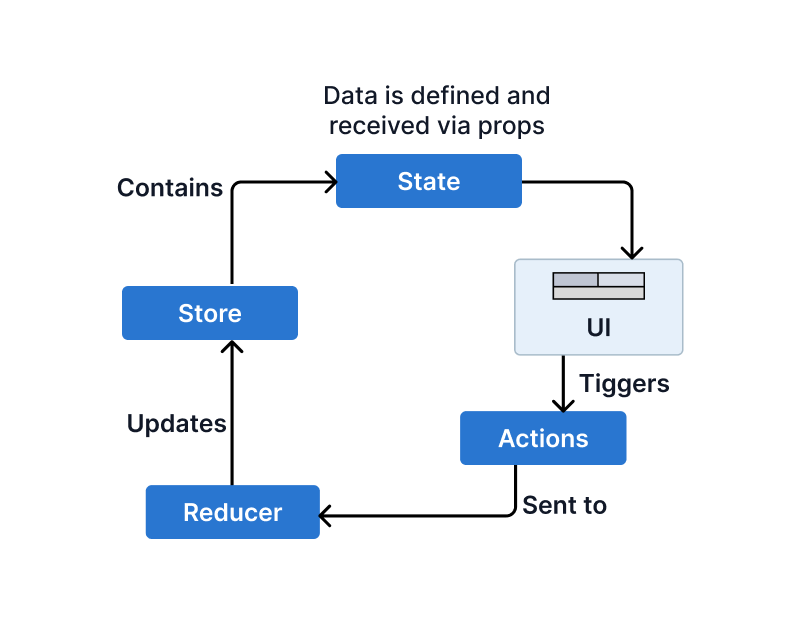
Compatibility matrix
The following matrix shows supported state management libraries and typical integration approaches for the Tree Grid.
| State library | How the Tree Grid connects |
|---|---|
| Redux and Redux Toolkit | Store value is passed as a data source and the dispatch is called inside Tree Grid event handlers. |
| Zustand | Zustand store slice is passed as a data source and the Tree Grid consumes it, but never writes to the store. |
| TanStack Query and RTK Query | Query result is passed as a data source and the Tree Grid triggers a re-fetch via a built-in change event. |
| React Context | Context value passed as a data source, and no provider wrapping is required inside the Tree Grid. |
| MobX | Observable is passed as a data source and the Tree Grid re-renders on observable change. |
| Jotai and Recoil | Atom value is passed as data source, following the standard React data flow. |
Try live demo and navigate to the State Management tab to explore different integration patterns and verify data flow in real time.
Multi-Tree Grid and micro-frontend integration
The Tree Grid supports deployment in applications that use multiple Tree Grid instances or micro-frontend architectures, enabling flexible composition across modules and application boundaries.
Multi-Tree Grid and Micro-Frontend Runtime Behavior
Validate instance isolation independently of shell-level dependency sharing. Coordination between Tree Grid instances remains application-owned.
| Runtime concern | How the Tree Grid behaves |
|---|---|
| State isolation between instances | Each Tree Grid instance maintains an independent configuration, data source, and lifecycle. Actions in one Tree Grid do not affect another. |
| Cross-Tree Grid coordination | Coordination between Tree Grid instances is handled entirely through the application's state layer. The Tree Grid provides the event and method surface; the application owns the coordination logic. |
| Micro front-end module boundaries | The Tree Grid operates as a self-contained React component. It can be added, updated, or removed from a module without affecting other modules in the shell. |
| Lazy loading compatibility | The Tree Grid loads inside React.lazy and Suspense boundaries without hydration errors. It is compatible with on-demand, module-based loading to enable Tree Grid features in MFE shells. |
| Independent upgrade path | Each module can upgrade its Tree Grid version independently when the shell enforces a shared singleton. Version conflicts are resolved at the shell level, not at the module level. |
| Multi-Tree Grid dashboard composition | Multiple Tree Grid instances run simultaneously on the same page. Each renders and scrolls independently with no cross-instance event leakage. |
Use the micro-frontend architecture reference when defining shell ownership and shared dependencies.
3
Performance and scalability
Evaluate performance optimization mechanisms, including virtualization, server-side data operations, and efficient hierarchical data rendering. Validate scalability across large datasets, deep hierarchies, concurrent instances, and real-time updates to ensure Tree Grid meets application workload requirements.
Rendering and data processing performance
Select hierarchy-loading, viewport-rendering, and server-processing strategies before scale testing.
Rendering performance modes
Choose the rendering and loading strategy according to hierarchy depth, row count, column width, navigation pattern, and update frequency.
| Rendering mode | Typical data scenario | What it prevents | Architectural outcome |
|---|---|---|---|
| Row virtualization | Very large hierarchical datasets with vertical scrolling | Rendering all tree rows, including off-screen and collapsed nodes | Only rows within the viewport (plus buffer rows) are rendered; DOM size remains bounded to the viewport while preserving expanded/collapsed state |
| Column virtualization | Tree Grid with many columns and horizontal scrolling | Rendering all columns regardless of visibility | Only visible columns are rendered, which reduces memory spikes during horizontal scrolling |
| Infinite scrolling | Sequential browsing of large tree-structured data | Loading the entire hierarchy during initial render | Data loads incrementally as the user scrolls; initial render time remains low even for large datasets |
| Immutable mode | Frequent or real-time updates to hierarchical records | Full Tree Grid re-render on every data change | Change detection is scoped to modified records; rendering work is minimized while preserving tree structure |
| Load child on demand | Deep hierarchies where all child nodes are not needed upfront | Fetching all child records during initial data load | Child data is retrieved only when a parent row is expanded, allowing network and rendering costs to scale with user interaction |
Server-Side operations
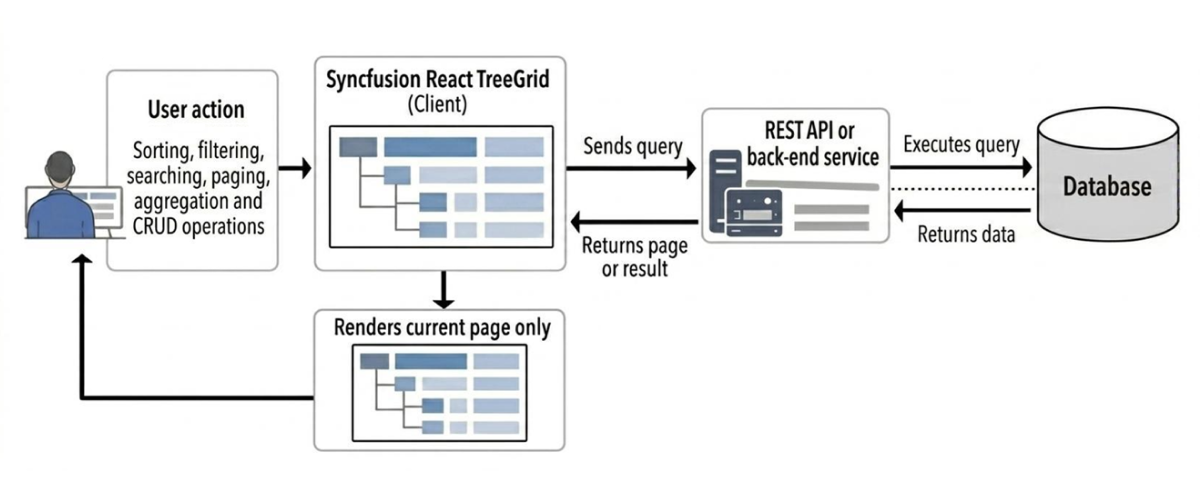
Delegate operations to the back end when the full hierarchy cannot be transferred or processed safely in the browser.
| Server-side operation | Coverage | Architectural benefit |
|---|---|---|
| Paging | Page size and page index parameters sent to the API | Limits client memory usage by transferring only the required top-level records per page |
| Sorting | Sort descriptors passed to the server for execution | Enables database-level sorting for large hierarchical datasets |
| Filtering | Filter conditions transmitted to the back-end API | Avoids client-side traversal and filtering of deep tree structures |
| Searching | Search terms converted to server-side filter predicates | Supports scalable search without loading the full hierarchy |
| Aggregation | Aggregate values calculated by the back-end data source | Ensures summary values reflect the complete dataset, not just loaded nodes |
| CRUD operations | Hierarchical create, update, and delete actions routed to API endpoints | Preserves data integrity, parent-child relationships, and server-side validation |
Figure: Server-side operations flow
DOM efficiency
The Tree Grid minimizes DOM growth through viewport-based rendering, reducing memory usage and helping maintain responsive scrolling and interactions across large hierarchical datasets.
The following node counts illustrate the impact of viewport rendering.
| Dataset or concern | Standard HTML tree | Tree Grid with virtualization enabled |
|---|---|---|
| 1,000 rows × 10 columns with hierarchical rows expanded | ~10,000–15,000 DOM nodes (rows, cells, and hierarchy elements) | ~300–600 DOM nodes (viewport rows × columns and structural elements) |
| 100,000 rows × 10 columns | ~1,000,000+ DOM nodes, often causing browser slowdown | ~300–600 DOM nodes, bounded by viewport size |
| 1,000,000 rows × 10 columns | Browser often becomes unresponsive due to large DOM size | ~300–600 DOM nodes, dependent on viewport height and row height |
| Memory footprint at large scale | Memory grows linearly with dataset size and expanded child records | Memory primarily influenced by viewport height and visible rows |
| Scroll performance | Degrades due to layout, paint, and DOM management overhead | Stable; only viewport rows participate in layout and paint, enabling smooth scrolling |
Performance benchmarking and validation
Measure the production-shaped hierarchy instead of relying on a generic workload.
Testing environment
- Component: Syncfusion React Tree Grid 2026 Volume 1, version 33.1.44.
- Framework: React production build.
- Browser: Google Chrome 122.x.
- Operating system: Windows 11 64-bit.
- Hardware: AMD Ryzen 5 7530U, 16 GB RAM, AMD Radeon graphics.
- Method: Action lifecycle events measured the time from operation start through completion of the corresponding UI update.
Results can change with hardware, browser, viewport, data volume, columns, enabled features, templates, and application configuration.
Benchmark results
The following benchmark results show approximate timings for initial load, sorting, filtering, searching, and infinite scrolling, and virtual scrolling. Results were measured on a large interactive Tree Grid and should be interpreted in the context of the documented testing environment.
| Operation | Virtual scrolling (ms) | Infinite scrolling (ms) |
|---|---|---|
| Initial load | ~782 | ~778 |
| Sorting | ~500 | ~552 |
| Clear sorting | ~135 | ~216 |
| Filtering | ~139 | ~225 |
| Clear filtering | ~177 | ~269 |
| Searching | ~821 | ~767 |
| Clear searching | ~145 | ~153 |
| Expanding | ~86 | ~13 |
| Collapsing | ~106 | ~13 |
Try live demo and open the Performance Benchmark tab to view and validate live performance metrics.
Real-Time performance and scalability
Validate sustained updates and scale dimensions beyond total row count.
Real-Time update performance
Use immutable rendering to limit updates to changed hierarchical records and test the expected feed rate with the real interaction pattern.
| Real-time scenario | Coverage | Rendering behavior |
|---|---|---|
| Batch updates | Fully supported | Only modified hierarchical records update; unaffected nodes remain unchanged |
| Single row updates | Row-level update handling supported | Only the targeted tree row is updated, minimizing broader re-rendering |
| High-frequency data feeds | Immutable rendering mode | Change detection scopes DOM updates during rapid update streams |
| Live data with frozen columns | Fully supported | Frozen columns remain visually aligned during continuous hierarchical updates |
| Real-time updates with row virtualization | Fully supported | Only visible tree rows participate in rendering; off-screen nodes remain virtualized |
| Streaming updates with large hierarchical datasets | Fully supported | Updates are applied incrementally without rebuilding the full tree structure |
| Real-time updates with active row selection | Fully supported | Selection state remains consistent as updates are applied |
| Continuous updates during scrolling | Fully supported | Scroll position remains stable while hierarchical rows update |
| Continuous updates with complex tree layouts | Fully supported | Column layout, indentation, and hierarchy structure remain consistent |
Scalability beyond row count
Evaluate hierarchy depth, column volume, concurrent instances, dynamic schemas, dashboard composition, and aggregation—not only total row count.
| Scalability dimension | Coverage | Architectural behavior |
|---|---|---|
| Column count | Supports large column sets using column virtualization | Only visible columns are rendered, preventing DOM growth with wide schemas |
| Large hierarchical datasets | Row and column virtualization supported together | Rendering limited to visible tree rows and columns within the viewport |
| Deep parent-child hierarchies | Load-on-demand child records supported | Child nodes are fetched and rendered only when a parent row is expanded |
| Concurrent Tree Grid instances | Multiple Tree Grid instances supported on the same page | Each Tree Grid maintains an independent rendering and virtualization lifecycle |
| Dynamic columns at runtime | Column definitions can be added or updated dynamically | Tree Grid structure updates without full component reinitialization |
| Dashboards with multiple Tree Grid components | Fully supported | Each Tree Grid virtualizes and manages its own hierarchical dataset |
| Aggregation across large datasets | Server-side aggregation supported | Aggregate values can be computed against the complete dataset in the back-end |
4
Security and compliance
Understand the security responsibility boundary between Tree Grid and application-owned services such as authentication, authorization, data protection, and audit logging. Review deployment security considerations, export controls, compliance requirements, and vulnerability management practices to ensure organizational readiness and regulatory compliance.
Security architecture and responsibilities
Separate component behavior from application, back-end, and infrastructure controls.
Security responsibility matrix
Use this matrix to assign ownership before implementation. The Tree Grid is a UI layer and does not replace application or back-end security controls.
| Security concern | Component behavior | Application responsibility |
|---|---|---|
| Cross-site scripting (XSS) | Renders encoded text by default; applications must sanitize any HTML content they choose to render. | Sanitize and validate input on the server; block unsafe HTML or scripts; enforce encoding rules. |
| Authentication | Does not handle users, credentials, sessions, or tokens. | Integrate identity providers and manage authentication and session lifecycles. |
| Authorization | Enables or disables UI features based on configuration only. | Enforce authorization in API and service layers for all data operations. |
| Row-level Security (RLS) | Displays all rows and child nodes provided to the client. | Apply row level and hierarchical access controls; return only authorized data. |
| Column-level Security (CLS) | Renders all configured columns without permission checks. | Show, hide, or mask columns based on role or data policy. |
| Sensitive Data Handling | Displays data as received without masking or redaction. | Mask or remove sensitive or regulated data before sending it to the client. |
| Input Validation & Data Integrity | Accepts data and edits without enforcing business rules. | Validate structure, hierarchy, formats, and domain rules; reject invalid input. |
| Hierarchy Modification | Emits reorder events without validation. | Validate allowed hierarchy changes and enforce business constraints. |
| Inline Editing & CRUD Operations | Triggers client-side add, edit, and delete events only. | Apply authorization, validation, and concurrency controls on the back end. |
| Audit logging | Emits UI interaction events such as edits and reordering. | Capture events with user, role, and tenant context and send to audit systems. |
| Transport Security | Uses the application's existing HTTP stack. | Enforce HTTPS or TLS and secure Tree Grid data APIs. |
| Content Security Policy (CSP) | Designed to work with strict CSP configurations. Applications should validate CSP compatibility in their deployment environment. | Configure and enforce CSP headers across the application. |
| Dependency Security | Delivered as a versioned npm package without CDN usage. | Monitor dependencies for vulnerabilities and apply security updates. |
| Multitenancy & Data Isolation | No tenant awareness or isolation logic. | Enforce tenant isolation and authorization at the API level. |
| Denial of Service (DoS) Protection | Renders trees without size or depth limits. | Apply throttling, limits, and request validation to prevent abuse. |
Security architecture overview
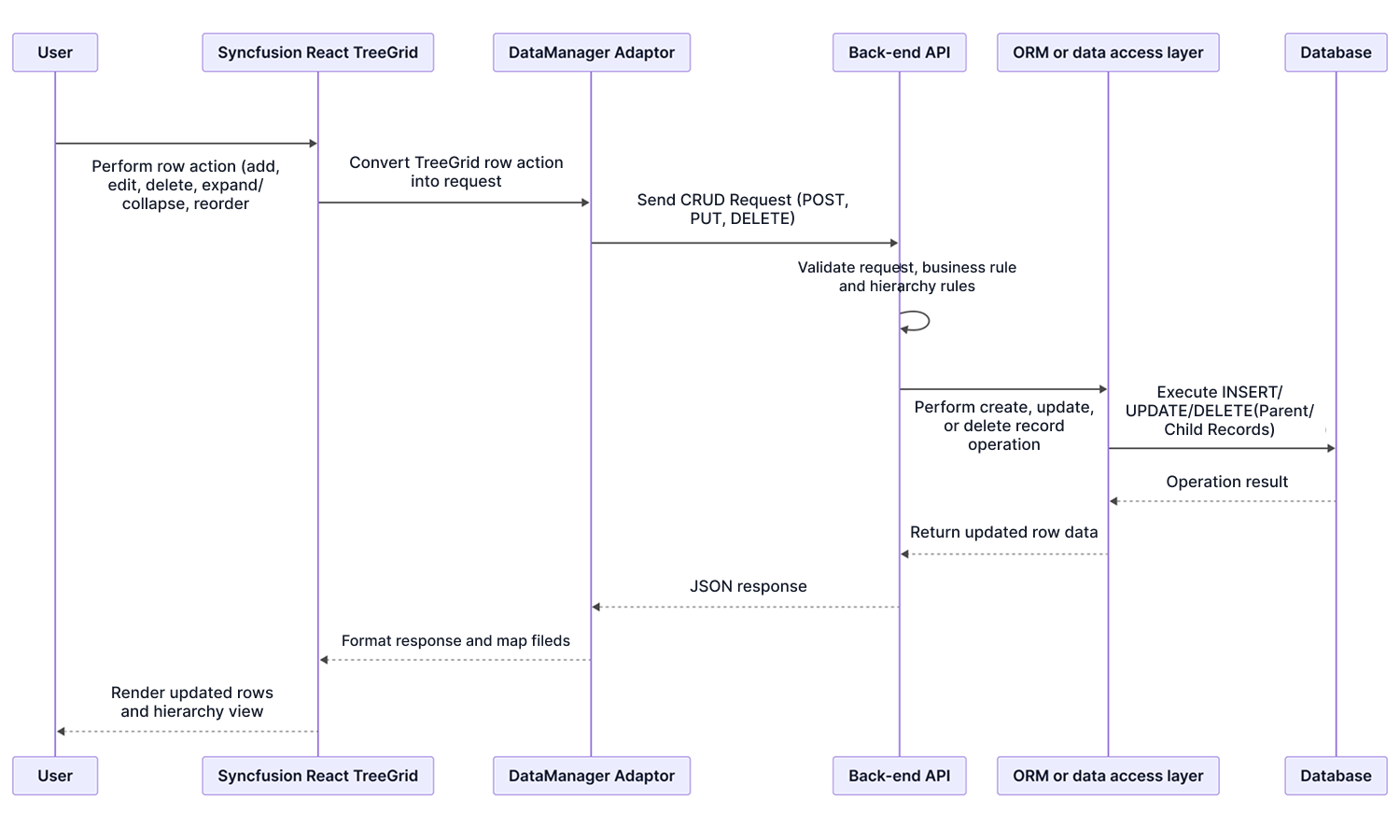
Trace hierarchical reads and changes across the browser, application API, business rules, and data layer so every trust boundary is explicit.
Tree Grid events describe additions, edits, deletions, reordering, and expansion activity. The application converts approved actions into API requests, and the back end validates hierarchy rules and business constraints before persistence.
After persistence, return the authoritative hierarchy to the application and rebind it so the displayed parent-child structure reflects the accepted server state.
OWASP security responsibility context
Apply OWASP controls according to the Tree Grid’s role as a client-side dependency. Identity, access, transport, validation, supply-chain, and logging controls remain outside the component.
| OWASP risk area | How it relates to the Tree Grid | Responsibility |
|---|---|---|
| A01: Broken Access Control | The Tree Grid renders hierarchical rows and columns as provided by the application and does not enforce visibility or edit permissions. | Access control must be handled in back-end services and application logic, including row and column level authorization. |
| A03: Software Supply Chain Failures | The Tree Grid component is brought in via client-side packages, which introduces risk if the dependency supply chain is not properly validated and controlled. | It is essential to manage source validation, apply timely updates, and implement safeguards in the software delivery lifecycle. |
| A04: Cryptographic Failures | Data shown in the Tree Grid is transmitted between the browser and back-end APIs; the component does not perform encryption. | TLS, certificates, and encryption standards must be enforced at the infrastructure and back-end layers. |
| A05: Injection | User-provided row or cell values may introduce XSS if unsafe content is rendered without sanitization. | Applications must validate, sanitize, and escape data before sending it to the client. |
| A07: Authentication Failures | The Tree Grid does not manage authentication, sessions, tokens, or user identity. | Authentication and identity must be implemented and secured by the application and identity provider. |
| A08: Software or Data Integrity Failures | Component integrity relies on trusted npm sources and build pipelines. | Use locked dependencies, integrity checks, secure CI/CD pipelines, and controlled registries. |
| A09: Security Logging and Alerting Failures | The Tree Grid emits client-side events but does not perform logging. | Applications should capture relevant events and forward them to centralized logging or monitoring systems. |
Application and data security
Validate data flow, hierarchy permissions, deployment behavior, and export governance.
Data flow and network behavior
All Tree Grid-related traffic follows application-defined API routes and security controls. The component does not add an independent network channel.
Data flow overview
- Data source initiation: The application selects and calls the approved API or service that supplies the hierarchy.
- Client-side binding: Pass only the authorized rows and relationships to the Tree Grid. It renders the supplied hierarchy and does not independently discover additional records.
- User interaction events: Selection, editing, filtering, sorting, paging, and hierarchy changes emit client-side events. An event describes the requested change but does not make it authoritative.
- Application-controlled persistence: The application decides whether an event is valid and explicitly sends approved changes to its back-end service. The Tree Grid does not write directly to a database.
- Back-end validation and response: Recheck identity, permissions, hierarchy rules, concurrency, and data integrity before applying a change. Return the resulting hierarchy for rebinding after the operation succeeds.
Network behavior characteristics
- The Tree Grid does not initiate outbound network calls to Syncfusion services or third-party endpoints.
- All network communication occurs through application defined HTTP(S) requests between the browser and back-end APIs.
- Authentication headers or tokens are attached by the application; the Tree Grid does not generate or manage credentials.
- All client-side events are treated as untrusted input and must be validated server side before persistence.
- The Tree Grid can render previously supplied data in offline or restricted environments without network access.
Authentication and authorization integration
Express evaluated permissions through the data returned, column configuration, edit settings, and intercepted hierarchy events. Revalidate every change at the back end.
| Security requirement | Tree Grid capability | Security enforcement layer |
|---|---|---|
| Column Visibility Control | Columns are rendered based on configuration supplied by the application. | Application layer: Column definitions included or excluded based on permission checks. |
| Row and Hierarchy Visibility | The Tree Grid renders only the rows and parent-child relationships provided by the application. | Back-end layer: Authorization, tenant scoping, and row level filtering enforced through access controlled queries. Application layer: Binds only authorized rows and hierarchies supplied by back-end services. |
| Edit Permissions | Add, edit, delete, drag, and reorder actions can be enabled or disabled per grid or column. | Application layer: Edit settings applied based on evaluated permissions before rendering. |
| Role-based Editing | Editing behavior is configurable based on role or user context. | Application layer: Role or claim based permission evaluation at render time. |
| Read-only Tree Grid | Full read only mode supported, disabling all edit interactions. | Application layer: Read only mode enabled based on role, tenant, or session context. |
| Hierarchy Modification Rules | Drag and drop and reparenting events can be intercepted. | Application layer: Business and authorization rules validated before persisting changes. |
| Sensitive Data Masking | Cell values can be formatted or masked before display. | Back-end layer (preferred): Masking applied before data is returned. Application layer: UI level masking for nonregulated data. |
| Bulk Action Control | Supports multirow selection and batch operations. | Back-end layer: Authorization validated per record; bulk limits enforced. |
| Multitenant Data Isolation | No tenant awareness within the component. | Back-end layer: Tenant scoped queries and row level isolation. Application layer: Tenant context validation. |
| Authenticated API Communication | All data operations occur through application defined data sources. | Application layer: Attaches auth tokens to requests. Back-end layer: Validates tokens per request. |
| Secure Event Trust Boundary | Client side change events are generated for user actions. | Back-end layer: Treats all client events as untrusted and revalidates authorization. |
| Audit and Traceability Support | Emits deterministic events for edits, deletes, selection, sorting, filtering, and hierarchy changes. | Application layer: Captures events and forwards them to audit logs or SIEM systems. |
Deployment security characteristics
Verify these runtime claims in the production build, especially CSP behavior, network activity, browser storage, and package loading.
| Deployment characteristic | What it means |
|---|---|
| No external runtime connections | Makes no outbound network calls to Syncfusion services or third-party endpoints during runtime. |
| CDN free, self hosted | All required CSS, and assets are bundled within the npm package; no reliance on external CDNs at runtime. |
| Closed network compatible | Fully functional in offline, air gapped, or regulated environments without internet connectivity. |
| Internal registry installation | Can be installed and managed entirely from private npm registries without access to the public npm registry. |
| Strict CSP compatible (no unsafe inline or unsafe eval) | Does not rely on unsafe inline scripts or dynamic code execution; applications should validate CSP compatibility for generated styles. |
| No telemetry or analytics | Does not transmit usage metrics, diagnostic data, or analytics information externally. |
| No embedded third-party scripts | Does not include, reference, or load scripts from any external domains. |
| Deterministic, build only behavior | Runtime behavior is fixed by the shipped code with no remote configuration, feature flags, or dynamic behavior changes. |
| Pure client-side rendering | Tree Grid rendering occurs in the browser runtime, even when used inside server-rendered application frameworks. |
| No browser storage by default | Does not persist data to localStorage, sessionStorage, or IndexedDB unless explicitly implemented by the application. |
| No cookie or token access | Does not read, write, or manipulate cookies, authentication tokens, or identity artifacts. |
| Licensing is offline | License validation occurs locally at deployment or build time, with no runtime dependency on license servers. |
Export security
The application controls who can export and which hierarchical records and columns are included. Apply masking, tenant filtering, and audit rules before file generation.
| Export security concern | How it is addressed | Enforcement location |
|---|---|---|
| Export Scope Control | The Tree Grid exports only the rows, columns, and hierarchical data currently available on the client. | Application layer: Controls data binding and scope. |
| Authorization for Export | Export actions can be enabled or blocked by the application based on user roles or policies. | Application layer: Export permissions are evaluated based on user roles or access policies. |
| Row-level Export Security | All rows present in the grid are included in the export output. | Back-end layer: Filters authorized rows before data reaches the client. |
| Column-level Export Security | All visible columns are exported by default. | Application layer: Hide, exclude, or mask columns before exporting. |
| Sensitive Data Exposure | Exported data exactly reflects what is rendered in the grid, without additional redaction. | Back-end or application layer: Apply masking or removal before exporting. |
| Export Format Control | Multiple export formats are supported when enabled. | Application layer: Restrict formats based on policy. |
| Client-side Trust Boundary | Export requests originate from the client and are not inherently trusted. | Back-end layer: Validate authorization and request integrity. |
| Audit Logging of Exports | Export actions can be intercepted and routed to application logging or audit systems. | Application layer to logging or SIEM systems. |
| Data Retention After Export | The Tree Grid does not control how exported files are stored or shared. | Organizational policy enforced by application and users. |
| Multitenancy and Data Isolation | The component has no tenant awareness during export operations. | Back-end layer: Ensure tenant scoped data isolation. |
| Download Transport Security | Uses standard browser download mechanisms for exporting files. | Infrastructure and application layer. |
Compliance and security assurance
Collect current compliance, vulnerability-management, and runtime-verification evidence.
Compliance certifications
Collect current procurement evidence rather than treating a guide summary as certification. Organizational controls do not certify an individual UI component.
| Certification or standard | Syncfusion coverage | Procurement reference |
|---|---|---|
| SOC 2® Type 2 | Independently audited controls covering security, availability, confidentiality, and operational effectiveness applicable to Tree Grid usage in enterprise solutions. | SOC 2® Type 2 overview |
| GDPR | Documented GDPR aligned data protection and processing practices supporting privacy and regulatory assessments for applications using the Tree Grid component. | GDPR overview |
| WCAG 2.1 AA (accessibility) | Tree Grid UI features are tested for WCAG 2.1 AA compliance; accessibility guidance and documentation are available across Syncfusion component suites. | Accessibility standards |
| ISO 27001 | ISO 27001 certification status is available through Syncfusion enterprise engagement; coverage applies across product development and delivery processes. | Contact sales team for certification details. |
| Section 508 | WCAG AA alignment provides the foundation for Section 508 support; formal conformance documentation is available through enterprise procurement channels. | Section 508 documentation |
Vulnerability management
Review disclosure, patch, release-note, and escalation processes against the organization’s vulnerability-response policy.
| Vulnerability management aspect | Syncfusion coverage | Where to verify |
|---|---|---|
| Responsible disclosure policy | Publicly documented responsible disclosure process with a dedicated reporting channel for external security researchers. | Responsible disclosure |
| Security patch delivery | Security fixes for the Tree Grid component are delivered through regular product releases and distributed via standard npm package channels. | Release notes |
| Security fix documentation | Release notes documents resolved issues, including security related fixes and the versions in which they are addressed. | Release history |
| Enterprise security escalation | Security issues may be reported through Syncfusion support; enterprise customers receive priority escalation based on their support agreement. | Support SLA |
| Dependency vulnerability monitoring | Third party dependencies used by the Tree Grid component are continuously monitored and updated as part of routine maintenance. | Release notes |
Review regulatory compliance guidance for additional compliance information.
Security assurance statements
Treat each assurance statement as a claim to verify and retain the resulting logs, screenshots, package versions, and procurement records.
| Assurance statement | Verification method |
|---|---|
| The Tree Grid component does not initiate outbound network calls to Syncfusion or third-party services during normal runtime operation. | Monitor the Network tab in browser DevTools while loading and interacting with the Tree Grid. |
| All data rendered by the Tree Grid is supplied explicitly by the hosting application. The component does not autonomously fetch data. | Inspect data binding logic and observe network requests using browser DevTools. |
| No inline styles are injected into the DOM by the Tree Grid component at runtime. | Inspect the Elements panel in browser DevTools and review CSP violation logs. |
| The Tree Grid does not use eval, function constructors, or dynamic code execution in its rendering pipeline. | Review the console output and CSP reports to confirm no unsafe eval violations. |
| Cell and row rendering includes protections to prevent script execution when rendering untrusted data values. | Inject harmless XSS test payloads and observe DOM behavior to confirm scripts are not executed. |
| Hierarchical data rendering (parent-child rows) does not bypass application-level data validation or authorization. | Validate server filtered responses during hierarchy expansion using DevTools and API inspection. |
| Drag and drop and hierarchy modification actions emit client-side events only and do not persist changes automatically. | Observe emitted events via debugger tools and confirm that no persistence occurs without application logic. |
| The component does not manage credentials, authentication tokens, cookies, or session state. | Inspect cookies, local storage, and session storage via browser DevTools. |
| Export requests can be intercepted and audited by the application. | Application logging or audit pipeline verification. |
| WCAG 2.1 AA accessibility conformance documentation is available for the Tree Grid component. | Accessibility documentation |
| Security fixes and dependency updates for the Tree Grid component are delivered through standard product release cycles. | Release history and Release notes |
| Vendor security documentation (SOC 2® Type 2, GDPR, ISO 27001 status) is available for enterprise customers. | Procurement request via Syncfusion enterprise sales. |
5
Interactive live demos
Use the interactive live demos to assess the component in representative usage scenarios. Explore key capabilities, interactions, configuration options, and runtime behavior to validate functional fit and user experience against application requirements.
Try our Live Demo
6
Evaluation checklist
Use this checklist as the final architecture and proof-of-concept scorecard. Mark an item only after collecting evidence in the target application and deployment environment.
01. Runtime compatibility
- Validate the target React version against the current Syncfusion compatibility matrix and release history.
- Build the real application with its production bundler, TypeScript settings, CSS strategy, and module format.
- Confirm the Next.js client-component boundary, hydration path, Suspense behavior, ISR behavior, and Edge constraints where applicable.
- Confirm the browser support policy and document any legacy polyfill requirement.
- Confirm that React Native is outside the supported scope.
02. Data and hierarchy
- Choose and test the required hierarchy model, including parent-child relationships, depth, expansion, and editing behavior.
- Validate the selected DataManager adaptor with production-shaped responses, errors, filters, search, aggregation, and CRUD.
- Confirm whether the full hierarchy can be transferred or whether child records must load on demand.
- Validate back-end hierarchy rules, concurrency, reparenting, and transaction behavior.
- Confirm that ORM and database choices remain behind application APIs.
03. Extensibility and workflow
- Validate cell, row, header, detail, editing, toolbar, column chooser, pager, and aggregate templates required by the design system.* Confirm the state-management integration and ownership of refresh, caching, errors, and retries.
- Exercise programmatic events and methods required for selection, hierarchy control, cross-instance movement, export, accessibility, and audit capture.
- Define the shared dependency and upgrade policy for micro-front-end deployments.
- Validate multiple Tree Grid instances for state isolation and dashboard composition.
04. Performance and scalability
- Test the largest expected row count, hierarchy depth, column count, expansion pattern, and update frequency on target devices.
- Choose row virtualization or infinite scrolling based on the required navigation model; do not plan to enable both.
- Combine row and column virtualization when the hierarchy is both tall and wide.
- Validate immutable mode for sustained updates and confirm selection, expansion, frozen columns, and scroll stability.
- Validate server-side export when complete hierarchical reports exceed the browser memory budget.
05. Security and governance
- Enforce row, hierarchy, column, tenant, bulk-action, edit, and export authorization in application and back-end layers.
- Sanitize untrusted content before rendering it in templates or editable cells.
- Treat all client events and hierarchy changes as untrusted until the server revalidates them.
- Capture edits, deletes, filtering, sorting, selection, hierarchy changes, and exports in the audit pipeline where required.
- Verify CSP, outbound network behavior, browser storage, token access, telemetry claims, accessibility evidence, and release documentation.
06. Final decision
- Document POC results, unresolved limitations, implementation effort, operational ownership, and mitigation plans.
- Confirm that all must-have criteria are supported without unsupported workarounds.
- Assign owners and dates for accepted risks before approval.
- Record the final approve, approve-with-conditions, or reject decision.
7
Frequently asked questions
Review the questions that most often affect architecture fit, analytical scale, security approval, and long-term adoption.
Does the React Tree Grid work in both Next.js routing models?
Yes, the React Tree Grid is documented for both Next.js Pages Router and App Router integration patterns. Validate mixed-router deployments during migration, particularly hydration, data loading, and code-splitting behavior.
Can the React Tree Grid use GraphQL without a completely custom integration?
Yes. Syncfusion DataManager provides GraphQL integration capabilities through a GraphQL adaptor. Depending on the GraphQL schema, custom request or response mapping may still be required.
Can row virtualization and infinite scrolling be enabled together?
No. Row virtualization and infinite scrolling are mutually exclusive features. Use infinite scrolling for continuous data loading and row virtualization for efficiently navigating large hierarchical datasets.
Does virtualization apply to both rows and columns?
Yes. Row and column virtualization can be enabled together so that only visible hierarchical rows and columns participate in DOM rendering.
Can child records load only when a parent expands?
Yes. Load-on-demand retrieves child records after expansion, reducing the initial hierarchy payload and rendering cost.
Can the React Tree Grid operate when the full hierarchy cannot be loaded into the browser?
Yes. Server-side paging, sorting, filtering, searching, aggregation, CRUD, and load-on-demand child fetching allow the client to receive only the required records.
Can the React Tree Grid handle frequent real-time updates?
Yes. Immutable mode scopes change detection to modified hierarchical records, while virtualization limits rendering to visible rows. Validate the actual update rate and data shape in the target environment.
Does drag-and-drop hierarchy reordering persist automatically?
No. Reordering emits client-side events. The application must validate authorization and business rules and explicitly persist approved hierarchy changes.
Does the React Tree Grid enforce row-level, hierarchy-level, or tenant permissions?
No. It renders the rows and hierarchy supplied by the application. The back end must filter authorized data and revalidate every create, update, delete, move, and bulk request.
Does the React Tree Grid transmit data to Syncfusion at runtime?
No. The supplied security source states that the component makes no outbound runtime calls to Syncfusion services or third-party endpoints. Application-configured APIs remain under the host application’s control.
Is the React Tree Grid compatible with a strict Content Security Policy?
The sources state that it is designed for strict CSP configurations and does not rely on unsafe-eval or dynamic script execution. Validate generated styles, templates, and the complete production build with CSP reporting enabled.
Can React Tree Grid actions be captured for audit logging?
Yes. The component emits deterministic events for edits, deletes, selection, filtering, sorting, and hierarchy changes. The application must enrich and forward them with user, role, and tenant context.
How should very large hierarchical exports be handled?
Use server-side export when document generation would create excessive browser memory pressure. The server-side path can generate complete Excel or PDF output outside the browser runtime.
Can multiple React Tree Grid instances run on the same page or in micro-frontends?
Yes. Each instance has an independent state and rendering lifecycle. In Module Federation, define shared Syncfusion dependencies at the shell level to avoid version duplication.
8
Resources
Use these references after the FAQ to continue implementation, validation, troubleshooting, and procurement review.
- React Tree Grid documentation- Start with installation and basic configuration.
- Knowledge base articles- Review task-specific solutions and troubleshooting guidance.
- Tutorial videos- Follow feature walkthroughs in video format.
- Feature walkthrough video- See a guided product overview.
- Live interactive demo- Explore the Tree Grid in a browser.
- Feature web story- Review a brief visual feature summary.
- Figma UI kits- Check available design assets.