

Transform your applications today by downloading our free evaluation version
Overview
The React Dropdown List is a quick replacement of the HTML select tags. It has a rich appearance and allows users to select a single value that is non-editable from a list of predefined values. It has several out-of-the-box features, such as data binding, filtering, grouping, UI customization, accessibility, and preselected values.
React Dropdown List code example
Easily get started with the Dropdown List using a few simple lines of TSX code, as demonstrated below. Also explore our React Dropdown List example, which shows you how to render and configure a Dropdown List in React.
import { DropDownListComponent } from '@syncfusion/ej2-react-dropdowns';
import * as React from 'react';
import * as ReactDOM from "react-dom";
export default class App extends React.Component<{}, {}> {
  public render() {
    return (
       // specifies the tag for render the DropDownList component
      <DropDownListComponent id='ddlelement'/>
    );
  }
}
ReactDOM.render(<App />, document.getElementById('sample'));
Data binding
You can bind data from a variety of data sources in an array from primitive data, JSON data collections, or a remote data source using different kinds of adaptors such as OData, OData V4, URL, JSON, and Web API. The component uses the JavaScript data manager to manage data and has customization options for data requests and processing.
Filtering and searching drop-down lists
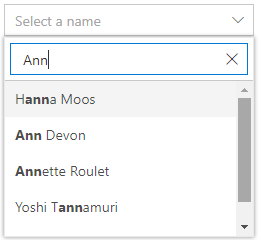
The React Dropdown List Component has built-in filtering support with a rich set of filtering configurations available to match all your application needs. Enable the filtering functionality to show the search input box in the drop-down pop-up list.

Custom filtering
The React Dropdown List Component filter queries can be customized. You can also use your own filter libraries to filter data like Fuzzy search.

Diacritic sensitive search
The React Dropdown List Component has built-in diacritic character sensitivity support. This behavior can be turned on or off.
Filter settings
The filtered search can be customized with case sensitivity, and you can set the number of characters required to make a filtered search.
UI customization with templates
The appearance (style) of each item displayed in the selection pop-up list, header and footer of the selection pop-up list, and the drop-down input box (select box) can be customized.

Header template
Design your own header for the pop-up list using a header template.

Item template
Define the custom appearance of each list item using an item template.

Footer template
Design your own custom footer for the pop-up list using a footer template.

Value template
Define a custom appearance for a selected value in the drop-down input box using a value template.

Empty record template
Configure the custom look of a pop-up list when no items are available to display in the filter search functionality.

Drop-down icons
Each list item of the pop-up list is configurable with a custom icon to improve readability and visualization.
Cascading drop-down list
Create a cascading drop-down list to help the user populate data to the next-level drop-downs based on the selected value of the parent Dropdown List.

Grouping with category
Group the pop-up list items with the corresponding category, making it easy to pick an item quickly from the select drop-down and increase the visual experience of the user.
HTML form support
The React Dropdown List is a form component that seamlessly supports HTML forms and obtains values on form submission actions.


Dropdown List pop-up dimension
The width and height of the pop-up option list is customizable.
Sortable list items
You can display items in ascending or descending order in a pop-up select option list.


Drop-down floating label
The React Dropdown List component placeholder can float like a martial design with impressive animation.
Responsive drop-down list
The component provides a responsive mode that gives an adaptive, redesigned UI appearance to mobile devices and is at ease with touch actions.
Web accessibility
- Fully supports WAI-ARIA accessibility that makes a list view accessible to on-screen readers and assistive devices.
- Follows WAI-ARIA best practices for implementing keyboard interaction.
- Designed with UI element visuals such as foreground color, background color, line spacing, text, and images based on the WCAG 2.0 standard.
- Supports right-to-left (RTL) direction for users working in right-to-left languages like Hebrew, Arabic, or Farsi.
Developer-friendly APIs
Developers can customize all UI elements and component their behaviors according to the end user’s requirement using the component’s rich set of client-side APIs.
Not sure how to create your first React Drop Down List? Our tutorial videos and documentation can help.
I’d love to watch it now I’d love to read it nowExplore all Syncfusion React components
Explore over 140+ React UI components featuring established, and production-ready controls built for modern web app development.
-
SMART COMPONENTSGRIDSDATA VISUALIZATIONDROPDOWNSFILE VIEWERS & EDITORSBUTTONSINTERACTIVE CHATINPUTSNAVIGATIONNOTIFICATIONS
Standalone UI SDKs
Integrate the DataGrid, Chart, Scheduler, Gantt, Rich Text Editor, File Manager, and Diagram UI components into applications to enable rich interaction and visualization, delivering a seamless user experience.
Document Solutions
Integrate the PDF Viewer, DOCX Editor, Spreadsheet Editor, and document-processing libraries into the React applications to enable a smooth user experience.
Frequently Asked Questions
Why should you choose Syncfusion React Dropdown List?
- A quick replacement of the HTML select tag.
Built-in support for filtering, hierarchical data binding, grouping, and UI customization with templates.
- Supports standard Syncfusion themes which include Bootstrap v5 and Tailwind CSS.
- Display floating labels, sortable list items, and customizable popup dimensions.
Highly customizable interface with web accessibility features.
- Ability to create a cascading drop-down list that helps users populate data to the next level drop-down based on the selected value of the parent.
Simple configuration and API.
- Supports all modern browsers.
- Mobile-touch friendly and responsive.
- One of the best React Dropdown List in the market that offers feature-rich UI to interact with the software.
Extensive demos and documentation to learn quickly and get started with React Dropdown List.
Where can I find the Syncfusion React Dropdown List demo?
You can find our React Dropdown List demo.
Can I download and utilize the Syncfusion React Dropdown List for free?
No, this is a commercial product and requires a paid license. However, a free community license is also available for companies and individuals whose organizations have less than $1 million USD in annual gross revenue, 5 or fewer developers, and 10 or fewer total employees.
How do I get started with Syncfusion React Dropdown List?
A good place to start would be our comprehensive getting started documentation.
Our Customers Love Us
Having an excellent set of tools and a great support team, Syncfusion® reduces customers’ development time.Here are some of their experiences.

Aweseome, enough said. really
Easy usability, solving real life problems. easy to implement. most of the cases has the operators and settings possibilities you right away need. never fails to impress

Oliver O,

Geschäftsführung Kreation/Artdirektion, Small-Business
A giant framework with great pricing options
I have loved the components and options that Syncfusion has, besides, its documentation, demos, and Support are excellent.

Alejandro Javier V,
CEO, Small-Business
See Real Success Stories
Developers around the world trust Syncfusion’s Essential Studio to simplify complex projects and speed up delivery. With a vast library of UI controls, powerful SDKs, and reliable support, Essential Studio helps teams build enterprise-ready applications with confidence.
Read Our Customer StoriesIndustry
Software development
75% Cost reduction
50% Faster development
Industry
Utilities (oil and gas)

450+ hours saved
Streamlined processes and hours of development effort saved.

Advanced, flexible features
Empowered users through robust and versatile functionality.
Industry
Software and technology
1000+ of hours saved
Accelerated development with enterprise-ready UI components.

Efficient file management
Streamlined workflows with document libraries without building them from scratch.
Industry
Software and technology

2 Years of delay avoided
Two years of delays prevented with proactive planning.

On-time delivery
Projects delivered on schedule using trusted controls.
Industry
IT services and IT consulting

Improved performance
Large datasets handled with easy customization and quick debugging.

Highly customizable
Plug-and-play controls with quick template integration.
Industry
Professional services
Instant access
Quick availability of features and resources.
Reduced dependencies
Fewer dependencies for faster development.
Rated by users across the globe
Syncfusion React Resources
Learning
 Documentation
 Documentation


Awards
Greatness—it’s one thing to say you have it, but it means more when others recognize it. Syncfusion® is proud to hold the following industry awards.