
 Rangarajan Ashokan
TL;DR: Converting documents to PDF in .NET doesn’t have to be complex or error-prone. With the PDF conversion library, you can preserve layouts, fonts, and data perfectly, no matter what the file format. From Word and HTML to Excel and images, everything turns into flawless PDFs in seconds without extra tools or manual fixes. The real advantage lies in faster development, fewer bugs, and documents that consistently work across every platform.
Effortless PDF conversion in minutes
Tired of documents breaking, layout shifting, or file formats causing chaos? What if you could turn Word, Excel, PowerPoint, HTML, images, and more into flawless PDFs, instantly, with just a few lines of code?
That’s exactly what the Syncfusion® .NET PDF conversion library makes possible.
Whether you’re building apps, automating reports, or scaling document workflows, this powerful solution removes the complexity and delivers pixel-perfect PDFs every single time.
- Convert Word, Excel, PowerPoint, HTML, images, and XPS to PDF effortlessly.
- Preserve layout, fonts, charts, and formatting without surprises.
- Get professional-quality output with minimal code.
- Build faster with a developer-friendly, reliable API.
The result? Fewer bugs, faster development, and documents that just work, everywhere.

Supported document types for PDF conversion
Syncfusion PDF Conversion Library supports converting multiple document formats into high-quality PDFs. Each format uses a specialized library to ensure accurate rendering, layout integrity, and performance.
Here are the supported document types and their corresponding libraries:
- Word documents → Syncfusion.DocIORenderer.NET
- Excel Spreadsheets → Syncfusion.XlsIORenderer.NET
- PowerPoint presentations → Syncfusion.PresentationRenderer.NET
- HTML pages → Syncfusion.HtmlToPdfConverter.Net.Windows
- Images → Syncfusion.Pdf.Imaging.Net.Core
- XPS → Syncfusion.XpsToPdfConverter.NET
In the following sections, you’ll find step-by-step instructions and code examples for each conversion type. This approach ensures optimized performance and precise rendering for every document format, whether you’re building web, desktop, or mobile apps.
Convert Word documents to PDF
Word documents often cause formatting issues across devices. Converting them to PDF ensures:
- Pixel-perfect layouts.
- Preserved fonts, styles, tables, headers, footers, and images.
Syncfusion provides a robust Word-to-PDF conversion API that ensures your documents retain their exact layout, formatting, and visual consistency across all devices.
- Install the Syncfusion.DocIORenderer.NET NuGet package from NuGet Gallery as a reference to your project.
- Then, refer to the following code example to convert a Word document to PDF.
// Instantiation of DocIORenderer for Word to PDF conversion
using (DocIORenderer render = new DocIORenderer())
{
    // Converts Word document into PDF document
    using (PdfDocument pdfDocument = render.ConvertToPDF(document))
    {
        // Saves the PDF document to MemoryStream
        MemoryStream stream = new MemoryStream();
        pdfDocument.Save(stream);

        // Save and launch the PDF document
        SaveService saveService = new();
        saveService.SaveAndView("Sample.pdf", "application/pdf", stream);
    }
}
Note: This example works in .NET MAUI, ASP.NET Core, and other .NET platforms. For platform-specific setup, refer to our documentation.
Refer to the following output image.
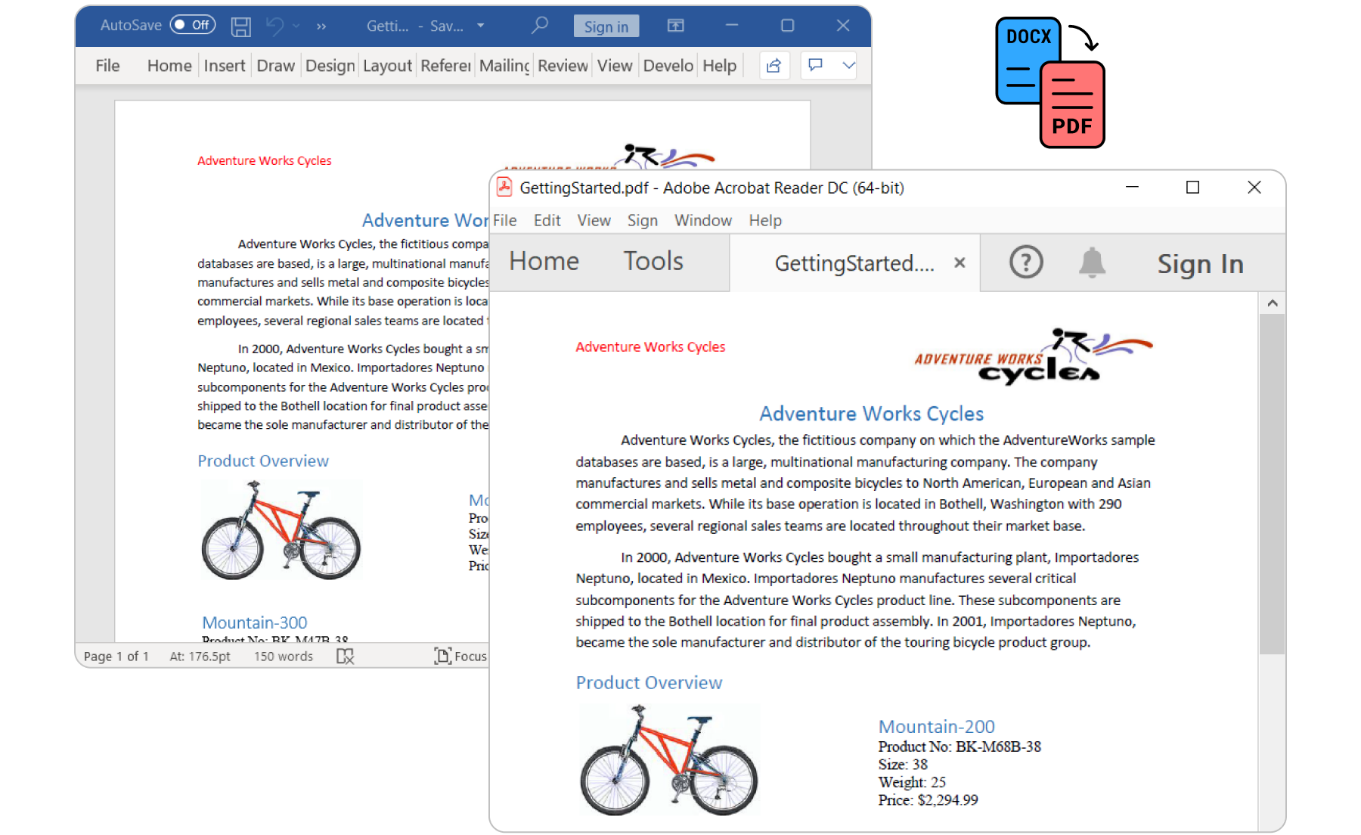
Use case: A reliable Word-to-PDF conversion library is essential for contracts, reports, resumes, and official documents where consistency matters.
Convert Excel to PDF
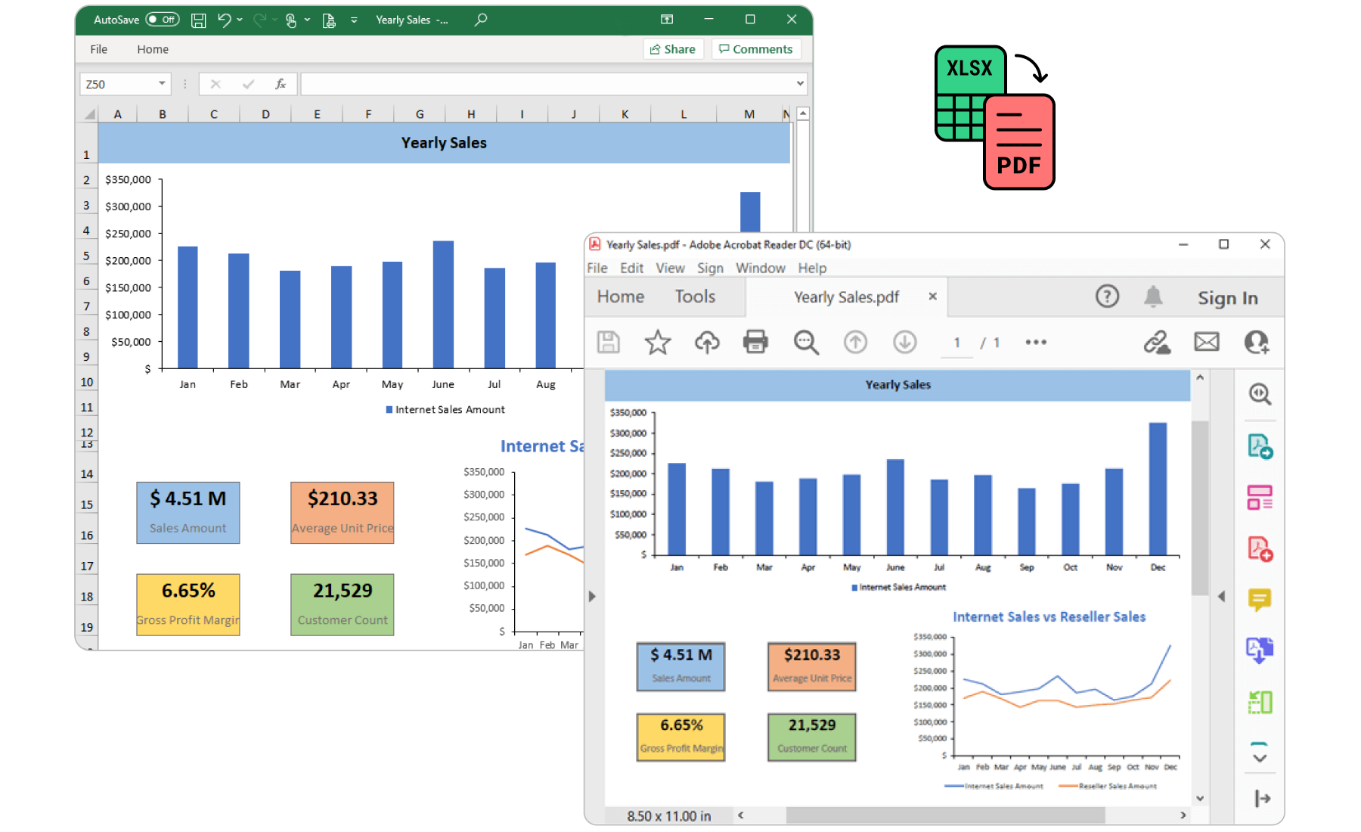
Excel files often contain complex formulas, charts, and large datasets that can break when shared. Our Excel-to-PDF conversion API guarantees accurate rendering of tables, charts, and cell formatting.
Use case: You can make it perfect for financial reports, invoices, and compliance documents, where the data quality matters.
Please follow these steps to convert an Excel document to PDF:
- Install the Syncfusion.XlsIORenderer.NET NuGet package as a reference to your project.
- Then, execute the following code example to convert an Excel document to PDF.
{
    // Open the workbook
    IWorkbook workbook = application.Workbooks.Open(inputStream);

    // Instantiate the Excel to PDF renderer
    XlsIORenderer renderer = new XlsIORenderer();

    // Convert Excel document into PDF document
    PdfDocument pdfDocument = renderer.ConvertToPDF(workbook);

    // Create the MemoryStream to save the converted PDF
    MemoryStream pdfStream = new MemoryStream();
    pdfDocument.Save(pdfStream);
    pdfStream.Position = 0;

    // Save and launch the PDF document
    SaveService saveService = new();
    saveService.SaveAndView("Sample.pdf", "application/pdf", pdfStream);
}
Note: This example works in .NET MAUI, ASP.NET Core, and other .NET platforms.
Convert PowerPoint to PDF
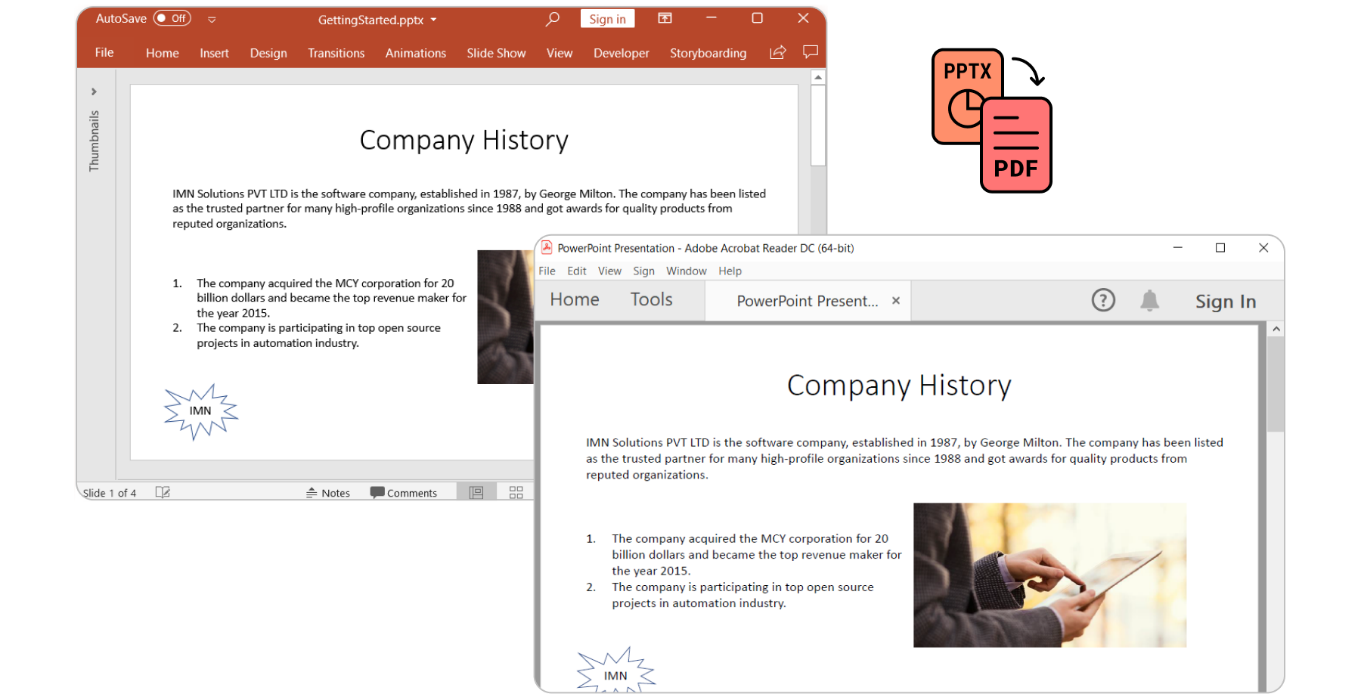
PowerPoint presentations are great for meetings, but not for sharing static content. You can easily convert PowerPoint slides to PDF to create non-editable slides while preserving the design, images, and layout.
Use case: It will be helpful for training materials, proposals, and handouts, ensuring your content remains consistent and secure across platforms.
Steps to follow:
- Install the Syncfusion.PresentationRenderer.NET NuGet package as a reference to your project.
- Run the following code example to convert a PowerPoint presentation to PDF.
// Convert the PowerPoint document to a PDF document
using (PdfDocument pdfDocument = PresentationToPdfConverter.Convert(pptxDoc))
{
    // Save the converted PDF document to a MemoryStream
    MemoryStream pdfStream = new MemoryStream();
    pdfDocument.Save(pdfStream);
    pdfStream.Position = 0;

    // Save and launch the PDF document
    SaveService saveService = new();
    saveService.SaveAndView("Sample.pdf", "application/pdf", pdfStream);
}
Note: This example works in .NET MAUI, ASP.NET Core, and other .NET platforms.
Convert HTML to PDF
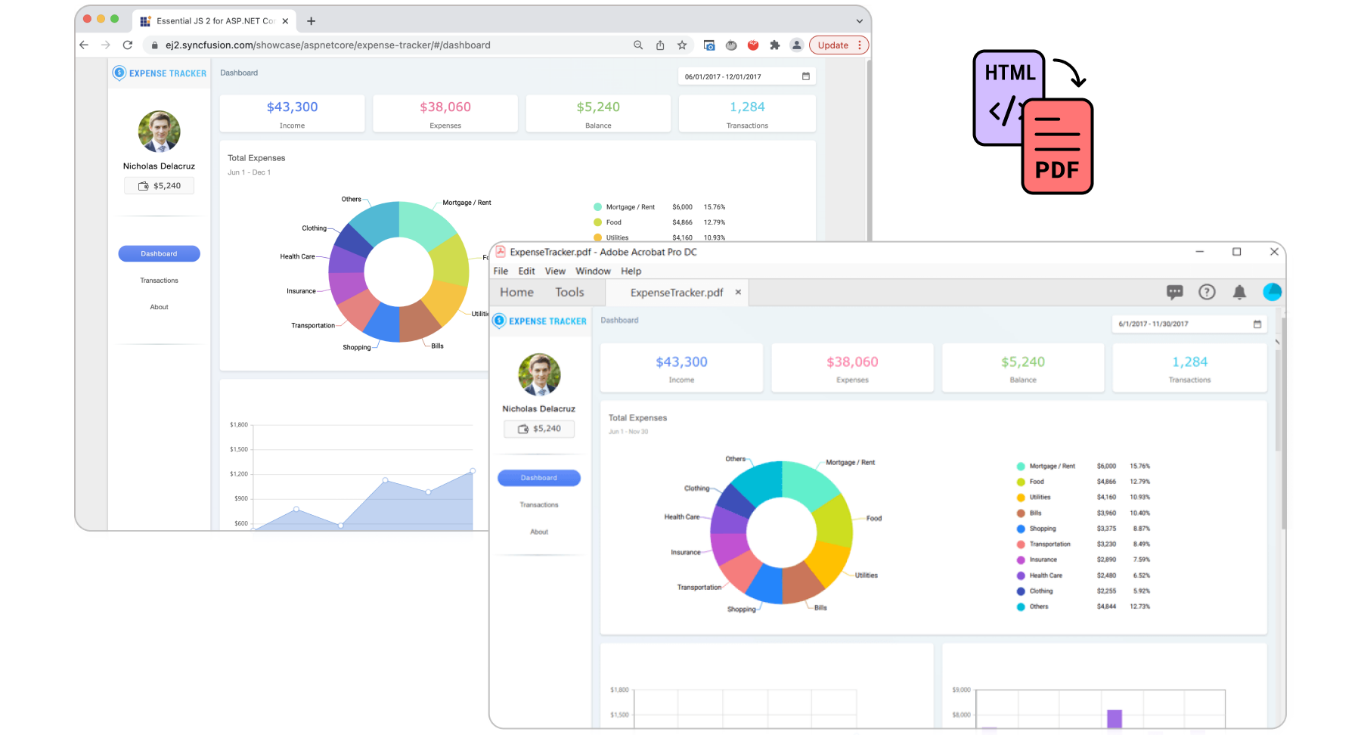
Modern web pages are rich with CSS styling, JavaScript functionality, and responsive layouts, making them hard to share or archive without losing fidelity.
Our HTML-to-PDF conversion engine solves this by rendering web content into pixel-perfect PDFs, preserving styles, scripts, and dynamic elements.
Use case: You can generate invoices, tickets, reports, or capture entire web pages for offline use, ensuring your content looks exactly as intended, every time.
Steps to HTML-to-PDF conversion:
- To enable HTML-to-PDF conversion in your app, install the appropriate Syncfusion.HtmlToPdfConverter.Net.Windows NuGet package.
- Now, execute the following code example.
using Syncfusion.HtmlConverter;
using Syncfusion.Pdf;

// Initialize HTML to PDF converter
HtmlToPdfConverter htmlConverter = new HtmlToPdfConverter();

// Convert URL to PDF
PdfDocument document = htmlConverter.Convert("https://www.google.com");

// Save and close the PDF document
document.Save("Output.pdf");
document.Close(true);
Convert image to PDF
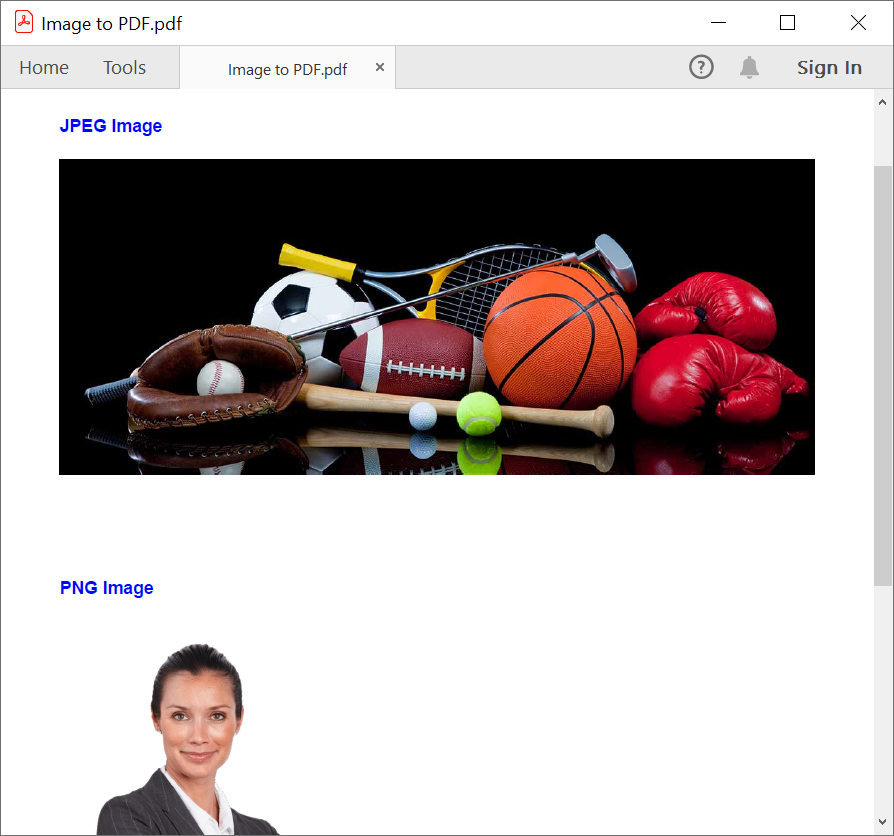
Combine multiple images into a single PDF for easy sharing and archiving.
Use case: This is great for scanned documents, photo albums, and receipts, ensuring everything is stored in a compact, portable format.
Follow these steps to convert images into a PDF document:
- Install the Syncfusion.Pdf.Imaging.Net.Core NuGet package as a reference to your project.
- Then, refer to the following code example.
// Create an instance of the ImageToPdfConverter class
ImageToPdfConverter imageToPdfConverter = new ImageToPdfConverter();

// Create a file stream to read the image file
using (FileStream imageStream = new FileStream("Image.jpg", FileMode.Open, FileAccess.Read))

// Convert the image to a PDF document using the ImageToPdfConverter
using (PdfDocument pdfDocument = imageToPdfConverter.Convert(imageStream))
{
    // Save the PDF document
    pdfDocument.Save("Output.pdf");
}
Convert XPS to PDF
Convert XPS documents into PDF format for better compatibility, sharing, and long-term archiving. This ensures the layout, fonts, and visual formatting are preserved accurately in the output document.
Use case: This is especially useful for print-ready files, reports, and archived documents that need to be distributed in a universally supported format.
Steps to convert an XPS file to PDF:
- Install the Syncfusion.XpsToPdfConverter.Net NuGet package in your project.
- Then, run the following code example.
// Initialize XPS to PDF converter
XPSToPdfConverter converter = new XPSToPdfConverter();

// Open the XPS file as stream
using (FileStream fileStream = new FileStream("Input.xps", FileMode.Open, FileAccess.ReadWrite))

// Convert the XPS to PDF
using (PdfDocument document = converter.Convert(fileStream))
{
    // Create a MemoryStream to store the PDF
    MemoryStream stream = new MemoryStream();

    // Save the document into the stream
    document.Save(stream);
}
Why choose Syncfusion PDF conversion library?
Here’s what sets Syncfusion apart from other PDF conversion solutions:
1. Multi-format conversion
You can convert Word, Excel, PowerPoint, HTML, images and XPS to PDF with ease using our PDF conversion library. It also supports PDF/A for archival compliance.
2. High-quality rendering
Accuracy matters. Syncfusion ensures that fonts, layouts, images, and styles are preserved during conversion, delivering professional-quality PDFs that mirror the original documents.
3. Performance & scalability
Optimized for server-side and client-side apps, handles large files without slowing down.
4. Cross-platform compatibility
It works with .NET, Blazor, MAUI, and more ideal for web, desktop, and mobile apps.
5. Security features
You can add password protection, encryption, and digital signatures for secure PDFs.
6. Customization options
Insert headers, footers, watermarks, metadata, and control page size and orientation.
7. No external dependencies
No need for Adobe Acrobat or MS Office, simplifies deployment.
8. Enterprise-grade support
Backed by comprehensive documentation and continuous updates for dependable performance, it offers powerful PDF conversion APIs designed to support enterprise-scale document processing.
Frequently Asked Questions
Does Syncfusion maintain layout consistency when converting documents across formats?
What is the advantage of using dedicated converters for each format instead of a unified converter?
Using format-specific rendering engines ensures more accurate layouts and fewer formatting issues during conversion.
Can I customize PDFs during or after conversion?
Yes. You can add headers, footers, watermarks, metadata, and security settings using the Syncfusion .NET PDF Library, giving full control over the output document.
Is it possible to convert multiple document types into a single workflow?
When should I use XPS to PDF conversion instead of other formats?
XPS to PDF is ideal for print-ready documents and archived files where layout accuracy is critical, and the original document needs to be preserved exactly.

Ready to eliminate PDF conversion headaches? Start now
Stop wasting time fixing broken layouts and juggling multiple tools. With Syncfusion’s powerful .NET PDF conversion library, you can turn any document, Word, Excel, PowerPoint, HTML, images, or XPS into flawless, secure PDFs in just minutes.
Whether you’re building a cross-platform app in .NET or a server-side solution, our PDF conversion APIs for document processing ensure accuracy, speed, and flexibility for every conversion.
Get the latest version: Current customers can download it from the license and downloads page. New here? Start your 30-day free trial and experience all the newest features!
Need assistance? We’re here for you. Connect with us via our support forums, support portal, or feedback portal anytime.

 No spam, just valuable updates.