
 Arunachalam Kandasamy Raja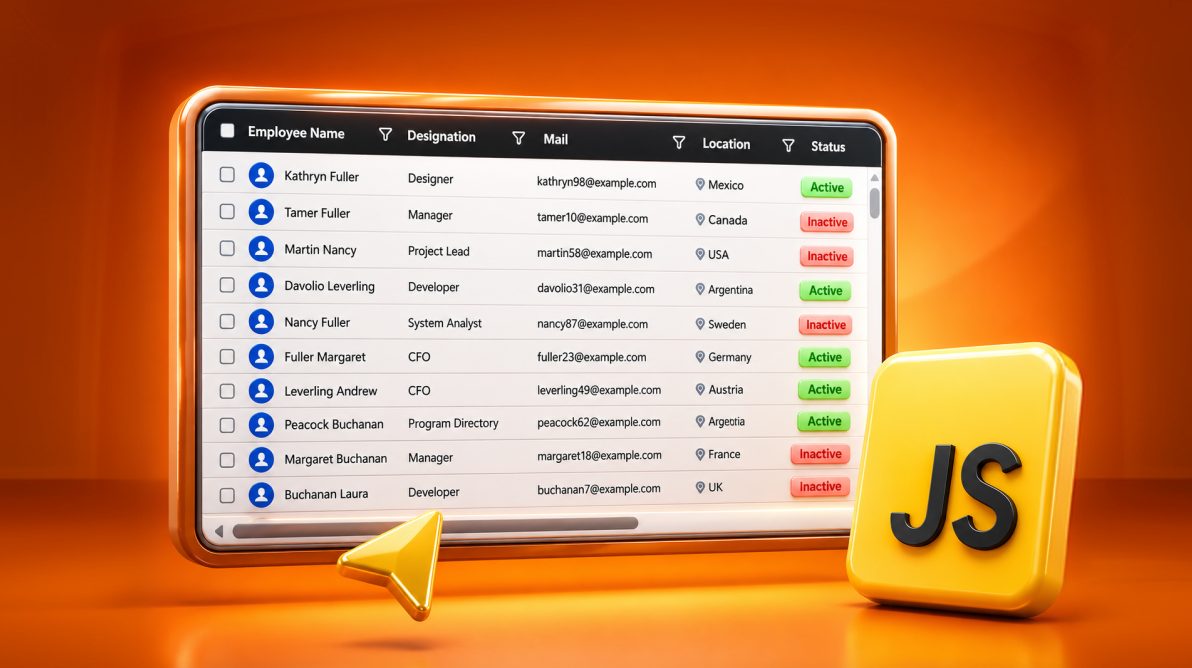
TL;DR: Choosing a JavaScript data grid library can be challenging, especially when modern applications require features such as editing, filtering, export, accessibility, and high-performance data handling. This comparison reviews AG Grid, TanStack Table, Syncfusion JavaScript DataGrid, Handsontable, and Kendo UI Grid to help developers identify the best fit for their application requirements.
At first glance, displaying data in a web application seems simple. Render a table, load some rows, and you’re done.
But that simplicity rarely survives contact with real-world requirements.
Users eventually ask for filtering, inline editing, exports, grouped views, responsive layouts, role-based access, keyboard navigation, localization, and the ability to handle millions of records through virtualization, paging, incremental loading, and server-side data operations.
That’s why choosing a JavaScript data grid isn’t just a UI decision. The right grid can accelerate development and improve user productivity. The wrong one can create performance issues, increase maintenance costs, and slow down future product development.
In this guide, we’ll compare five popular JavaScript data grid libraries in 2026:
- AG Grid
- TanStack Table
- Syncfusion JavaScript DataGrid
- Handsontable
- Kendo UI Grid
Rather than looking for a universal winner, we’ll focus on which grid works best for specific application requirements.
| Feature | AG Grid | TanStack | Syncfusion | Handsontable | Kendo |
| Virtualization | Yes | API-driven | Yes | Yes | Yes |
| Excel Export | Yes | Custom | Yes | Yes | Yes |
| PDF Export | Yes | Custom | Yes | Limited | Yes |
| Built-in Editing | Yes | Custom | Yes | Yes | Yes |
| Headless | No | Yes | No | No | No |
How we evaluated these JavaScript Data Grids
This comparison is based on publicly available product documentation and capabilities reviewed in July 2026. We evaluated each library based on its data-handling model, built-in features, customization options, developer experience, accessibility support, licensing approach, ecosystem maturity, and suitability for common application scenarios.
The order does not represent a universal ranking. Each grid has different strengths, and the best choice depends on your application’s workflows, technical requirements, framework, budget, and long-term maintenance needs. Product capabilities and licensing terms can change, so verify the latest vendor documentation before making a final decision.
Feature availability, APIs, licensing, and accessibility details may also differ across framework-specific editions. Verify the documentation for the exact package and edition your application uses.
Why choosing the right JavaScript Data Grid matters
In many business applications, the data grid becomes the primary workspace for users. Instead of simply viewing data, users filter records, edit values, export reports, review exceptions, and complete day-to-day operational tasks directly within the grid.
This is common in applications such as:
- Admin dashboards
- ERP and CRM systems
- Inventory management software
- Financial reporting tools
- Analytics platforms
- Data review and approval workflows
- Internal operations portals
- B2B SaaS applications
The challenge is that not all JavaScript data grid libraries are designed for the same purpose.
Some provide a fully featured component with built-in capabilities such as editing, filtering, grouping, and export. Others focus on table logic and give developers complete control over the user interface. There are also solutions designed specifically for spreadsheet-style workflows and data-entry scenarios.
Because the grid often becomes one of the most frequently used parts of an application, choosing the right solution can affect development effort, performance, maintainability, and overall user experience. Before comparing individual libraries, it’s worth understanding the different approaches available and how they align with your application’s requirements.
Three approaches to JavaScript Data Grids
Before comparing products, it’s useful to understand the three major categories of grid solutions.
Component-based grids
Component-based grids ship with built-in UI, interaction models, styling systems, and common data operations.
They’re typically chosen by teams that want enterprise-grade functionality without having to build every interaction from scratch.
Common examples:
- AG Grid
- Syncfusion DataGrid
- Kendo UI Grid
These solutions work particularly well for business applications, reporting portals, ERP systems, CRM platforms, and operational dashboards.
Headless grid libraries
- Headless libraries focus on data-processing logic rather than visual presentation.
- Instead of providing a complete UI, they offer APIs and state management that let you build your own experience.
- TanStack Table is a widely used example of this approach.
- This model works well for organizations with established design systems and teams that require complete UI control.
- In return for that control, the development team is responsible for implementing or integrating the rendered UI, styling, semantic markup, accessibility, focus management, and keyboard interaction behavior required by the application.
Spreadsheet-oriented grids
Some applications revolve around data entry rather than data presentation.
Spreadsheet-style grids provide cell editing, keyboard workflows, copy-paste support, validation, and interactions that mimic spreadsheet software.
Handsontable is a popular candidate in this category.
How to evaluate a JavaScript data grid library
When comparing grid libraries, feature count alone is rarely the deciding factor for long-term success. Most mature products already support filtering, sorting, paging, and editing.
The more important question is whether the available features match your workflows, performance requirements, customization needs, and maintenance capacity.
Instead, focus on these questions:
Performance
How will the grid behave with realistic datasets?
Consider:
- Large record counts
- Frequent updates
- Virtual scrolling
- Server-side data operations
Editing requirements
Do users need:
- Inline editing?
- Batch updates?
- Validation rules?
- Custom editors?
Customization
How closely must the grid match your design system?
Some products provide extensive customization, while others prioritize ready-made functionality.
Accessibility
For many enterprise applications, accessibility is a requirement rather than an option. Verify the grid against your organization’s required WCAG 2.1 or WCAG 2.2 conformance level, and test the configured implementation rather than relying only on a vendor-level accessibility statement.
Evaluate:
- Keyboard-only navigation and operation
- Logical and visible focus management
- Screen-reader behavior
- Accessible editing, validation, and error reporting
- Roles, names, states, and relationships
- Alternatives for drag-based interactions
- Behavior after customization and theming
Export and reporting
Many business workflows still depend on:
- Excel export
- CSV export
- PDF export
If reporting is critical, ensure these capabilities meet your requirements.
Licensing and support
Before committing, verify:
- Commercial licensing terms
- Production restrictions
- Support availability
- Upgrade policies
JavaScript Data Grid libraries at a glance
Library | Best For | Primary Strength |
AG Grid | Data-intensive enterprise applications | Extensive feature set and scalability |
TanStack Table | Design-system-driven products | Complete UI flexibility |
Syncfusion DataGrid | Business applications and dashboards | Broad enterprise functionality out of the box |
Handsontable | Spreadsheet-style workflows | Familiar editing experience |
Kendo UI Grid | Existing Telerik ecosystems | Integration with a larger UI platform |
Detailed review of the top JavaScript Data Grid libraries
1. AG Grid
AG Grid is widely adopted in enterprise web applications and is frequently evaluated for data-intensive use cases. Its extensive feature set, multiple row models, and support for popular JavaScript frameworks make it a strong candidate for applications with complex data requirements.
One of AG Grid’s biggest strengths is its ability to handle complex requirements without relying heavily on additional libraries. Features such as filtering, grouping, aggregation, pivoting, virtualization, and advanced data operations make it a strong candidate for large-scale business applications.
Key strengths
- Extensive feature set for enterprise scenarios
- Multiple row models for client-side and server-side data scenarios
- Mature ecosystem and documentation
- Community and Enterprise editions to suit different project needs
- Works across multiple JavaScript frameworks
Things to consider
AG Grid’s breadth of functionality can be more than smaller projects require. Teams should also carefully review feature availability between the Community and Enterprise editions before making a long-term commitment.
Ideal use cases
AG Grid is particularly well suited for reporting systems, operational dashboards, financial applications, analytics platforms, and enterprise software where users spend significant time working with data.
2. TanStack Table
Unlike traditional grid components, TanStack Table takes a headless approach. Instead of providing a ready-made user interface, it focuses on the underlying table logic and state management while giving developers complete control over rendering and styling.
This flexibility makes it suitable for teams that maintain their own design systems or need highly customized user experiences. Rather than adapting a prebuilt grid to match an application’s design, developers can build exactly the experience they need.
Key strengths
- Complete control over UI and styling
- Headless architecture with minimal visual constraints
- Well suited for integration with custom design systems
- Supports multiple frontend frameworks
- Composable row models and controlled state management
Things to consider
This flexibility comes with additional implementation responsibility. TanStack Table provides the underlying table logic rather than a complete grid interface, so developers must implement or integrate the UI rendering, styling, semantic markup, accessibility, focus management, and keyboard interactions required by their application. Features available out of the box in component-based grids may therefore require additional development, integration, and testing.
Ideal use cases
TanStack Table is a strong choice for SaaS applications, internal platforms, design-system-driven products, and teams that prioritize flexibility over out-of-the-box functionality.
3. Syncfusion JavaScript DataGrid
Syncfusion JavaScript DataGrid is a feature-rich HTML5 data grid component for displaying and managing tabular data in JavaScript applications. It includes data binding, editing, Excel-like filtering, custom sorting, aggregation, selection, and export support for Excel, CSV, and PDF formats.
It is designed for applications where the grid supports real business workflows, not only data display. Teams can bind data from local and remote data sources, including JavaScript object arrays, JSON, OData services, REST APIs, and other supported endpoints through DataManager.
Key strengths
- Broad built-in functionality for data presentation and editing
- Local and remote data binding through DataManager
- Filtering, grouping, sorting, summaries, and selection
- Export options for Excel, CSV, and PDF.
- Responsive layouts, themes, and localization support
Things to consider
Applications that require complete control over markup and interaction behavior may prefer a headless solution. Teams should also evaluate licensing, package size, required modules, framework compatibility, and whether the broader component suite aligns with their project needs.
Ideal use cases
Syncfusion JavaScript DataGrid works well for ERP modules, CRM systems, inventory management applications, business dashboards, reporting portals, and enterprise applications with complex data workflows.
4. Handsontable
Handsontable approaches data grids from a different angle. Rather than focusing primarily on data presentation, it emphasizes spreadsheet-style interaction and editing experiences.
Users can work directly with cells, making it a natural fit for workflows where entering, validating, and manipulating data is more important than simply viewing it.
Organizations migrating spreadsheet-based processes to web applications often find Handsontable particularly appealing because it provides familiar interaction patterns that reduce the learning curve for end users.
Key strengths
- Spreadsheet-like user experience
- Cell-based editing workflows
- Familiar copy-and-paste interactions
- Validation and structured data-entry capabilities
- Framework support across modern JavaScript ecosystems
Things to consider
Not every application benefits from spreadsheet-style behavior. If users primarily view data rather than actively edit and manipulate it, a traditional data grid may be a better fit.
Ideal use cases
Handsontable is well suited for planning tools, budgeting systems, resource management applications, inventory workflows, financial data-entry screens, and other spreadsheet-oriented business processes.
5. Kendo UI Grid
Kendo UI Grid is part of the broader Kendo UI ecosystem and is often chosen by organizations that want a consistent set of UI components across their applications.
The grid provides a mature collection of data management capabilities, including editing, filtering, sorting, grouping, export, and both local and remote data operations. Its integration with the wider Kendo UI platform can simplify development for teams already invested in the Telerik ecosystem.
Key strengths
- Mature and comprehensive grid functionality
- Multiple editing modes
- Local and remote data binding
- Export support for business reporting workflows
- Strong integration with other Kendo UI components
Things to consider
The platform delivers the greatest value when organizations use other Kendo UI components alongside the grid. For projects seeking a lightweight standalone solution, the broader ecosystem may introduce functionality that isn’t required.
Ideal use cases
Kendo UI Grid is a practical choice for business applications, enterprise portals, administrative systems, and organizations that have standardized on Telerik and Kendo UI technologies.
Notable alternatives worth evaluating
The JavaScript grid ecosystem continues to evolve. Depending on your requirements, other libraries may also deserve consideration:
- Tabulator
- Grid.js
- MUI Data Grid
- React Data Grid
These solutions can be attractive for teams looking for lighter-weight implementations or framework-specific experiences.
Production-readiness checklist
Before making a final decision, test your shortlisted grids using realistic workloads.
Validate:
- Initial grid render time
- Time until the grid becomes interactive
- Scroll responsiveness and dropped frames
- Sorting, filtering, grouping, and editing response times
- Row and column virtualization behavior
- Memory consumption during prolonged use
- Performance during frequent data updates
- Bundle-size impact
- Server request volume and payload size
- Paging, caching, and request-cancellation behavior
- Export time and memory use for realistic datasets
- Keyboard and screen-reader workflows
- Mobile and responsive behavior
- Licensing limitations
- Documentation quality
- Upgrade and long-term support expectations
Run these tests with production builds, realistic row and column counts, representative cell templates, expected network conditions, and the same browser and device profiles used by your target audience.
Feature comparison tables are useful, but production testing often reveals the best choice faster than any marketing page.
Frequently Asked Questions
How do JavaScript data grids handle large datasets?
Most modern grids rely on techniques such as virtualization, lazy loading, server-side processing, and paging to handle large volumes of data efficiently.
When should server-side filtering and sorting be used?
Server-side operations are generally preferable when datasets become large, change frequently, or require database-level filtering and security rules.
What should teams verify before purchasing a commercial grid?
Review licensing terms, support options, upgrade policies, and whether required functionality exists in the edition you plan to deploy.
How important is accessibility?
Accessibility is increasingly important across enterprise software. Keyboard navigation, focus handling, editable cells, validation, and screen reader compatibility should all be validated in the configured implementation.
Conclusion
The best JavaScript data grid in 2026 depends entirely on how your users work with data.
- Choose AG Grid for feature-rich, data-intensive applications.
- Choose TanStack Table when complete UI control matters most.
- Choose Syncfusion JavaScript DataGrid when you need enterprise functionality out of the box.
- Choose Handsontable for spreadsheet-style workflows.
- Choose Kendo UI Grid when you’re already invested in the Telerik ecosystem.
Instead of selecting the grid with the longest feature list, focus on the one that aligns with your application’s workflows, performance requirements, and long-term maintenance goals. That decision will deliver far more value than any single feature ever could.
Try the Syncfusion JavaScript DataGrid
If you’re a Syncfusion user, you can download the setup from the license and downloads page. Otherwise, you can download a free 30-day trial.
You can also contact us via our support forum, support portal, or feedback portal for queries. We are always happy to assist you!


 No spam, just valuable updates.