Try Our Live Demo
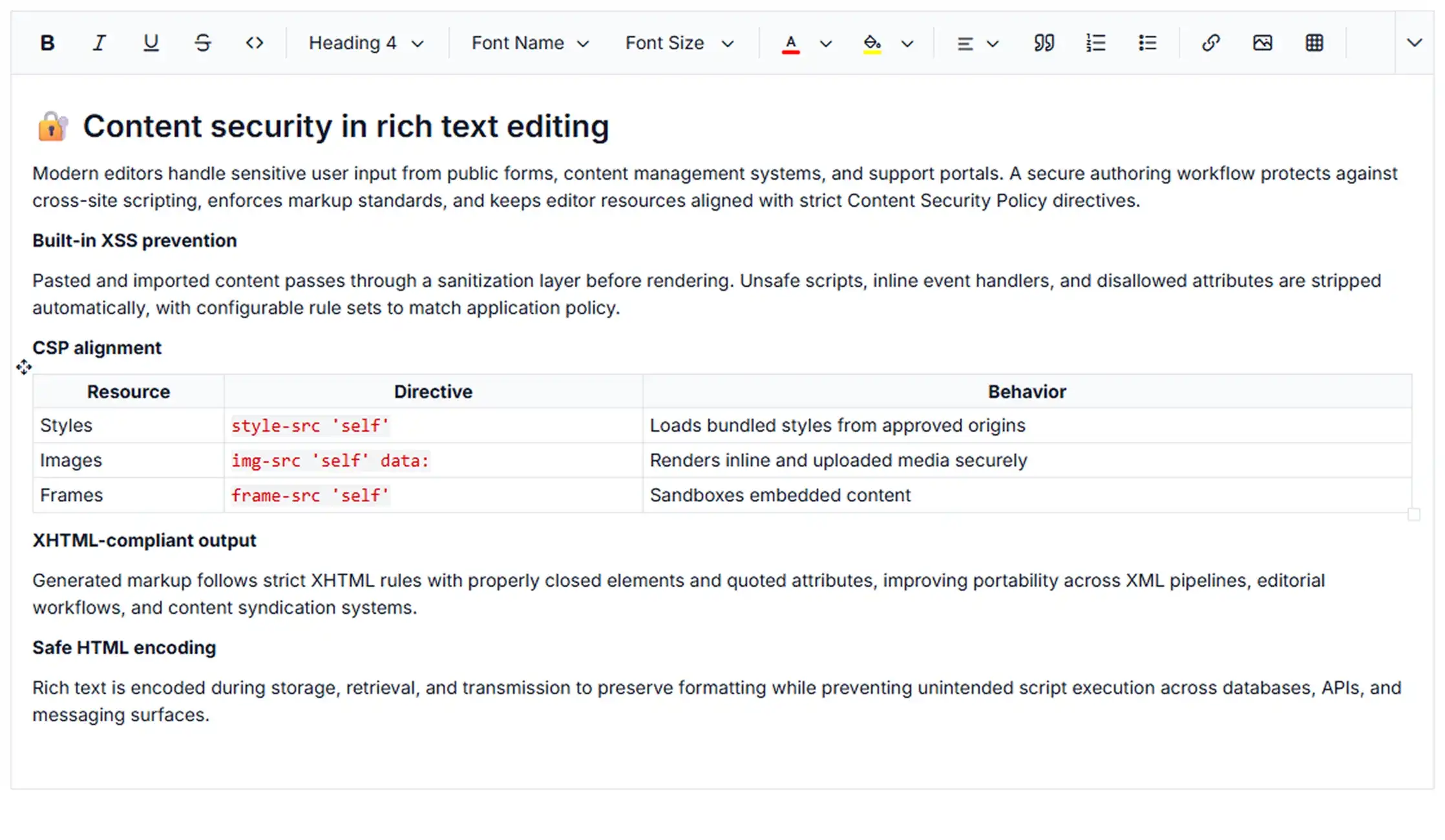
Content protection and compliance in Rich Text Editor
Protect content in the React Rich Text Editor with XSS mitigation, content sanitization, HTML encoding, trusted resource controls, and standards-compliant output. Apply content security measures and best practices in the React Rich Text Editor, while the application enforces its regulatory and organizational compliance requirements.

CSP support for editor assets
Configure Content Security Policy directives for the styles, fonts, and images required by the editor. CSP configuration is suitable when applications restrict resource loading to approved sources.
Standards-compliant XHTML output
XHTML validation checks editor source content against XHTML rules for elements, attributes, casing, closing tags, and nesting. Standards-based validation is suitable when generated markup requires consistent XHTML structure.
XSS mitigation and content sanitization
HTML sanitization removes potentially unsafe elements and attributes from editor content using configurable filtering rules. Sanitization is suitable when applications accept pasted, imported, or user-provided HTML content.
HTML encoding for safe storage
HTML encoding returns editor content in an encoded format for storage, processing, or data transfer. Encoded output is suitable when applications or services need to handle HTML content as text.
See Why Developers Love Syncfusion
Our Customers Love Us
Having an excellent set of tools and a great support team, Syncfusion reduces customers’ development time. Here are some of their experiences.




Frequently Asked Questions
Does the Syncfusion React Rich Text Editor support Content Security Policy?
Yes. The React Rich Text Editor can be used in CSP-enabled applications when the required policy directives are configured for the editor resources and application assets.
Can sanitization rules be customized in the Syncfusion React Rich Text Editor?
Yes. Sanitization rules in the React Rich Text Editor are configurable to match application security needs.
Can Syncfusion React Rich Text Editor content be encoded for safe storage?
Yes. The React Rich Text Editor supports HTML encoding for storage, processing, and transmission. HTML encoding helps applications handle rich text content consistently across storage, processing, and data-transfer workflows.
Is HTML sanitization enabled by default in the Syncfusion React Rich Text Editor?
Yes. The React Rich Text Editor enables HTML sanitization by default and removes potentially unsafe elements and attributes from HTML content. Applications can apply additional server-side validation or sanitization based on their security requirements.
Does the Syncfusion React Rich Text Editor produce XHTML-compliant output?
Yes. The React Rich Text Editor normalizes output to standards-compliant XHTML markup when XHTML validation is enabled.
Where can more information about the Syncfusion React Rich Text Editor content security features be found?
The React Rich Text Editor documentation, demos, and knowledge base provide additional information about content security features and configuration. The community forum can also be used to explore related questions and discussions.
Resources
Learn more about our React Rich Text Editor
Explore demos, KB articles, and documentation to get the most out of the React Rich Text Editor.
Explore guides, APIs, and quick-start tips
See live use cases in action
Ask, share, and connect with peers
Find solutions and best practices fast
Get expert help when you need it
Feature requests and bug reports
Track issues and suggest improvements
Awards
Greatness—it’s one thing to say you have it, but it means more when others recognize it. Syncfusion® is proud to hold the following industry awards.