Try Our Live Demo
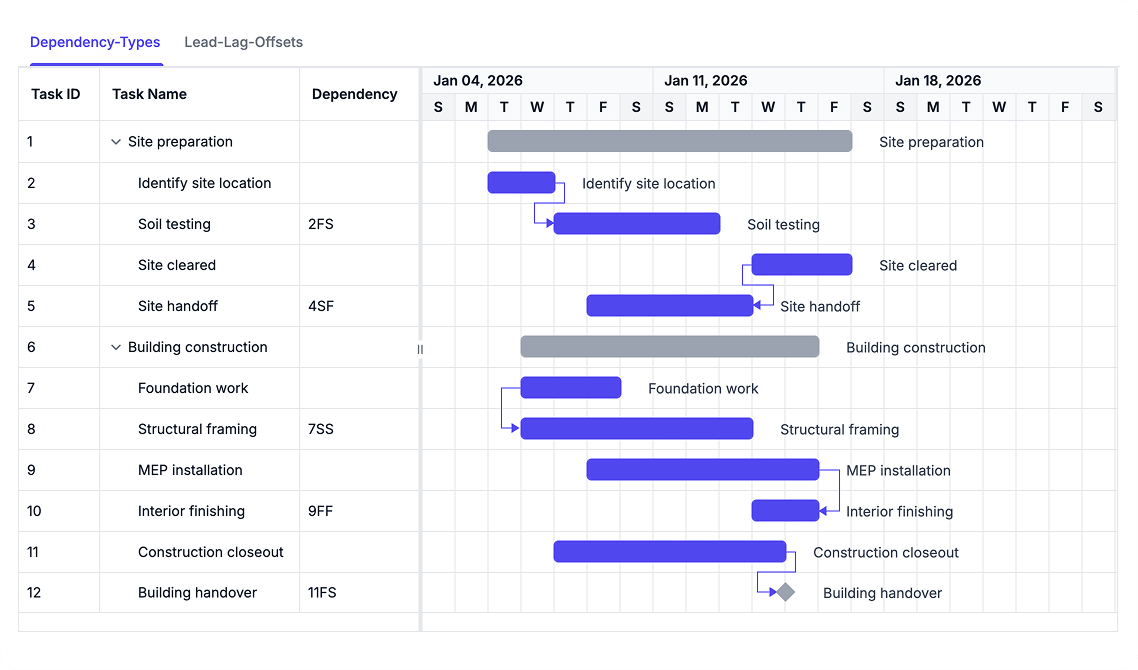
Manage Task Dependencies and Sequencing
Define project workflows using standard dependency relationships and flexible lead or lag offsets. Maintain accurate scheduling while controlling how activities interact and progress.
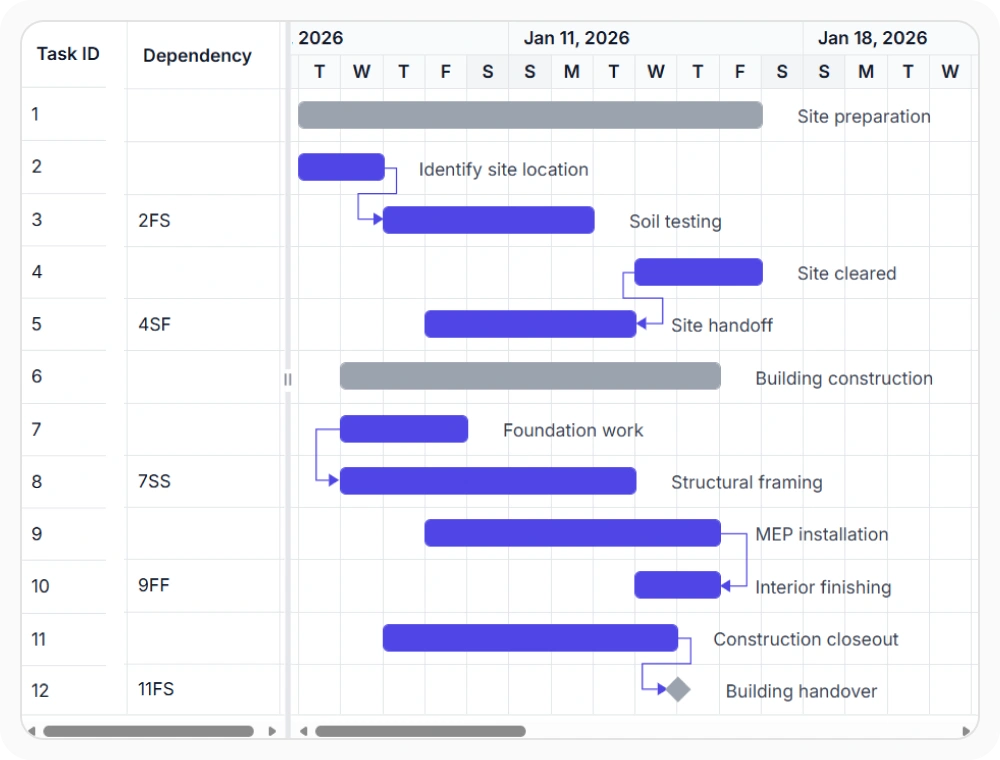
Define dependency types
Dependency types define how predecessor and successor tasks relate to each other in a project schedule. They help maintain accurate task sequencing and scheduling logic across dependent work items. Use this option when projects require clear predecessor-successor relationships.
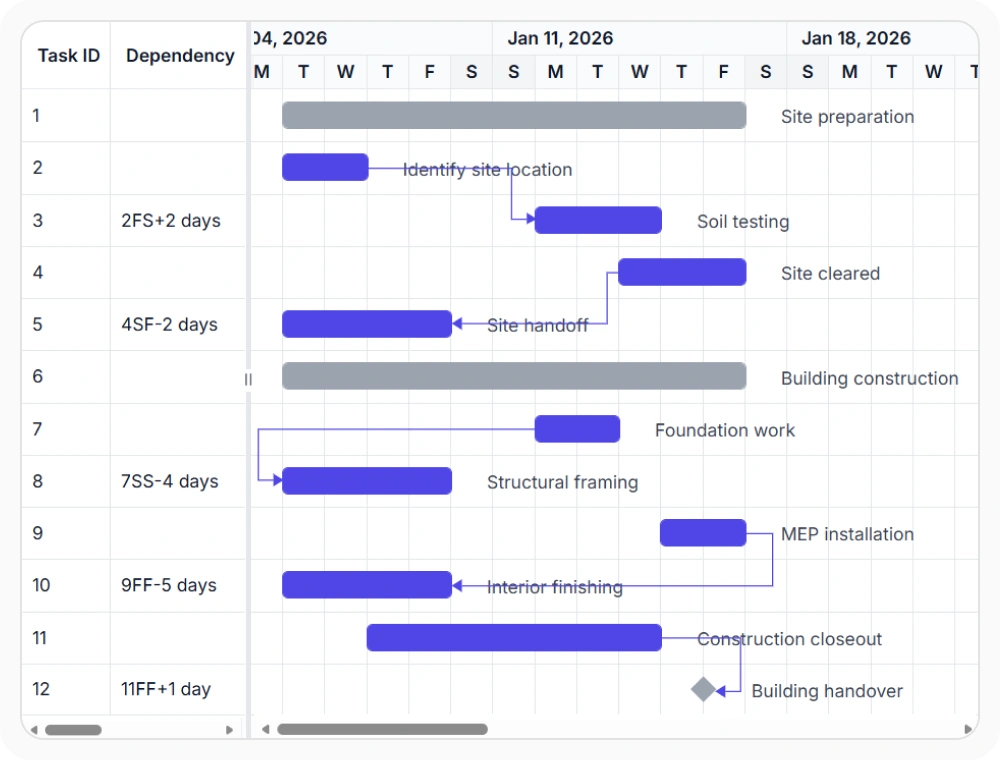
Manage dependency offsets
Lead and lag offsets add planned overlap or delay between dependent tasks while preserving their scheduling relationship. Offset preservation helps maintain existing dependency timing when project schedules are updated. Use this option when dependency timing must remain consistent throughout schedule revisions.
See Why Developers Love Syncfusion
Our Customers Love Us
Having an excellent set of tools and a great support team, Syncfusion reduces customers’ development time. Here are some of their experiences.





Frequently Asked Questions
What dependency types are supported in React Gantt Chart?
The React Gantt Chart supports finish-to-start, start-to-start, finish-to-finish, and start-to-finish task relationships. These dependency types help represent common sequencing patterns and maintain accurate task ordering across project timelines.
When should lead and lag offsets be used?
Lead and lag offsets are useful when tasks require planned overlap or delays instead of immediate handoff. Use lead for tasks that can run in parallel, and lag for tasks requiring setup time, cooling periods, or other waiting intervals.
Why are task dependencies important in project scheduling?
Task dependencies define the relationships between related activities and establish the order in which work should occur. They help teams coordinate project execution, maintain scheduling accuracy, and manage interconnected tasks more effectively.
What is the difference between lead and lag in task dependencies?
Lead allows a successor task to start before a predecessor finishes, creating overlap between tasks. Lag introduces a waiting period after a predecessor completes before the successor can start. Both preserve the dependency relationship while adjusting timing.
Can task dependencies be edited in React Gantt Chart?
Yes. Task dependencies can be created, modified, or removed as project requirements change. This allows teams to adjust task relationships and offsets throughout the project lifecycle while maintaining accurate scheduling.
How are dependency offsets handled in React Gantt Chart?
Dependency offsets can be preserved when tasks are edited, allowing existing lead and lag values to remain unchanged. This helps maintain planned timing relationships and supports manual control over dependency adjustments.
Resources
Learn more about React Gantt Chart
Explore demos, KB articles, and documentation to get the most out of the React Gantt Chart.
Explore guides, APIs, and quick-start tips
See live use cases in action
Ask, share, and connect with peers
Find solutions and best practices fast
Get expert help when needed
Feature requests and bug reports
Track issues and suggest improvements
Awards
Greatness—it’s one thing to say you have it, but it means more when others recognize it. Syncfusion® is proud to hold the following industry awards.