
 Gowthaman Thavasiyappan
TL;DR: AI can generate answers in seconds, but ensuring those answers are accurate, current, and backed by reliable sources remains a major challenge. Our newly published RAG Handbook helps developers tackle this problem by exploring how Retrieval-Augmented Generation improves answer quality using trusted data. Covering everything from core concepts to advanced techniques like hybrid search and GraphRAG, it provides practical insights for building more dependable AI applications.
What happens when an AI assistant confidently gives the wrong answer to a customer, employee, or support engineer?
In real-world scenarios, that could mean referencing an outdated HR policy, surfacing incorrect product information, or providing guidance based on obsolete documentation.
As AI becomes an integral part of search, support, and knowledge discovery experiences, answer quality matters just as much as response speed.
That’s one of the key reasons Retrieval-Augmented Generation (RAG) has become a foundational pattern in modern AI development. By connecting AI models to trusted knowledge sources, RAG helps produce responses that are grounded in current, verifiable information rather than relying solely on a model’s training data.
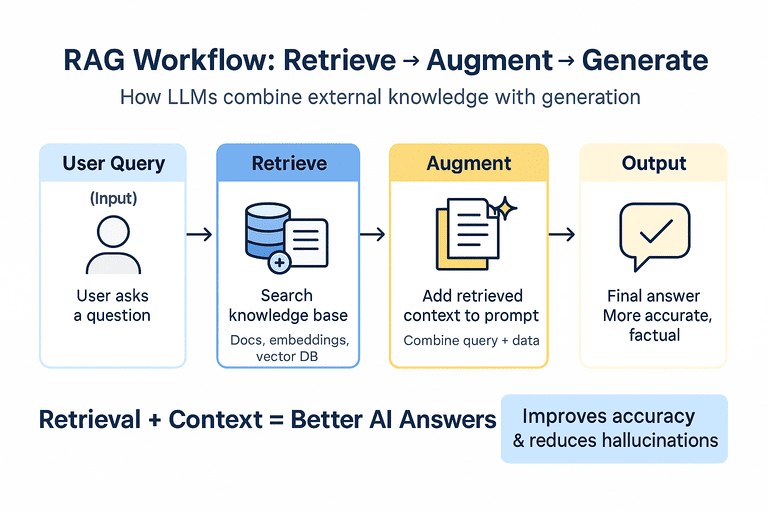
To help developers better understand and implement RAG effectively, we’ve published our new RAG Handbook, a practical resource that explores the concepts, components, and techniques behind building AI systems that generate evidence-based answers.
Whether you’re evaluating RAG for your next AI project or refining an existing implementation, this handbook provides a structured path from foundational concepts to advanced retrieval techniques used in modern AI applications.
Why developers are choosing RAG for production AI
The value of RAG becomes much clearer when AI applications need to work with information that changes frequently, such as product documentation, support articles, release notes, or internal knowledge bases.
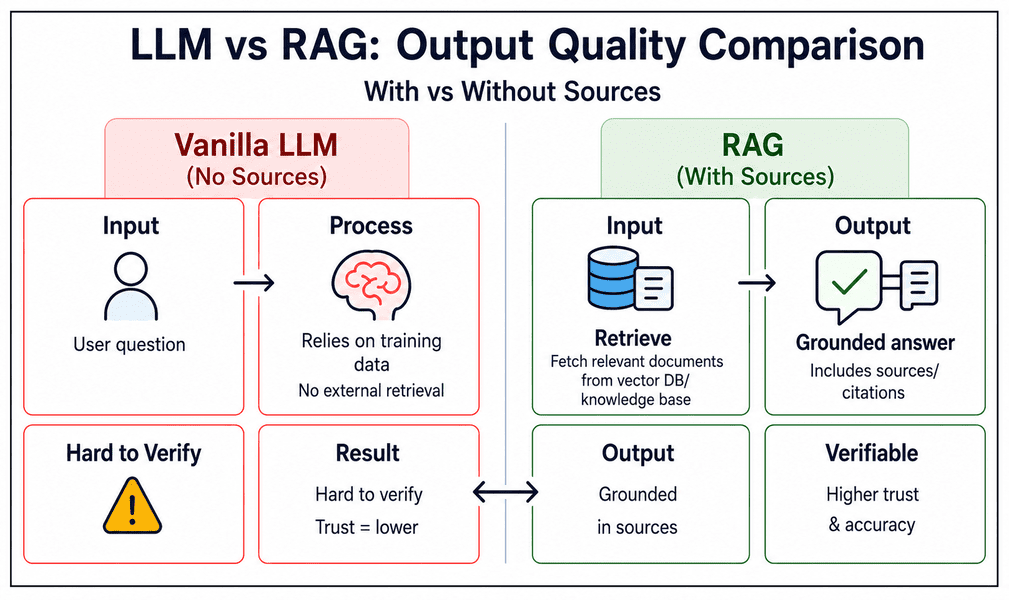
Instead of relying solely on a model’s training data, Retrieval-Augmented Generation (RAG) retrieves relevant information at the time a question is asked and uses that context to generate a response. This helps keep answers aligned with current information.
For example, imagine a customer support assistant for a software product. A customer asks:
“Was the authentication issue I reported fixed in a recent release?”
A RAG-powered assistant can:
- Search the latest release notes and support documentation.
- Retrieve the most relevant update.
- Provide that context to the model.
- Generate a response based on the documented fix or issue status.
This approach is commonly used in:
- Technical documentation search,
- Customer support assistants,
- Enterprise knowledge portals, and
- Self-service help systems.
By combining retrieval with generation, RAG helps AI applications deliver answers that are more relevant, easier to verify, and better aligned with the information teams maintain every day. That’s a key reason why it has become a widely adopted architecture for building reliable AI experiences.
What you’ll take away from this guide
The handbook is designed to help developers understand both the theory and practical implementation of RAG systems.
Inside, you’ll learn how to:
- Understand what RAG is and why it plays a critical role in improving AI reliability.
- Explore the RAG lifecycle and its core components.
- Use private and domain-specific data to generate more useful responses.
- Work with documents, chunks, metadata, embeddings, and retrieval methods.
- Build and implement a basic RAG-powered assistant.
- Evaluate accuracy, relevance, and performance trade-offs.
- Identify common implementation mistakes and RAG failure modes.
- Explore advanced approaches such as hybrid search, reranking, and GraphRAG.
Why RAG matters
RAG has become a key technique for teams building reliable AI applications because it helps:
- Reduce hallucinations by grounding responses in real data.
- Improve answer quality by providing relevant and up-to-date information.
- Enable access to private and domain-specific knowledge.
- Provide explainable answers with traceable sources.
- Build greater confidence in AI-generated outputs.
Who should read this handbook?
This handbook is especially useful for:
- Developers– Building RAG-powered applications and AI assistants.
- Product managers– Planning and designing AI-driven experiences.
- Technical writers– Responsible for maintaining knowledge repositories.
- Students– Learning modern AI architectures and retrieval techniques.
- Early-career developers– Looking to understand how production AI systems work.
From foundational concepts to implementation considerations, the handbook is designed to help readers better understand how modern AI applications retrieve, process, and generate responses using real-world data.
Build trusted AI systems with RAG
RAG may seem straightforward, but building effective solutions requires the right approach to retrieval, relevance, evaluation, and response generation. That’s why we created this handbook to help developers better understand the techniques behind reliable, production-ready AI systems.
Whether you’re learning the fundamentals or exploring advanced topics like hybrid search, reranking, and GraphRAG, this handbook provides practical guidance for building AI systems that deliver more accurate, evidence-based responses.
As AI development evolves, many of these techniques are becoming part of everyday engineering. Syncfusion Code Studio, an AI-powered IDE for enterprise software teams, helps developers apply modern AI capabilities through context-aware development, agent skills, MCP integrations, and AI-assisted software delivery.
Explore the RAG Handbook to learn more about retrieval-based AI, and try Syncfusion Code Studio to accelerate development.
For questions or feedback, contact us through our support forum, support portal, or feedback portal. We’re always happy to help.




 No spam, just valuable updates.