
 Suchitha Ramesh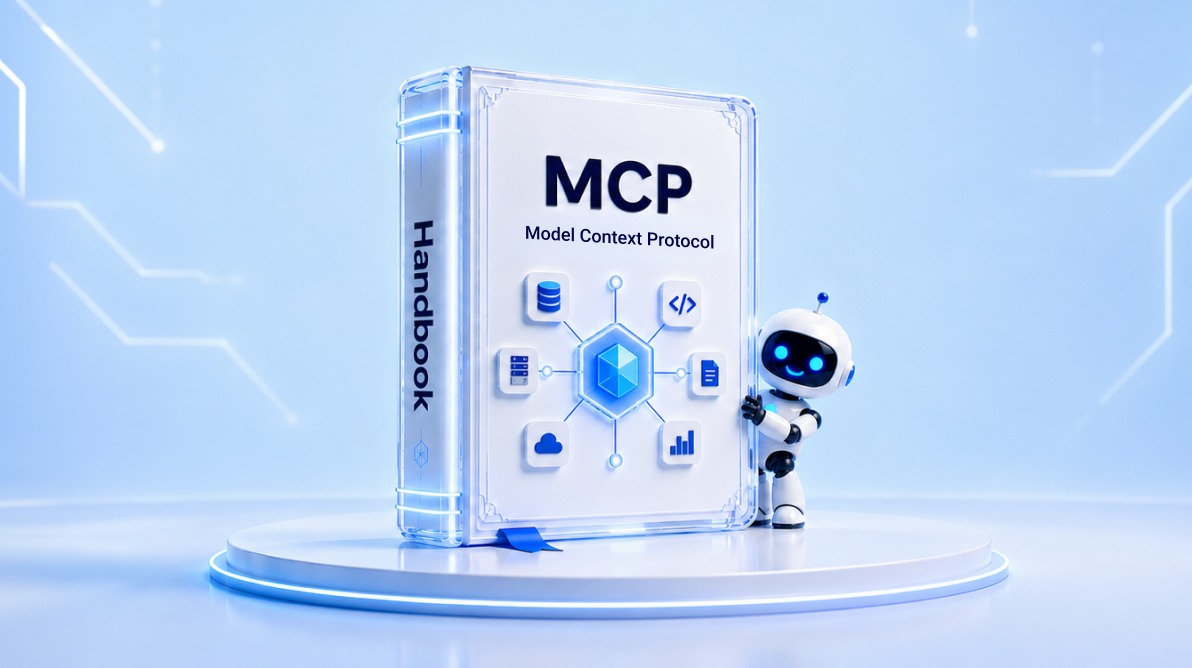
TL;DR: Your AI application works today, but what happens when it needs to connect with more tools, data sources, and business systems? Model Context Protocol (MCP) provides a consistent way for AI applications to interact with external resources. The MCP Handbook explains the concepts, architecture, and implementation patterns needed to build AI solutions that remain maintainable as they grow.
Building an AI prototype has never been easier. Modern AI models can quickly power chatbots, assistants, and workflow automation. The challenge begins when those applications need to access multiple systems, retrieve information from different sources, and perform actions across business tools. Without a consistent integration approach, complexity grows rapidly.
Model Context Protocol (MCP) addresses this challenge by providing a standard interface between AI applications and external systems. To help developers apply these concepts in real-world projects, we’ve created the MCP Handbook, a practical guide focused on architecture, implementation patterns, and production-ready practices.
How Model Context Protocol fits into modern AI development
As AI development evolves, concepts such as prompts, context, RAG, agent skills, and MCP are often discussed together. While they work together, each serves a different purpose:
| Term | Purpose |
| Prompt | Defines what the AI should do |
| Context | Provides information needed to complete the task |
| RAG | Retrieves relevant knowledge before generating a response |
| Agent Skills | Provides reusable instructions and capabilities for specific tasks |
| MCP | Provides a consistent way for AI applications to interact with external tools and resources |
A simple way to remember:
- Prompts define the task
- Context provides the information
- RAG retrieves knowledge
- Agent Skills perform specialized actions
- MCP connects AI applications with external capabilities.
Understanding how these pieces work together helps teams build AI systems that extend beyond basic chat experiences.
How Model Context Protocol works
At a high level, MCP acts as a bridge between AI applications and external systems. Instead of creating separate integrations for every API, database, documentation source, or business application, developers expose capabilities through MCP servers. AI clients can then discover and use those capabilities through a common interface.
A typical interaction looks like this:
- A user sends a request.
- The AI determines whether additional information or actions are required.
- The MCP client identifies available tools, resources, or prompts.
- The MCP server provides the requested capability.
- Data is retrieved, or an action is executed.
- Results are returned to the AI application.
- The AI generates a response using that information.
This approach simplifies integration management and promotes reuse across multiple AI applications.
Why MCP matters
Consider an AI assistant that needs to access customer data, search documentation, generate reports, create support tickets, and send notifications.
For a proof of concept, separate integrations may be sufficient. As additional AI applications are introduced, maintaining those integrations becomes increasingly difficult. MCP solves this problem by enabling teams to expose reusable capabilities via MCP servers, which can be shared across multiple AI solutions.
The result is:
- Simpler architecture
- Easier maintenance
- Greater reusability
- More flexibility as requirements evolve
This makes MCP especially valuable for organizations building multiple AI-powered applications.
What you’ll learn in the MCP handbook
The MCP Handbook focuses on practical implementation rather than protocol definitions alone. Inside, you’ll learn:
- How MCP connects AI systems with tools and resources
- MCP client and server architecture fundamentals
- How tools, resources, and prompts work together
- Design patterns for AI assistants and agents
- Common implementation and debugging challenges
- Security and reliability considerations
- Best practices for building scalable AI applications
Whether you’re exploring MCP for the first time or planning a production deployment, the handbook provides guidance you can apply immediately.
Who should read it?
The handbook is designed for:
- Developers who want to connect AI applications with APIs, tools, and external systems.
- Solution Architects evaluating scalable AI integration patterns.
- Engineering Teams looking to establish reusable approaches across multiple AI projects.
It also serves as a practical introduction for developers new to MCP who want to understand how it fits within the modern AI ecosystem.
Frequently Asked Questions
How do you decide whether a capability should be exposed as an MCP tool or resource?
A good rule of thumb is that resources are best for information retrieval, while tools are better suited for actions and operations. Choosing the right approach helps keep MCP integrations easier to maintain as they grow.
What are the common mistakes teams make when adopting MCP?
Many teams treat MCP as just another integration layer and expose too many capabilities without clear boundaries. Defining focused, reusable tools and resources from the start can simplify maintenance and improve the AI application’s reliability.
How can you evaluate whether MCP is a good fit for your project?
MCP delivers the most value when AI applications need to interact with multiple systems, share integrations across projects, or support future expansion. For small, standalone applications, direct integrations may be sufficient, but MCP becomes increasingly beneficial as complexity grows.
Conclusion
As AI applications continue to evolve, the challenge is no longer building a prototype. The challenge is building systems that can reliably connect to the tools, data sources, and services users depend on every day.
Model Context Protocol provides a consistent foundation for those integrations. If you’re exploring connected AI applications, the MCP Handbook offers practical guidance, architectural insights, and implementation patterns to help you get started.
👉 Download the MCP Handbook for free and learn how to build more maintainable, extensible AI solutions.
Want to see MCP in action? Syncfusion MCP Server enables MCP-compatible AI clients to access Syncfusion documentation, API references, code examples, and technical resources through a standardized interface.
Together, the MCP Handbook, Syncfusion Code Studio, and Syncfusion MCP Servers can help you move from understanding MCP concepts to building connected AI solutions with confidence.



 No spam, just valuable updates.