
 Brittany Kearns
A new century, a new way to build
In 2001, building software for Windows meant assembling pieces from many sources. Developers didn’t write applications from scratch; they leaned on prebuilt components for data grids, chart libraries, reporting tools, and more, stitched together from a patchwork of vendors. They often spent as much time wiring those pieces together as they did on the application itself.
2001 was also the year the dot-com bubble burst. The companies that lasted were the ones built by people confident that they could make software better and willing to do the methodical work to prove it.
Eight developers in Research Triangle Park, North Carolina, had spent their careers in software product management and component development, and in 2001, they founded Syncfusion® with a straightforward conviction: development should be easier, faster, and more predictable. Twenty-five years later, Syncfusion serves over a million active developers and more than 40,000 companies, topping 2,000 employees working from offices in the US, India, and Kenya.
A convergence of visions
Syncfusion’s eight founders brought complementary backgrounds to a single problem. Stefan Hoenig, the company’s first CEO and now chairman of the board and president, had the founding idea: a high-performance data grid built for Microsoft’s new .NET Framework platform. He designed it, he built it, and it became Essential Grid, the company’s most recognized early product. From there, the library grew, control by control, feature by feature, as developers asked for more.
Clay Burch built Syncfusion’s support infrastructure, and with it, the customer responsiveness that became a defining trait.
Daniel Jebaraj, now CEO, led development on Essential Chart. His brother, Davis Jebaraj, contributed to several foundational early products, including Essential Tools.
Praveen Ramesh, Prakash Surendra, and Arun Srinivasan were central to product development and technical infrastructure from the start.
Ellis Gregory, an experienced entrepreneur in the RTP technology community, provided operational grounding when the company needed it most.
Within months, the first product was ready.
The initial offering
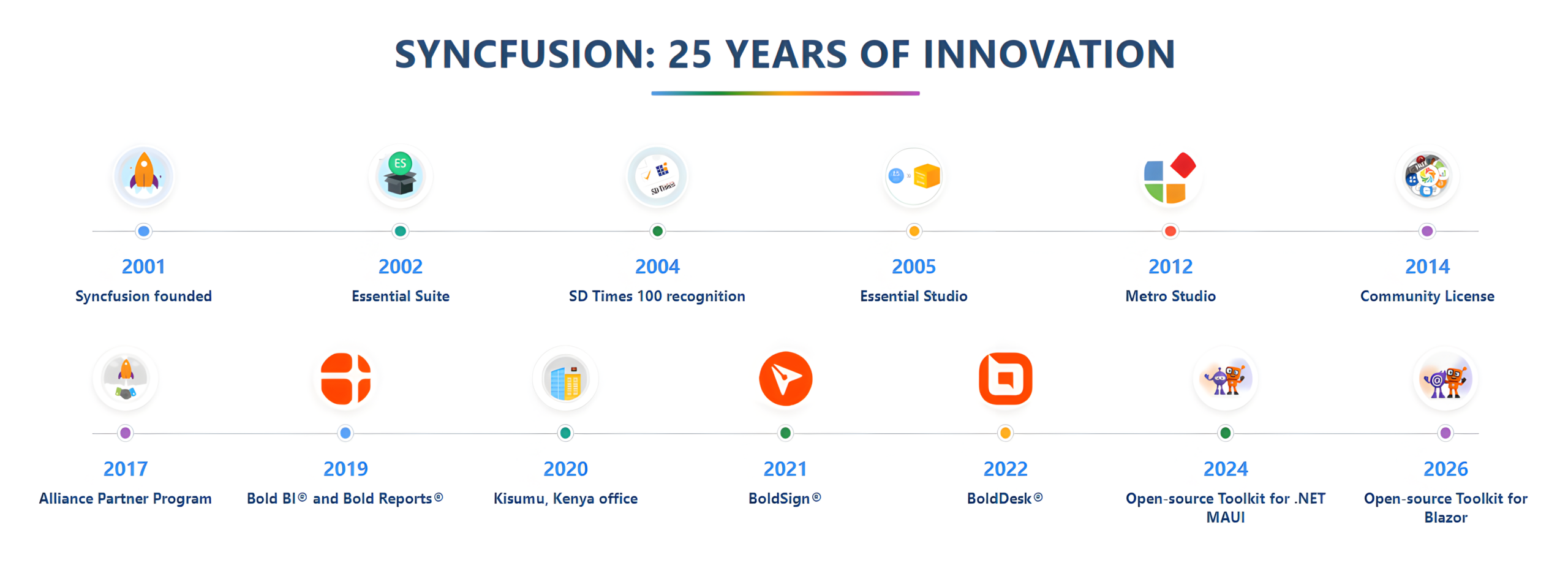
One evening in March 2002, the team shipped Essential Suite: a bundle of components covering grids, charts, and tools for Windows application development. A full year of work was suddenly out in the world. How would developers respond? What would they think? The answer arrived with the first license sold.
The early feedback was specific: developers wanted more controls, more features. Syncfusion had found its customers, and they were already pointing the way forward. The company would rise to the occasion, and by April 2004, Essential Suite had grown to 33 controls, earning Syncfusion a spot on the SD Times 100, an annual recognition of companies with the most influence on the software development industry.
When the giants are all looking the same way
The component market of the early 2000s ran on specialization. One company made the best grid, another owned charting, and a third had the best reporting tools. Each dominated its narrow category, leaving developers who needed all three (which was most of them) buying à la carte, juggling multiple vendor relationships and components that were never designed to work together.
Syncfusion’s bet was to become the one vendor a developer could rely on for everything. That meant matching the quality of established specialists in every category it entered, a high bar. It also meant doing something no competitor would: handing over the source code.
Most vendors treated their components as a black box: customers got the finished product but never the recipe. Syncfusion, however, offered both. Developers could see exactly how every component was built, trust what they were building on, and modify it when needed. In an industry where vendor lock-in was the default, that level of access was unprecedented and truly impactful for developers. Essential Suite sales climbed, and the customer base began to take shape.
Following the work
The early product line covered Windows desktop applications. When developers moved to web frameworks, Syncfusion’s library moved with them. When mobile applications arrived, Syncfusion followed suit. And when cross-platform tools let developers write one codebase and deploy it across devices, Syncfusion had components ready for that as well. That responsiveness, sustained across more than two decades of platform shifts, earned the company a place on the Inc. 5000 list of fastest-growing private companies.
Not every platform lasted long enough to justify the work. Syncfusion built component suites for Windows Phone and Silverlight, both of which ultimately faded. It also developed Orubase, its own framework for hybrid mobile apps. Each was a bet on staying close to where developers were working, even when the destination turned out to be temporary.
Years of exponential growth
The company that shipped one component in 2002 looked very different by 2005. Growth meant hiring; not just developers, but people in sales, support, and operations. Teams formed around specific functions, and the founders, who had each been doing a little of everything, settled into defined roles.
In 2005, Syncfusion signed its first global license agreement and rebranded its flagship as Essential Studio, a name that reflected how far the library had come. To meet demand from outside the US, the company opened its first international office in Chennai, the capital of the state of Tamil Nadu in southern India, and the city where Daniel and Davis Jebaraj grew up. The Chennai office started as a technical support operation and expanded into full product development, eventually growing to nearly 2,000 employees across three locations in the city.
The second international expansion, in September 2020, took a different path. Daniel Jebaraj had spent years volunteering with an organization that teaches computer skills to high school graduates in Kisumu, a city in western Kenya. There he met young people with strong fundamentals and a real eagerness to learn, most of them priced out of university. The potential was plain, and giving it the opportunity to flourish was reason enough to open an office. Syncfusion started in Kisumu with four employees. Today, there are over 500 employees working in product development, technical writing, sales, legal, and accounts.
Reaching out, giving back
In 2004, Syncfusion joined the Microsoft Visual Studio Partner Program, deepening its ties to the .NET developer community. But its relationship with developers was never only commercial. Alongside the products came a steady run of free resources. Guides, icon libraries, ebooks, and full licenses were all built on the same logic as everything else Syncfusion was creating: take the friction out of a developer’s day, whether someone pays for a subscription or not.
The WinForms FAQs
In June 2002, three months after Essential Suite launched, Syncfusion technology consultant George Shepherd published the WinForms FAQs, a practical guide for developers building Windows desktop applications. The FAQs have since expanded to cover WPF, ASP.NET, and Blazor, and remain a working reference today.
Metro Studio
By 2012, UI design was moving away from three-dimensional, texture-heavy icons toward flat, two-dimensional design: simpler visuals that rendered faster and worked better on small screens. Syncfusion released Metro Studio that year, a free library of more than 7,000 customizable icons that could be combined into over 100,000 unique UI elements. It now has more than 170,000 downloads.
The Succinctly series
Developer documentation has a recurring problem: it’s either too shallow or too dense. Blog posts don’t go deep enough; textbooks are overwhelmingly long. In 2012, Syncfusion launched the Succinctly® series to fill the gap with free ebooks, each around 100 pages, written by experts who teach through real projects. The first title, jQuery Succinctly by Cody Lindley, came out that year. The series now holds more than 200 titles, has over four million downloads, and boasts a mobile app.
The Community License
In 2014, Syncfusion introduced a Community License, giving individual developers and small businesses full access to its entire product suite at no cost. The terms are straightforward: meet the eligibility requirements and get a fully featured, fully supported license. More than 154,000 have been claimed to date, representing over $1.9 billion in software distributed for free.
The Alliance Partner Program
In 2017, Syncfusion launched the Alliance Partner Program, extending its reach through software consultancies and DevOps firms. Partners get access to the full product suite and can offer clients deep customization built on Syncfusion’s frameworks.
Open-source packages
In 2024, Syncfusion released the open-source Toolkit for .NET MAUI in collaboration with Microsoft. The toolkit now offers more than 30 freely available components on GitHub and NuGet. Syncfusion was the only software vendor selected for this collaboration with Microsoft.
In June 2026, the Syncfusion Toolkit for Blazor was released, providing developers with an open-source suite of UI components designed to accelerate the development of Blazor Server and WebAssembly apps. These toolkits were formed from the same conviction as the Succinctly series and the Community License: the tools developers need shouldn’t depend on the size of their budget.
The enterprise turn
Syncfusion built products for developers, who then built products for everyone else. But that began to shift around 2009, when Syncfusion started developing frameworks for dashboards and data visualization. The work was still technical and component-level, but it was pointing somewhere new.
The ideas came from customers. They kept asking Syncfusion to build things like dashboards and reporting tools for them. Syncfusion realized that with Essential Studio as the foundation, they could develop, maintain, and deliver these applications at scale and at the same level of quality for a fraction of what they cost elsewhere.
That conviction, backed by a decade of foundational work, became Bold BI®. Launched in 2019, it’s a business intelligence platform designed to be embedded directly into other applications. It gives businesses a way to visualize and act on their data without leaving the tools they already use. Bold Reports® followed the same year: a dedicated solution for the structured, formatted documents enterprise operations depend on, like financial summaries, compliance reports, and operational readouts.
These products were the natural destination of work Syncfusion had been doing since 2009, now packaged for a different kind of customer. The company that had spent twenty years helping developers build software was now building it directly.
Four products, one pattern
Bold BI and Bold Reports established the template: identify a genuine gap, build the right solution, release it as a product. Two more followed, each rooted in expertise Syncfusion had already spent years building.
BoldSign® grew out of Syncfusion’s PDF expertise, which dates to 2006. That foundation (a deep familiarity with the specifications underlying most document-processing work in the .NET ecosystem) pointed toward an adjacent need: signatures that could be verified, audited, and issued at scale through an API. BoldSign launched in March 2021 with those requirements already built in and now competes directly with leading e-signature providers in enterprise evaluations, serving more than 50,000 customers worldwide.
BoldDesk® has a longer history than its 2022 launch date suggests. For years, Syncfusion ran its own support operations through an internal tool called Direct Trac, built because Essential Studio customers could potentially spend a long time developing before shipping, and tracking those relationships required more than a standard ticket queue. That experience became BoldDesk: a full-stack platform for ticketing, omnichannel communication, automation, and AI-driven capabilities. It was less a reaction to the help desk market than an opinionated product built from the inside out.
Twenty-five years, same instinct
In 2001, there were eight founders, one product, and a market nobody was serving well. In 2026, there are 2,000 employees and offices in three countries, more than 1,600 components, four enterprise software products, an ebook series of 200 titles and over four million downloads, a $1.9 billion Community License program, and a community of over a million active developers.
The platforms for which Syncfusion builds today didn’t exist when the company started. The Bold line is a category the founders weren’t in when they shipped Essential Suite. The Kisumu office operates in an economic, geographic, and cultural context a world away from Research Triangle Park. What’s held steady is the approach: find what developers and businesses are struggling with and fix it better than anyone else can.
Development should be easier, faster, and more predictable. That was the idea in 2001. Twenty-five years on, it still is.




 No spam, just valuable updates.