 Manikanda Akash Munisamy

TL;DR: AI coding agents can struggle with large codebases when they cannot access the right code and dependencies. For example, a repository with 1 million lines of code (LOC) contains far more code than a 200K-token context window can hold. This can lead to missed dependencies, incorrect API usage, and coding errors. This article explores seven practical ways to improve agent accuracy through better task scoping, repository instructions, code search, dependency tracking, testing, multi-agent collaboration, and human review.
An AI coding agent can generate a function, fix a bug, or refactor a component in minutes. But what happens when that change affects dozens of files across a large enterprise codebase? The code may compile successfully, yet break existing dependencies, miss important call sites, or introduce APIs that don’t exist.
This is one of the biggest challenges of using AI coding agents in large codebases. As repositories grow, agents must navigate more dependencies, understand established conventions, and identify the right code before making changes.
The 2026 Stack Overflow Developer Survey reports that 66% of respondents use AI coding assistants or coding agents, and 73% of those users work with them daily. As adoption grows, understanding where these tools struggle becomes increasingly important.
In this blog, we’ll explore why AI coding agents lose accuracy in large repositories and discuss seven practical techniques to improve context retrieval, dependency awareness, code verification, and review. We’ll also look at how engineering teams can evaluate AI coding solutions for enterprise environments.
How AI coding agents work
An AI coding agent typically has four layers:
- Language model: Each model call processes the information supplied in its current context window. Conversation history, repository knowledge, and continuity across calls are managed by the surrounding agent system.
- Context assembly: The system selects files, search results, and conversation history for the prompt. If it selects the wrong material, even a capable model can produce plausible but incorrect output.
- Tools and actions: The agent reads files, makes edits, and runs tests through a think-act-observe loop. The checks available to it influence how reliably it can verify its work.
- Orchestration: Planning, retries, and task decomposition coordinate the agent’s actions and help it complete larger changes.
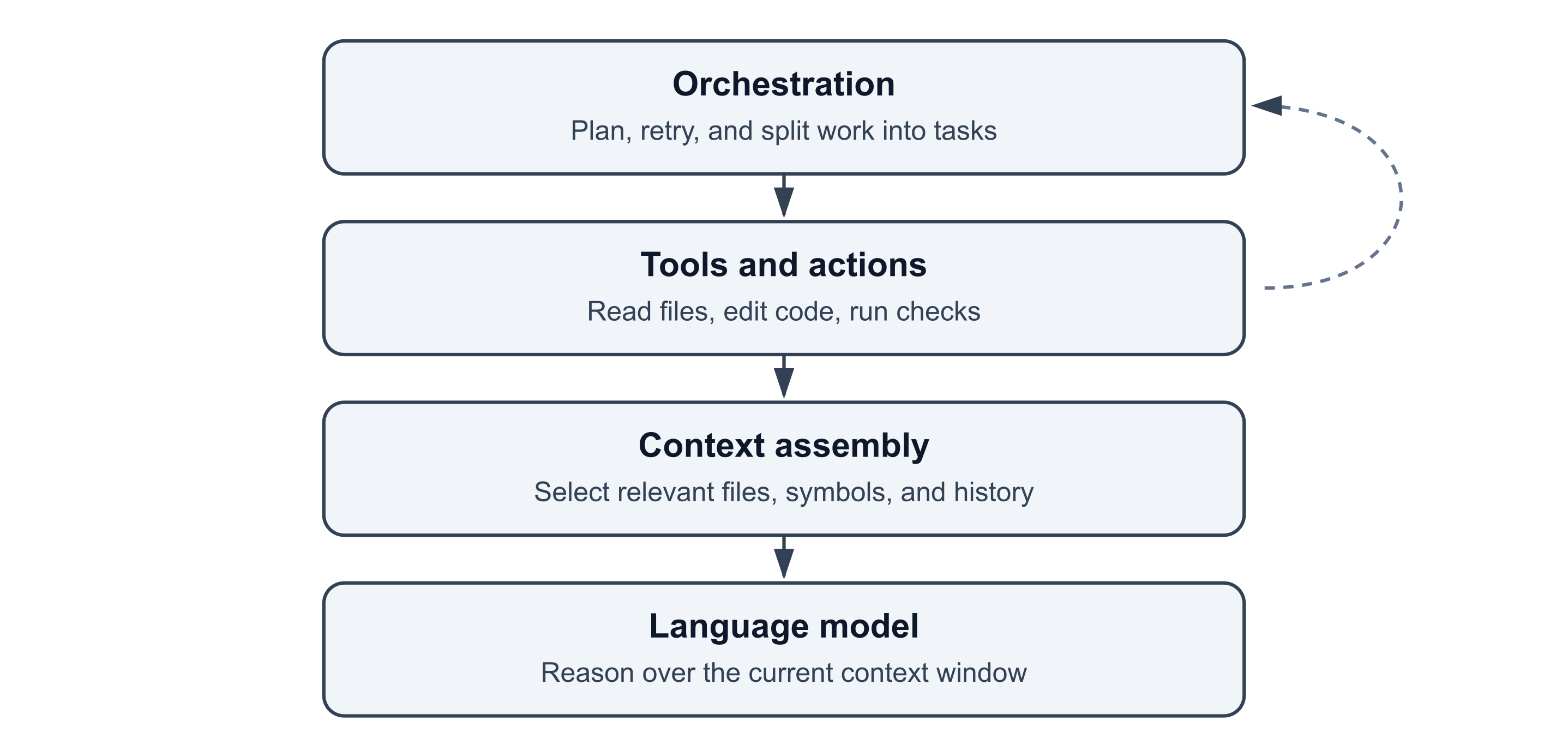
Each layer has its own constraints. The model has a context window, retrieval must identify relevant material, and the agent has a limited number of useful tool-and-check cycles. For example, a 5,000-line service may fit within an agent’s working context. However, changing a shared type in a 1M-line monorepo may require tracing references across multiple packages. Retrieval and verification are often the constraints engineering teams can improve directly.
Why AI coding agents struggle with large codebases
The challenge grows with repository size, but there is no single threshold at which every agent suddenly stops working. As dependencies and conventions spread across more files, text search alone becomes less effective.
| Dimension | 5K LOC | 100K LOC | 1M+ LOC |
|---|---|---|---|
| Dependency graph | Usually limited | Cross-module | Difficult to navigate with text search alone |
| Naming collisions | Less common | More common | Multiple UserService symbols may exist |
| Convention layers | Often few | Several patterns | Legacy, current, and in-migration patterns |
Three forces compound the challenge:
- Implicit knowledge matters. Important rules may exist in architecture decision records (ADRs), event schemas, migration ordering, or commit history rather than alongside the code being changed.
- Changes can have non-local effects. Editing a shared type may affect hundreds of call sites, serialized payloads, and downstream consumers. The agent needs a way to identify the potential impact of its changes.
- Verification becomes harder. Large builds and partitioned test suites can make it difficult to determine whether the checks being run adequately cover a change.
Understanding context windows in large codebases
For a rough illustration, assume an average of 10 tokens per line of code. Actual token density varies by programming language, formatting, and code structure. At this rate, a 200K-token context window could accommodate the following repository sizes:
| Repository size | Approx. tokens | Share fitting in a 200K-token window | Share fitting in a 1M-token window |
|---|---|---|---|
| 5K LOC | ~50K | 100% | 100% |
| 50K LOC | ~500K | ~40% | 100% |
| 100K LOC | ~1M | ~20% | 100% |
| 1M LOC | ~10M | ~2% | ~10% |
These figures are theoretical capacity estimates. In practice, system instructions, conversation history, retrieved documents, and tool outputs also consume tokens, leaving less room for source code.
At enterprise scale, the agent may have to reason about the system through a keyhole. Even a 1M-token context window holds only about 10% of a 1M-LOC repository under this estimate. A larger window helps, but it doesn’t guarantee that the relevant files will be selected or used effectively.
Research on long-context language models has found that models may use information less reliably when it appears in the middle of long inputs. That research examined retrieval and question-answering tasks rather than coding agents specifically, but it illustrates why a larger context window alone doesn’t guarantee better repository understanding. Larger prompts can also increase latency and cost across an agent’s repeated steps.
Long sessions introduce another risk: context rot. As conversations grow, agents may compact or evict earlier content, lose previously established decisions, and contradict them. One sign is when an agent reintroduces a pattern that was rejected earlier.
The goal is to select relevant context, not simply maximize the amount of text in the context window.
Dependency and architecture challenges in large codebases
Even with effective retrieval, text alone may not reveal all the structures that matter in a large codebase.
- The hidden call graph. Text search may not follow dynamic dispatch or dependency injection, trace messages through an event bus, cross language boundaries, or identify references in generated code. For example, when an agent renames a handler, a plain text search may miss callers that reference it indirectly through a registration table.
- Architectural inconsistency. Large codebases contain layers of historical code. Unless retrieval identifies which conventions are current, an agent may copy a deprecated pattern from an older module.
- Transitive effects. A serialization change may affect a mobile client with a slower release cycle and eventually breach an SLA. Identifying that chain requires access to the relevant contracts and dependencies.
Structural tools can improve visibility, but they may not capture every runtime dependency, especially in systems that rely heavily on reflection, dynamic registration, or generated code.
Common AI code hallucinations and generation errors
When context is incomplete or outdated, models may fill in the gaps with plausible but incorrect details. Common examples include:
- Phantom internal APIs: Calling
UserService.findByEmailAndTenant()because the method seems like it should exist, even though it doesn’t. - Wrong-version library usage: Generating code for an API that isn’t available in the project’s installed library version.
- Fabricated configuration and environment variables: Inventing settings keys that follow the project’s naming conventions but don’t actually exist.
- Following conventions without understanding their semantics: Copying the structure of nearby code while violating its underlying assumptions or invariants.
- Manipulating tests to produce passing results: Weakening assertions or adding broad mocks until the test suite passes.
In practice, incomplete or outdated context can make these mistakes more likely. Reviewers can miss them too, especially when no single person understands the entire codebase.
One costly failure mode is code that compiles but is logically incorrect. Examples include incorrect transaction boundaries, race conditions, and missing cache invalidation. Some defects may pass the checks that were run and surface only later.
7 practical ways to improve AI coding agent accuracy
These techniques are ordered from the easiest to implement to the more ambitious.
1. Scope tasks to match effective context
Break work into changes that fit within the agent’s effective context. Specify the files, symbols, and acceptance criteria clearly. For example:
Add a retryCount field to InvoiceJob in src/billing/jobs.ts.
Update the two consumers in src/billing/scheduler.ts and src/billing/worker.ts.
Acceptance: npm run test:billing passes, and no other packages change.
Prefer one logical change per session, and start a fresh session when earlier discussions are no longer relevant. If you can’t identify a likely starting point, first ask the agent to map the relevant files.
2. Write repository-level agent instructions
Files such as AGENTS.md or .github/copilot-instructions.md provide repository-specific guidance to agents whose tools support and load them. These files supply instructions for a task; they aren’t persistent model memory.
For example:
# Agent Instructions
- Services live in src/services/; follow src/services/billing/ as the reference pattern.
- Never modify src/generated/; run npm run codegen instead.
- All DB access goes through the repository layer; no raw SQL in handlers.
- Run npm run test:affected before declaring any task complete.
Keep these instructions concise. In monorepos, add nested instruction files for package-specific conventions. Maintain them like code: review them in pull requests and add a rule when the agent repeatedly makes the same mistake.
3. Use RAG with semantic indexing
Retrieval-augmented generation (RAG) searches an index for relevant code instead of adding large numbers of files directly to the prompt.
A practical hybrid setup combines embedding similarity for conceptual matches, BM25 keyword search for exact identifiers, and symbol-aware chunks that keep functions intact.
For example, when asked, “Where is invoice retry behavior implemented?”, retrieve semantic matches for retry behavior alongside exact matches for retryInvoice. Then rank and deduplicate the results before adding the relevant symbols and callers to the context.
Update the index when relevant source files change. Use a freshness strategy suited to the repository so retrieval doesn’t rely on outdated files.
4. Give agents the code graph, not just code text
Connect agents to structural sources such as language server protocol (LSP) features, static analysis, abstract syntax tree (AST) tooling, and the build graph.
For example, an MCP server backed by an LSP can expose definition lookup, references, and type signatures. Before changing findByEmailAndTenant(), the agent can ask the server whether the symbol exists and identify its callers. This helps verify API assumptions and find references that text search may miss.
Retrieval and code-graph tooling work best together. For a task such as updating the authentication flow, retrieval can surface candidate files and documentation. Find-references and type signatures can then confirm which symbols are involved and where their callers are before the agent makes changes.
5. Build fast, strict feedback loops
Agents can respond to feedback only as quickly as the checks return results. Invest in incremental type-checking, affected-test selection, architectural fitness tests (such as “no module in api/ imports from internal/”), and contract tests at service boundaries.
Build and task orchestration tools such as Nx, Bazel, and Turborepo can support change-based targeting in CI, depending on how they’re configured.
Run the fastest relevant checks during iteration, then run broader checks before merging.
6. Orchestrate multi-agent and subtask workflows
Separate planning from execution when a task has clearly defined, independent parts. A planner can survey the repository and produce a task list, while executor agents handle scoped tasks with clean contexts.
For example, ask a planner to identify the definition, callers, tests, and migration risks for a rename. Then assign an executor one package and its acceptance checks.
Planner:
Map the symbols and packages affected by renaming LegacyInvoice to InvoiceRecord.
Return a short task list with files, dependencies, risks, and tests.
Do not edit files.

Executor:
Implement task 1 only. First inspect the listed files and verify the current API.
Make the smallest compatible change, then run the listed checks and report the results.
For mechanical bulk edits, such as renaming a symbol across hundreds of files, generate a codemod and run it deterministically.
More agents don’t automatically produce better results. Multi-agent workflows introduce coordination overhead and can lead to duplicated work or conflicting edits. Define clear task boundaries and avoid assigning overlapping files to parallel executors.
7. Keep humans in the loop at the right level
Reviewing a 40-file AI-generated diff line by line isn’t scalable. Instead, review the plan before execution, including the files involved, the proposed approach, and potential risks.
Set review requirements according to the potential impact of a change. Shared types, migrations, and security-sensitive paths may require senior review.
Track metrics such as revert rates and review time per AI-assisted pull request to understand how reliably agents contribute to the codebase.
Evaluating AI coding solutions for enterprise repositories
Tools that appear similar when used with small repositories may behave differently at enterprise scale. Evaluate them using the following criteria:
| Capability | Question to ask |
|---|---|
| Repository indexing | Does it use a semantic index or rely only on on-demand text search? |
| Code-graph awareness | Can it use find-references and type information? |
| Context transparency | Can you see which information was retrieved and added to the prompt? |
| Instruction-file support | Does it honor AGENTS.md-style repository conventions? |
| Verification integration | Can it run tests and type checks as part of its workflow? |
| Multi-file capability | Can it coordinate changes across multiple modules? |
| Security and compliance | Is code indexing hosted or self-hosted? What are the data-retention and model-training policies? |
| Measurability | Can you track acceptance rates, revert rates, and review time? |
For security and compliance, confirm whether indexing is hosted or self-hosted, how long code and embeddings are retained, whether customer code is used to train vendor models, and whether agent actions are audit-logged.
Then benchmark candidate tools using your own codebase and three types of tasks:
- A cross-cutting refactor.
- A feature that touches at least three modules.
- A bug fix that requires historical context.
Score each tool based on correctness after CI, missed call sites, adherence to coding conventions, and review time. Public benchmarks may not reflect how a tool performs in your repository, so use your own results when comparing candidates.
Frequently Asked Questions
Do larger context windows (1M+ tokens) solve this problem?
No. Under the estimate used in this article, a 1M-token context window holds about 10% of a 1M-LOC repository. It also doesn’t guarantee that relevant information will be retrieved or used reliably throughout a long context.
Should we fine-tune a model on our own codebase instead of using retrieval?
Fine-tuning can be expensive and may become outdated as the code changes. It also doesn’t guarantee accurate recall of specific APIs. Retrieval and code-graph tooling provide ways to fetch current code and verify symbols, so many teams may want to evaluate these options first.
Would splitting our monorepo into smaller repositories make AI agents more accurate?
Not necessarily. Splitting a repository can move complexity from within the repository to the relationships between repositories, where cross-service dependencies may be less visible. Better indexing, repository instruction files, and verification loops are options to explore before restructuring an architecture.
Are AI coding agents suitable for junior developers working in large codebases?
They can be useful with appropriate guardrails. Pair agent use with plan reviews and strict CI checks, especially for changes with a large potential impact. Reviewers should also verify API assumptions and ensure that changes follow the established architecture.
Conclusion
AI coding agents can accelerate development, but working with large codebases requires more than a capable language model. Agents need relevant repository context, visibility into dependencies, clear architectural instructions, and reliable verification.
The techniques discussed in this article range from task scoping and repository instruction files to semantic retrieval, code-graph tooling, and plan-level review. Together, they can help engineering teams improve the accuracy and reliability of AI-generated changes.
Before choosing a coding agent, test it against real tasks in your largest repository rather than relying on product demos. Measure correctness after CI, missed call sites, adherence to coding conventions, and review time to determine whether the tool delivers reliable results at scale.



Be the first to get updates