
 Suchitha Ramesh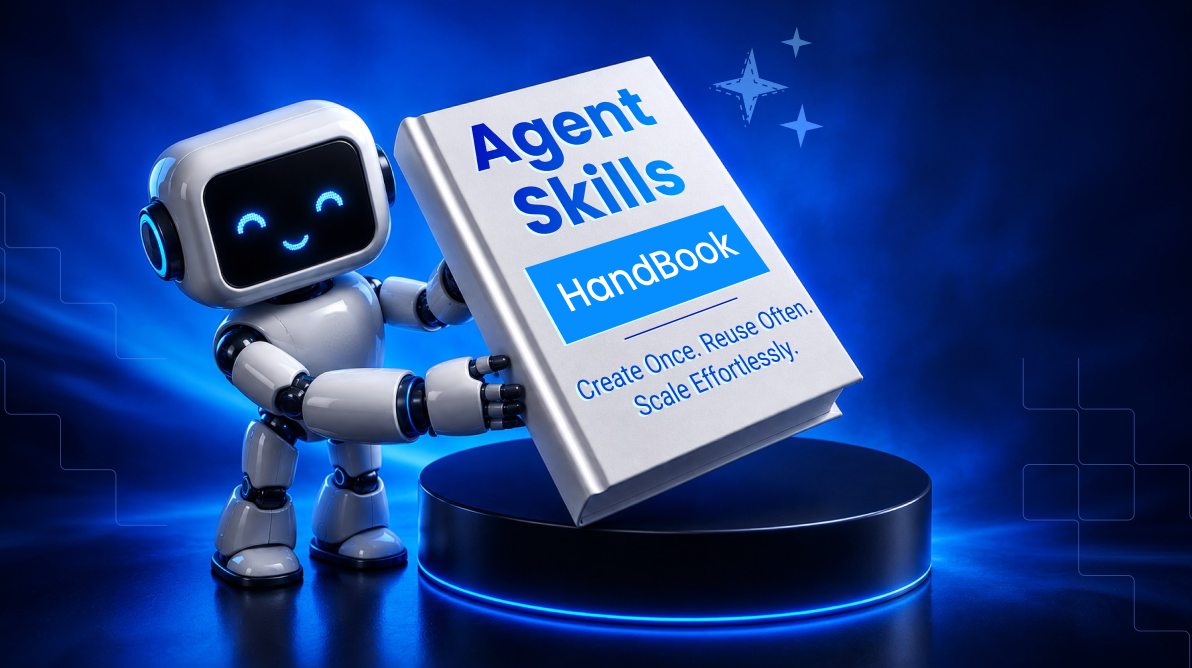
TL;DR: Why teach AI the same task over and over? Agent Skills help developers capture recurring instructions once and reuse them consistently across code reviews, testing, documentation, and more. The Agent Skills Handbook shows how to build these reusable capabilities with practical examples and proven best practices.
AI can generate code, create test cases, review pull requests, write documentation, and summarize information in seconds. Yet many developers still spend time rewriting the same instructions every time they work with an AI assistant.
- A developer repeatedly explains code review expectations.
- A QA engineer recreates testing guidelines for every feature.
- A content team keeps re-entering formatting requirements for reports and summaries.
The AI may already be capable of performing the task. The problem is that the instructions live inside individual prompts instead of being packaged as reusable guidance.
As AI adoption grows, this creates familiar challenges:
- Inconsistent outputs across project.
- Time spent rewriting instructions.
- Difficult-to-maintain prompt libraries.
- Knowledge that exists in conversations instead of reusable assets.
The question is no longer whether AI can help. The real question is how to make AI perform tasks consistently without having to explain the same thing repeatedly.
That’s where Agent Skills come in.
To help move beyond one-off prompting, we’ve created the Agent Skills Handbook, a practical guide to creating, testing, and scaling reusable AI capabilities.
From repeated requests to reusable intelligence
Let’s look at a simple example. Imagine your team regularly summarizes technical documents.
Without a reusable approach, you might repeatedly write:
| Summarize this document, extract key takeaways, and present them as bullet points. |
The prompt may work. But after the tenth, fiftieth, or hundredth request, you’re still repeating the same instructions.
Agent Skills take a different approach. Instead of rewriting the instructions every time, you define them once:
- The input the AI should receive.
- The steps the AI should follow.
- The structure of the final output.
Once created, you can apply the same skill consistently whenever the task appears.
The immediate benefit is convenience. The long-term benefit is consistency. Every team member gets the same structured experience without maintaining multiple versions of the same prompt.
What are Agent Skills?
Agent Skills are reusable packages of instructions, resources, and, in some implementations, supporting scripts that give AI agents specialized knowledge and procedures for performing specific tasks.
A skill typically defines:
- Expected inputs,
- Task-specific instructions,
- Processing guidance,
- Constraints and best practices,
- Output requirements,
- Supporting examples and resources.
Think of a skill as a reusable playbook. Instead of describing a process every time, you package the knowledge once and make it available whenever that task appears.
Different AI platforms may implement skills differently, but the core idea remains the same:
- Define expertise once. Reuse it whenever needed.
Unlike a prompt template, a skill can package the knowledge and supporting resources an agent needs to approach a task in a more standardized way.
Prompt vs. Agent Skills
One question developers often ask is: “Why not just save the prompt?”
While prompts and skills are related, they serve different purposes.
| Prompt | Agent Skills |
| Task-specific instruction. | Reusable task knowledge and processing guidance. |
| Usually invoked manually. | Can be reused across many similar tasks. |
| Primarily contains instructions. | Can include instructions, resources, examples, and recommended practices. |
| Solves an immediate request. | Helps standardize how an agent approaches a recurring task. |
A reusable prompt saves instructions. A skill packages expertise.
How Agent Skills work
Most skills follow a simple lifecycle:
- Define the task: Identify a recurring activity such as code reviews, test generation, documentation, or requirement validation.
- Package knowledge and instructions: Capture the processes, standards, constraints, and examples that help guide the task.
- Make the skill available: The skill is added to a supported environment or workspace.
- Agent applies the skill: When a request matches the skill’s purpose, the agent can use the skill’s guidance and resources alongside the current project context.
- Improve over time: As requirements evolve, the skill can be updated and reused across future tasks.
This approach helps teams reuse expertise instead of repeatedly rewriting instructions.
Why developers should care about Agent Skills
Most developers have experienced prompt sprawl.
- A simple prompt starts with one instruction.
- Then formatting rules are added.
- Then coding standards.
- Then edge cases.
- Then project-specific exceptions.
Eventually, the prompt becomes harder to maintain than the task itself. Agent Skills help solve this problem by separating the task definition from the execution.
For example, instead of maintaining multiple code-review prompts, a team can create a reusable review skill that consistently checks for:
- Coding standards compliance,
- Security concerns,
- Performance issues,
- Maintainability risks, and
- Documentation quality.
When standards change, the skill can be updated once and reused everywhere. This not only saves time but also helps teams apply the same expectations across projects and contributors.
A real-world example: Standardizing AI-powered code reviews
Consider a team managing multiple repositories.
- One developer asks the AI to focus on performance.
- Another prioritizes security.
- A third emphasizes readability.
Even though they’re reviewing similar code, the feedback varies because the instructions vary.
Now, imagine creating a dedicated Code Review Skill.
The skill defines:
Input
- Source code or pull request changes.
Process
- Validate coding conventions.
- Check maintainability.
- Identify potential security concerns.
- Analyze performance considerations.
- Review documentation coverage.
Output
- Structured review summary.
- Improvement recommendations.
- Priority-based findings.
Instead of depending entirely on individual preferences, the skill helps standardize how the AI approaches code reviews. This becomes increasingly valuable as teams grow and development practices expand across repositories.
What you’ll learn in the Agent Skills Handbook
The Agent Skills Handbook focuses on practical implementation rather than theory.
Inside, you’ll learn:
- How to create Agent Skills for real-world development scenarios.
- The difference between prompts and skills.
- How to define clear inputs, instructions, and outputs.
- Techniques for creating maintainable and reusable skills.
- Methods for testing and refining skill behavior.
- Approaches for scaling skills across teams.
- Advanced patterns, best practices, and practical cheat sheets.
Whether you’re building your first skill or creating a shared library for your organization, the handbook provides actionable guidance you can apply immediately.
Who will benefit from this handbook?
- Developers: Standardize recurring AI-assisted tasks such as code reviews, bug analysis, documentation generation, and requirement validation.
- QA engineers: Create repeatable testing processes and improve consistency in test generation and quality verification.
- Technical writers: Establish structured approaches for generating summaries, technical content, and documentation.
- Solution architects: Create reusable standards that support governance, consistency, and scalability across teams.
- AI engineers: Design, test, and maintain skill libraries that can be reused across projects and development environments.
- Beginners: Learn structured AI interaction techniques that go beyond basic prompting.
Why reusable skills become more valuable over time
Reusable skills can turn knowledge that would otherwise remain scattered across prompts, chats, and documents into assets that can be maintained and shared.
| Benefit | Why it matters |
| Consistency | Provides similar guidance across contributors and projects. |
| Knowledge capture | Preserves team expertise and implementation practices. |
| Onboarding | Helps new team members access established processes. |
| Maintenance | Instructions can be updated centrally. |
| Scalability | Reuse capabilities across multiple projects. |
Putting Agent Skills into practice
Understanding the concept is only the first step. The real value comes from applying reusable skills within your everyday development process.
For example, if your team uses AI for planning, coding, testing, and reviewing software, reusable skills can help ensure those activities follow consistent standards instead of relying on different prompts from different developers.
This is especially useful when teams want AI assistance while still maintaining engineering standards, development guidelines, and repeatable processes.
Generic Agent Skills vs. Syncfusion Agent Skills
Agent skills can be used for any recurring AI-assisted processes.
Generic Agent Skills
Organizations often create their own skills to capture:
- Team standards,
- Internal processes,
- Domain-specific knowledge,
- Review and testing procedures, and
- Documentation requirements.
Syncfusion Agent Skills
Syncfusion Agent Skills provide product-specific knowledge about Syncfusion technologies, including:
- Component setup guidance,
- API usage recommendations,
- Implementation patterns,
- Product documentation references, and
- Best practices for working with Syncfusion components.
Rather than requiring AI assistants to infer how a component should be implemented, these skills provide structured guidance that can help the agent align more closely with Syncfusion’s recommended approaches.
Use AI agents to create implementation plans, generate production-ready code, automate repetitive tasks, and improve code quality across your projects.
Discover Code StudioBuild once. Reuse everywhere.
The biggest challenge with AI isn’t generating output. It’s generating reliable output repeatedly as projects, teams, and requirements evolve.
Agent Skills provide a practical way to capture expertise that would otherwise be scattered across prompts, chats, and documentation. Whether you’re reviewing code, generating test cases, validating requirements, or summarizing technical content, reusable skills help transform ad hoc AI interactions into repeatable processes.
If you’re looking to get started, explore the Agent Skills Handbook for a practical foundation in designing, testing, debugging, and scaling reusable AI capabilities.
For teams ready to apply those concepts in real development environments, Syncfusion Code Studio provides an AI-native development experience that supports reusable skills and standardized development practices. In Code Studio, skills can be made available to agents and loaded when relevant to a task, allowing specialized instructions and resources to supplement the agent’s general capabilities. This helps teams reuse established processes across planning, implementation, testing, and review activities.
For developers building with Syncfusion components and SDKs, Syncfusion Agent Skills give AI coding assistants access to implementation guidance, APIs, setup instructions, and recommended patterns, reducing trial and error and helping the agent generate code that better aligns with Syncfusion APIs and recommended implementation patterns.
Start with one repetitive task. Turn it into a reusable skill. Then repeat the process. Over time, reusable skills can reduce repetitive instruction-writing and help developers focus more on engineering tasks rather than repeatedly explaining the same processes.
For questions or feedback, connect with us through our support forums, support portal, or feedback portal. We’re always happy to help you!



 No spam, just valuable updates.