











Transform your applications today by downloading our free evaluation version
Overview
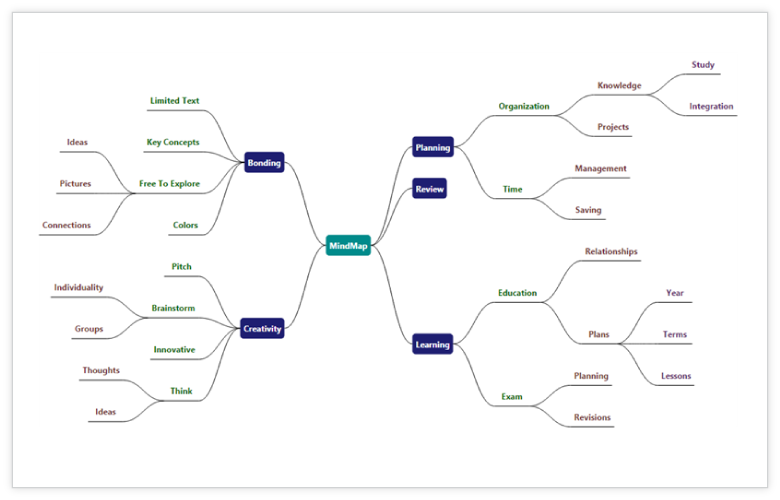
The JavaScript diagram is a feature-rich library for visualizing, creating, and editing interactive diagrams. It supports creating flowchart, organizational charts, mind maps, and BPMN either through code or a visual interface.
Easy and intuitive way to create professional diagrams
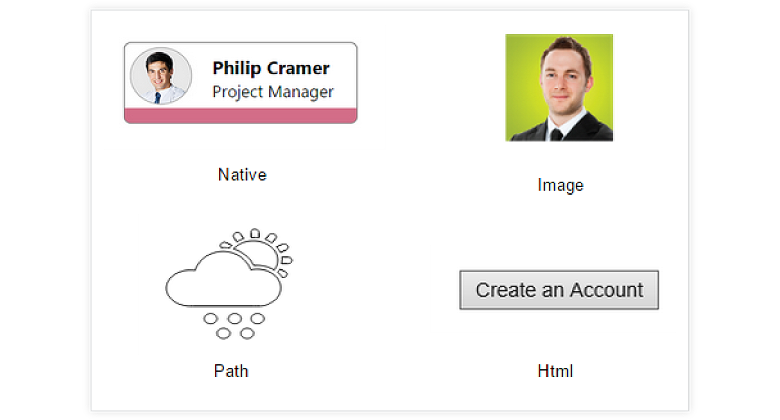
Nodes are used to host graphical objects like paths and controls that can be arranged and manipulated on a diagram page.
- Many predefined standard shapes are included.
- Custom shapes can also be created and added easily.
- The appearance of a node can be fully customized.
- A node’s UI can also be templated and re-used across multiple nodes.
Connectors
The relationship between two nodes is represented using a connector. Multiple instances of nodes and connectors form a diagram. Some of the key features are listed below.

Types
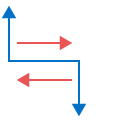
Different types of segments are available as connectors between objects.

Bridging
Bridging is a visual indication of overlapping between two connectors.
Routing
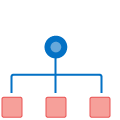
Orthogonal connectors take a smart path that avoids overlapping with nodes to which they are connected.
Decorators
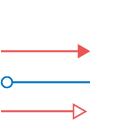
Arrows or decorators at the edges of connectors are used to represent relationships between nodes.
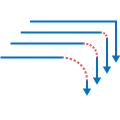
Rounded Corners
The corner radius can be specified for edges in connectors.
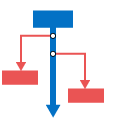
Ports
Ports are specific points in a node to which a connector can be connected.
Labels
Labels are used to annotate nodes and connectors. The diagram component also makes it easy to edit and align labels relative to the object to which it is mapped.

Ruler
The ruler provides a horizontal and vertical guide for measuring in diagram control. The ruler can be used to measure the diagram objects, indicate positions, and align diagram elements. This is especially useful in creating scale models.

Interactive Features
Interactive features are used to improve the run time editing experience of a diagram. You can easily edit a diagram with mouse, touch screen, or keyboard interfaces.
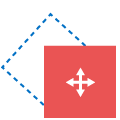
Select, Drag, Resize, Rotate
Objects can be selected and then dragged, resized, or rotated.
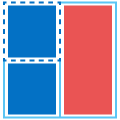
Snap
Objects can be aligned easily with gridlines or neighboring objects.
Keyboard Interactions
All common actions can also be performed through keyboard input.
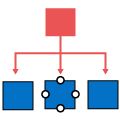
Connect
The connect tool can be used to create a connection between two nodes, ports, or points.
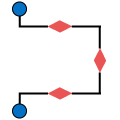
Edit Connector
A connector’s route can be manually edited by dragging thumbs that are visible after selection.

Zoom and Pan
Large diagrams can be explored using the zoom and pan tools.
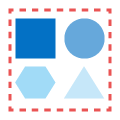
Group
Multiple nodes or connectors can be grouped together to form a single object called a group.
Drawing Tool
The drawing tool enables users to draw custom nodes and shapes by clicking and dragging on the diagram surface.
Data Binding
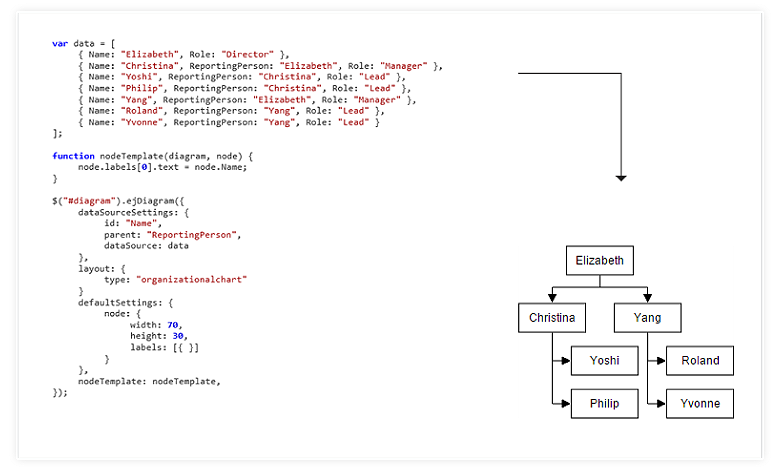
Seamlessly data-bind to various client-side and remote data sources such as JSON, RESTful services, OData services, WCF services, and many more.
Commands
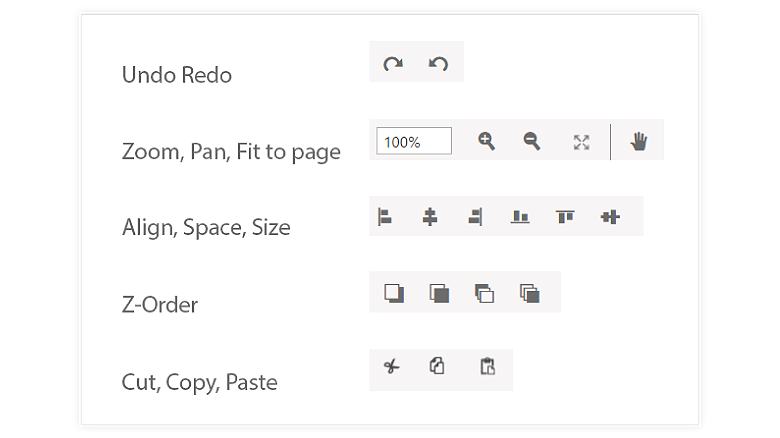
The diagram control has a predefined set of commands. Some of the standard commands are mapped to keyboard shortcuts. It is also possible to configure new commands and key combinations.
Automatic Layout
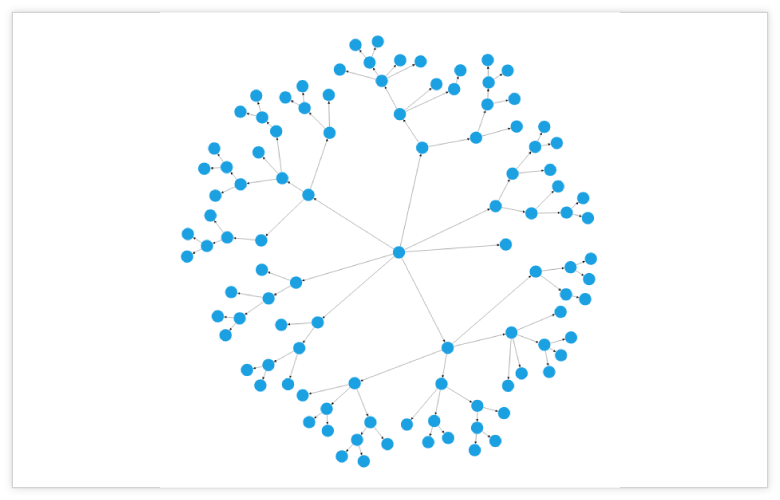
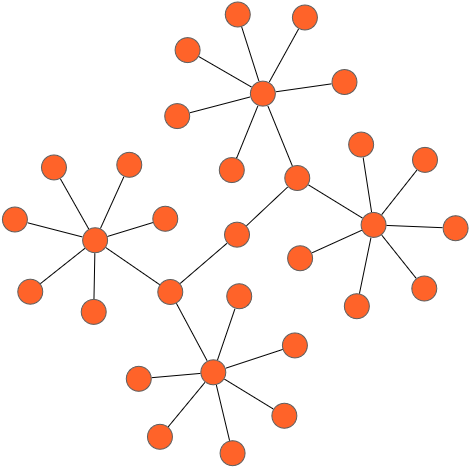
Automatic layouts are used to arrange nodes automatically based on a predefined layout logic. There is built-in support for organizational chart layout, hierarchical tree layout, symmetric layout, and radial tree layout.
Overview
The overview control is used to improve the navigation experience when exploring large diagrams. It displays a small preview of the full diagram page that allows users to perform operations such as zooming and panning within it.

Symbol Palette
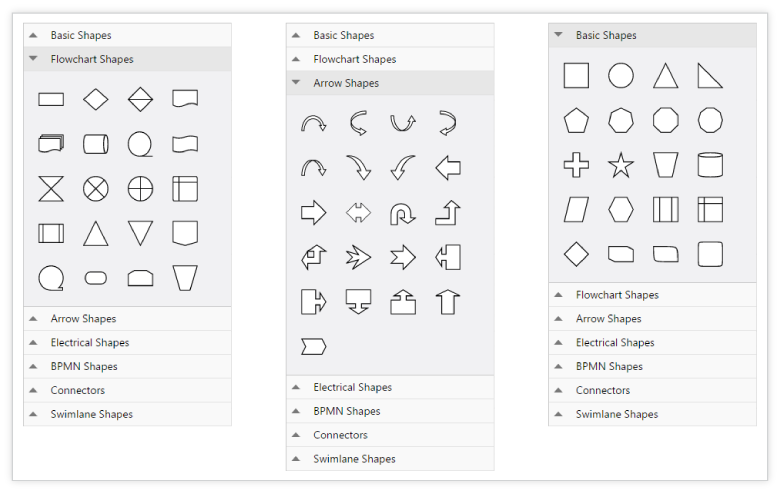
The symbol palette is a gallery of reusable symbols and nodes that can be dragged and dropped onto the surface of the diagram.
Swim Lane
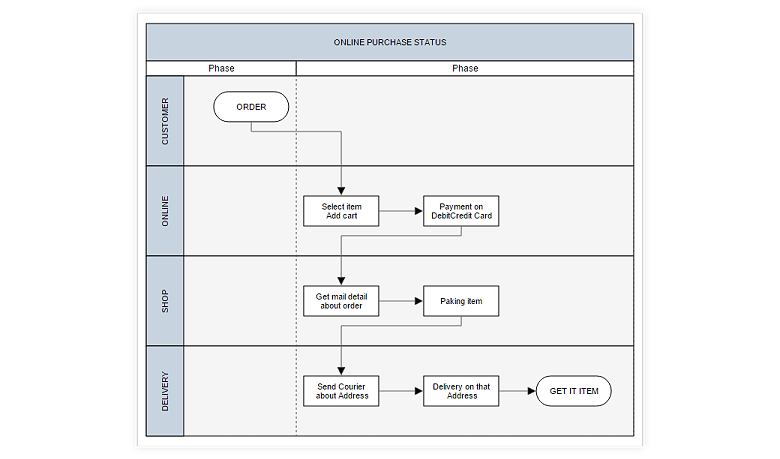
A swim lane is a visual element used in process flow diagrams or flowcharts. Swim lanes may be arranged either horizontally or vertically. A swim lane diagram has built-in lanes and phases where nodes can be added to it. It has rich interactive features and auto-alignment options, which makes editing easy.
Serialization
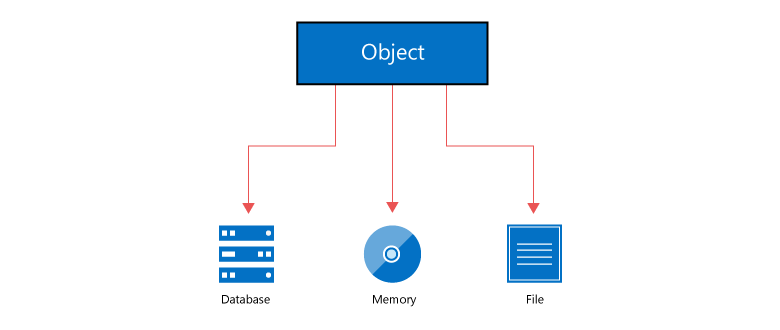
A diagram’s state can be persisted to JSON format and then be loaded back using serialization.
Exporting and Printing
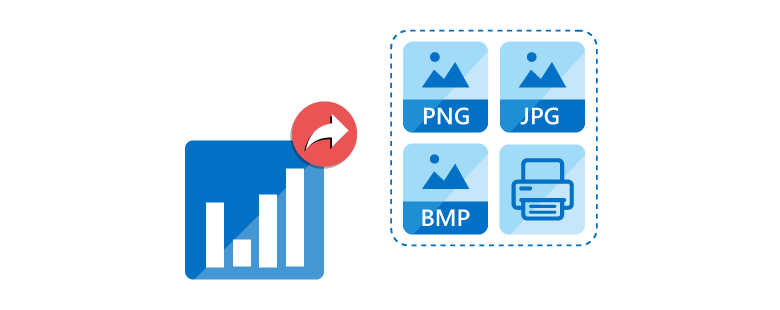
Diagrams can be easily exported as .png, .jpeg, .bmp, and .svg image files, and can also be printed as documents.
Miscellaneous
There are several other features available to enhance the diagramming experience.
Tooltip
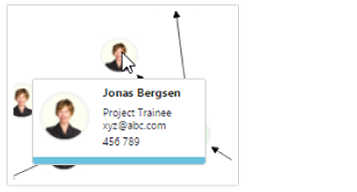
Additional information about a node can be viewed using tooltips.
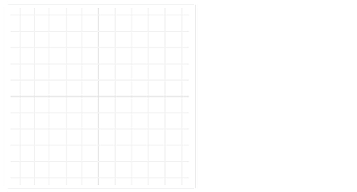
Gridlines
Gridlines provide guidance when trying to align objects.
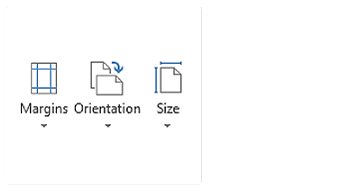
Page Layout
The drawing surface can be given a page-like appearance using page size, orientation, and margins.
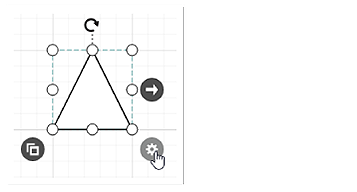
User Handles
Frequently used commands can be easily mapped to the user handles.
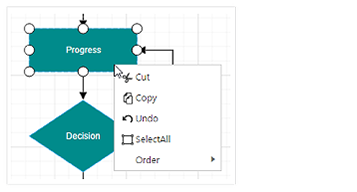
Context Menu
Frequently used commands can be easily mapped to the context menu.
Localization
All static text within the diagram can be localized to any desired language.

AngularJS and More
There is built-in integration with all the popular third-party frameworks like AngularJS, KnockoutJS, jQuery, TypeScript, and Bootstrap.

Diagram Builder
Diagram builder is a diagramming application created using the diagram control. It is used to create, edit, save, export, and print diagrams. It has a symbol palette, property editor, overview window, toolbox, and menu to provide a great editing experience.
75+ jQuery UI WIDGETS
ALL WIDGETS
GRIDS
DATA VISUALIZATION
EDITORS
NAVIGATION
NOTIFICATION
FRAMEWORK
MISCELLANEOUS
BUSINESS INTELLIGENCE
REPORTING
FILE FORMAT LIBRARY
Media
Our Customers Love Us
Having an excellent set of tools and a great support team, Syncfusion® reduces customers’ development time.Here are some of their experiences.

We're using the file formats and Windows/JavaScript list controls a lot. They're fast, easy to use, and the documentation is good and contains examples. Tickets with questions or suggestions were answered within a day, so we're happy to use the Syncfusion libraries.
Using Syncfusion Angular and JavaScript controls makes front-end web development a piece of cake. Each component has many properties that can be configured as per your desire, methods that can be used to interact with the element, and a lot of events that trigger at different stages, which makes modifying your components according to the state of the application an easy task. Also, their support is amazing! They always offer a sample working project, which makes it very simple to solve your question about your code.
Rated by users across the globe
Syncfusion jQuery Resources
Learning
 Documentation
 Documentation


Awards
Greatness—it’s one thing to say you have it, but it means more when others recognize it. Syncfusion® is proud to hold the following industry awards.