 Sumankumar G
TL;DR: A comparison of seven React animation approaches, focusing on how each one behaves in real product interfaces. Highlights the differences in workflow, flexibility, UI patterns, and trade‑offs developers should understand before choosing an animation strategy.
Animations in React often look simple in demos, but they become deceptively expensive in real products. A basic fade or slide can lead to jank on mid-range devices, inflate bundle size, complicate accessibility, and add long-term maintenance debt, especially in dashboards, admin panels, and enterprise apps with heavy data and frequent updates. The right animation library depends not on what looks good in a sandbox, but on how it behaves under real constraints: 60fps targets, layout thrashing, bundle budgets, server rendering, gesture support, and how safely your team ships UI changes.
This guide is for engineering teams building real products, not prototypes. It reviews seven reliable React animation options, explains when each works best, and highlights the trade-offs that often emerge only after launch (SSR, bundle budgets, large datasets, and accessibility).
What changes when animations move from demo to production
In isolated components, animations often look smooth. In production screens, they run alongside:
- Frequent state updates.
- Virtualized lists.
- Large and nested DOM trees.
- Heavy data operations.
- SSR + hydration pipelines (e.g., Next.js).
- Real network/device constraints.
That’s why teams commonly experience issues such as:
- Frame drops during scroll, filter, or pagination events.
- Animations lag when tables, charts, or API-driven widgets update.
- Hydration mismatches in SSR frameworks like Next.js.
- Increased bundle size affecting load time.
- Motion getting removed later due to performance or accessibility concerns.
The goal in production is not “more animation.” It’s the right amount of motion applied intentionally, without becoming a performance or maintenance liability.

The 7 best React animation libraries for production apps
Below are the seven most reliable approaches teams use in real-world React applications. The “best” choice depends on:
- What you’re animating.
- How data-heavy the UI is.
- How strict your performance budget and bundle size are.
1. Motion (formerly Framer Motion)
Motion is the most popular default choice for React teams because it feels native to React development. It handles common product UI needs with a clean, declarative API.
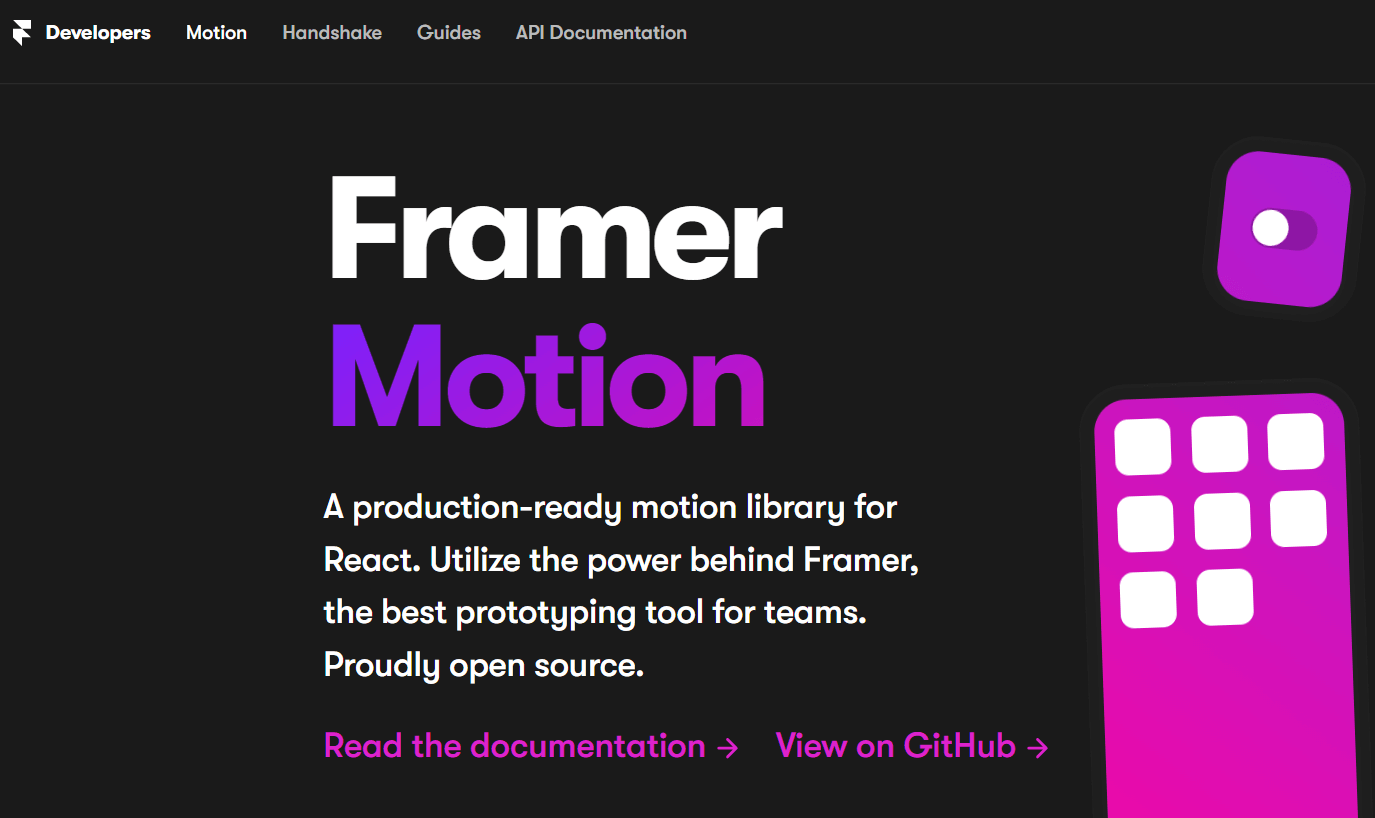
We can install the Motion package via npm or yarn.
npm install framer-motionor
yarn add framer-motionAfter installation, import Motion and wrap the elements in a <motion.div> or similar element. Use animate and transition properties for declarative animations.
import { motion } from "framer-motion";

export default function App() {
 return (
   <div style={{ padding: 40 }}>
     <motion.div
       animate={{ scale: [1, 1.2, 1] }}
       transition={{ duration: 2, repeat: Infinity }}
       style={{ padding: 20, background: "#007bff", color: "white", borderRadius: 8, display: "inline-block" }}>
       Framer Motion
     </motion.div>
   </div>
 );
}
Best suited for
- Micro-interactions and UI polish.
- Page transitions and enter/exit animations.
- Layout animations and shared element transitions.
- Gestures and interactive motion patterns.
Trade-offs to know
- Bundle size can feel heavy if you only need basic fades/slides.
- Large lists can lag if animations are tied to frequent updates.
- Layout animations require discipline in data-heavy screens.
Strong choice for
- Modern SaaS applications.
- Product UIs that benefit from motion clarity (state change, success feedback, navigation transitions).
2. GSAP (GreenSock Animation Platform)
GSAP is the most capable option for timeline-based animation and motion design. It’s widely used for polished marketing experiences, scroll-based storytelling, and detailed choreography.
To get started, follow these steps:
1. Install the core GSAP package via npm.
npm install @gsap/react2. Use the useGSAP hook and gsap.to() method for imperative animations.
import { useGSAP } from "@gsap/react";
import gsap from "gsap";

export default function App() {
 useGSAP(() => {
   gsap.to(".box", {
     x: 200,
     rotation: 360,
     duration: 2,
     repeat: -1,
     yoyo: true,
   });
 });
 return (
   <div style={{ padding: 40 }}>
     <div className="box" style={{ width: 100, height: 100, background: "#ffc107", borderRadius: 8 }}/>
   </div>
 );
}
Best suited for
- Complex timelines and sequencing.
- Scroll-driven animation and storytelling.
- SVG/path animation and advanced visual effects.
- Highly customized motion design requirements.
Trade-offs to know
- More imperative than typical React animation patterns.
- It can be misused in ways that create layout thrashing.
- Higher maintenance cost if used across a large UI surface area.
Strong choice for
- Landing pages with motion-led design.
- Product storytelling sites.
- Interactive experiences requiring precise control.
3. react-spring
react-spring focuses on physics-based motion. It produces natural-feeling transitions and can make interactions feel responsive and fluid.
To get started, follow these steps:
1. Install the web-targeted package via npm or yarn.
npm install @react-spring/webor
yarn add @react-spring/web2. Use hooks like useSpring and wrap the elements with <animated.div>. Define properties for physics-based motion, including from, to, and config.
import { useSpring, animated } from "@react-spring/web";

export default function App() {
 const props = useSpring({
   from: { opacity: 0 },
   to: { opacity: 1 },
   loop: { reverse: true },
   config: { duration: 1500 },
 });
 return (
   <animated.div
     style={{ ...props, padding: 20, background: "#28a745", color: "white", borderRadius: 8 }}>
     react-spring
   </animated.div>
 );
}
Best suited for
- Physics-based UI motion.
- Interactive drag-like experiences.
- Organic transitions where realism matters.
Trade-offs to know
- Spring tuning requires experimentation.
- CPU usage can increase depending on complexity and scale.
- Not ideal for rigid designer-defined timelines.
Strong choice for
- Interactive product UI components.
- Applications where motion is tied to user interaction rather than scripted choreography.
4. AutoAnimate
AutoAnimate is designed for teams that want quick visual polish with minimal code. It automatically animates DOM changes such as adding, removing, or reordering elements.
To get started, follow these steps:
1. Install the AutoAnimate package via npm or yarn.
npm install @formkit/auto-animateor
yarn add @formkit/auto-animate2. Use the useAutoAnimate hook and attach the ref property to the parent container for automatic list transitions.
import { useAutoAnimate } from "@formkit/auto-animate/react";
import { useState } from "react";

export default function App() {
 const [items, setItems] = useState(["One", "Two"]);
 const [parent] = useAutoAnimate();
 return (
   <div style={{ padding: 40 }}>
     <button onClick={() => setItems([...items, "New"])}>Add</button>
     <ul ref={parent} style={{ marginTop: 20 }}>
       {items.map((item) => (
         <li key={item} style={{ padding: 10, background: "#f8f9fa", margin: 5 }}>
           {item}
         </li>
       ))}
     </ul>
   </div>
 );
}
Best suited for
- List insert/remove/reorder transitions.
- Minor UI enhancements in real product screens.
- Teams that want “good enough” motion quickly.
Trade-offs to know
- Limited customization for complex motion behavior.
- Not meant for gesture-based or physics-based animation.
Strong choice for
- Dashboards and settings screens.
- Filter panels, dynamic forms, and sortable lists.
- Performance-sensitive apps that still want subtle motion.
5. React Transition Group
React Transition Group is a lightweight foundation for CSS-based transitions, especially around mount/unmount behavior. It’s stable, predictable, and widely understood.
To get started, follow these steps:
1. Install the React Transition Group package via npm or yarn.
npm install react-transition-groupor
yarn add react-transition-group
2. Wrap the elements with <CSSTransition> and define CSS classes for enter/exit states.
import { CSSTransition } from "react-transition-group";
import { useState } from "react";

export default function App() {
 const [inProp, setInProp] = useState(true);
 return (
   <div style={{ padding: 40 }}>
     <button onClick={() => setInProp(!inProp)}>Toggle</button>
     <CSSTransition in={inProp} timeout={500} classNames="fade">
       <div style={{ marginTop: 20, padding: 20, background: "#6f42c1", color: "white", borderRadius: 8 }}>
         React Transition Group
       </div>
     </CSSTransition>
   </div>
 );
}
Best suited for
- Simple enter/exit animations.
- Predictable lifecycle transitions.
- Teams that prefer CSS-driven animation.
Trade-offs to know
- Requires manual CSS work.
- Less convenient for advanced choreography and layout-aware motion.
- Not built for gestures, physics, or modern layout animation patterns.
Strong choice for
- Performance-critical applications.
- Enterprise apps where predictability matters more than expressiveness.
6. Lottie React
Lottie React enables you to play designer-created animations exported as JSON (usually from After Effects). It’s ideal for branded visuals that don’t need deep interaction logic.
To get started, follow these steps:
1. Install the Lottie React package via npm or yarn.
npm install lottie-react
or
yarn add lottie-react
2. Use the <Lottie> component with src, loop, and autoplay properties.
import Lottie from "lottie-react";

export default function App() {
 return (
   <div style={{ padding: 40, width: 200, margin: "0 auto" }}>
     <Lottie
       src="https://assets4.lottiefiles.com/packages/lf20_VwcwF8.json"
       loop
       autoplay
     />
   </div>
 );
}
Best suited for
- Onboarding screens.
- Empty states and success illustrations.
- Marketing visuals embedded inside apps.
Trade-offs to know
- JSON files can become large and affect performance.
- Limited control compared to code-driven motion.
- Best for illustrative animation, not UI-state animation.
Strong choice for
- When design teams deliver finalized animations.
- When visual consistency matters more than interaction complexity.
7. Anime.js (with React)
Anime.js is a lightweight JavaScript animation engine. It isn’t React-first, but it can still be useful for targeted timelines or staggered effects in React apps when carefully managed.
To get started, follow these steps:
1. Install the core Anime.js package via npm or yarn.
npm install animejs
or
yarn add animejs
2. Use the anime() method inside useEffect to animate DOM elements via useRef.
import { useEffect, useRef } from "react";
import anime from "animejs";

export default function App() {
 const ref = useRef(null);
 useEffect(() => {
   anime({
     targets: ref.current,
     translateX: 200,
     rotate: 360,
     duration: 2000,
     loop: true,
     direction: "alternate",
     easing: "easeInOutSine",
   });
 }, []);
 return (
   <div style={{ padding: 40 }}>
     <div
       ref={ref}
       style={{ width: 80, height: 80, background: "#dc3545", borderRadius: 8 }}/>
   </div>
 );
}
Best suited for
- Staggering multiple elements.
- Lightweight timeline motion.
- Isolated UI sections that need creative effects.
Trade-offs to know
- Requires lifecycle cleanup to avoid leaks.
- More imperative than React-native libraries.
- It can become hard to maintain if used throughout large apps.
Strong choice for
- Small feature areas where you want control without adopting heavier tooling.
- Creative interactions that don’t need deep React integration.
Quick decision table (Choose based on your real use case)
| What you’re building | Recommended option | Why it fits |
| Micro-interactions and UI polish | Motion | React-friendly API with strong ergonomics and a broad feature set. |
| Complex timelines and choreography | GSAP | Industry-leading sequencing, timeline control, and precision. |
| Physics-based interactive motion | react-spring | Produces natural‑feeling motion and responsive interaction-driven transitions. |
| Auto-animate list changes and layout shifts | AutoAnimate | Minimal setup, small overhead, and excellent defaults. |
| Simple enter/exit transitions | React Transition Group | Lightweight, predictable, and ideal for lifecycle-based CSS transitions. |
| Designer-created motion assets | Lottie React | Ideal for pre-built animations. |
| Lightweight staggering/timelines in isolated UI | Anime.js | Flexible, relatively small, and great for targeted animation sequences. |
Comparison table (Performance and bundle cost)
| Library | Runtime performance (typical) | Bundle impact (typical) |
| Motion | Good, but depends on usage | Medium |
| GSAP | Excellent for complex motion | Medium to high |
| react-spring | Good to very good | Medium |
| AutoAnimate | Excellent | Low |
| React Transition Group | Excellent | Low |
| Lottie React | Depends on payload | Medium to high |
| Anime.js | Very good | Medium |
Production constraints that affect animation choice
SSR and hydration stability (Next.js and similar frameworks)
Animation libraries can trigger UI shifts during initial load if the server and client render don’t match perfectly. In production, it’s safer to keep the first render stable and apply animation after mount.
Common symptoms:
- Hydration mismatch warnings.
- Layout shift during initial load.
- Transitions triggering too early.
Data-heavy screens and frequent UI updates
Dashboards and admin screens often rerender frequently due to filtering, pagination, sorting, and live data updates. If animations are tied to these changes, the cost compounds quickly.
Common symptoms:
- Scroll stutter.
- Delayed interactions during updates.
- Dropped frames when multiple widgets animate together.
Accessibility and reduced motion requirements
Production apps should respect user motion preferences and ensure keyboard navigation remains stable. Motion can enhance usability, but it must not disrupt focus flow or trigger discomfort.
Recommended strategy by app type
| App type | Recommended strategy | Libraries that fit best |
| Landing pages and marketing sites | Motion-led experiences are acceptable; prioritize visuals | GSAP, Motion, Lottie React |
| SaaS product apps | Keep motion to UI clarity and feedback | Motion, AutoAnimate, react-spring (selectively) |
| Data-heavy dashboards | Minimize motion; animate only key micro-interactions | AutoAnimate, React Transition Group, CSS-based transitions |
| Enterprise long-term apps | Favor predictable, maintainable patterns | React Transition Group, AutoAnimate, limited Motion |
Practical guidance: How to avoid common performance issues
For production-safe animation behavior:
- Prefer animating transform and opacity instead of layout properties.
- Avoid animating large containers that rerender often.
- Limit animations in tables, grids, and highly dynamic views.
- Test motion under realistic conditions (slow CPU, low-end device simulation, real datasets).
- Support reduced motion preferences and keep keyboard focus stable.
Frequently Asked Questions
Motion (formerly Framer Motion) is the best overall option for many teams because it’s React‑friendly, feature‑rich, and reliable for common UI animation needs.What is the best React animation library for production apps in 2026?
GSAP is the strongest choice for advanced sequencing, timelines, scroll‑driven animations, and detailed control.Which library is best for complex sequences and scroll-triggered animation?
For data‑heavy dashboards, keep motion to a minimum. AutoAnimate and React Transition Group are often safer than complex layout animations.What should I use for dashboards with tables, charts, and large datasets?
AutoAnimate and React Transition Group are lightweight and suitable for performance‑sensitive applications.Which React animation library is best for a small bundle size?
Use Lottie React when designers provide animation JSON, and you want polished visuals for onboarding, empty states, or branded motion elements.When should I use Lottie in a React app?
Conclusion
Thank you for reading! Each animation approach brings its own strengths, limitations, and impact on developer experience. By understanding how these options differ in workflow, flexibility, and UI behavior, teams can choose methods that align with their product goals rather than fight their tools. A clear view of these trade‑offs leads to smoother animations, cleaner architecture, and more maintainable React interfaces.
Have you used these React animation approaches? Check the breakdown and drop your insights in the comments.
If you have questions, you can contact us through our feedback portal. We are always happy to assist you!




 No spam, just valuable updates.