 Arun Kumar Chandrakesan
TL;DR: Reliable PDF navigation is achieved by handling hyperlinks at generation time. Learn how JavaScript developers can choose the right hyperlink types, apply consistent styling, validate destinations, and remove broken links to deliver faster, maintainable, and user‑friendly PDFs.
Generating PDFs with JavaScript has become a standard requirement for modern applications, covering reports, invoices, contracts, and technical documentation. While developers often focus on layout, fonts, and data accuracy, hyperlinks are one of the most common sources of post‑delivery issues.
In a PDF, navigation depends entirely on link annotations and destinations defined at generation time. If those links are misconfigured, misaligned annotation bounds, unclear labels, invalid URLs, or outdated references, the problem only becomes visible after the document reaches users.
This guide outlines four practical PDF hyperlink best practices using the Syncfusion® JavaScript PDF Library that help JavaScript developers create predictable, reliable, and user‑friendly navigation directly during PDF generation.

Add hyperlinks to PDFs during generation
The most reliable way to manage hyperlinks is while the PDF is being generated. Adding links at generation time ensures they are embedded directly into the document structure, eliminating post‑processing errors and broken navigation.
The Syncfusion JavaScript PDF Library works entirely in the browser, requires no server‑side processing, and allows hyperlinks to be attached precisely to text or page regions as the PDF is generated.
Below is a simplified example showing how a hyperlink is attached to text during PDF creation so that navigation works correctly the moment the file is downloaded.
// Create a PDF document
var document = new ej.pdf.PdfDocument();

// Add a page
var page = document.addPage();

// Get graphics from the page
var graphics = page.graphics;

// Set font
var font = document.embedFont(ej.pdf.PdfFontFamily.helvetica, 14, ej.pdf.PdfFontStyle.regular);

// Draw text
graphics.drawString('Explore the features and controls of the Syncfusion JavaScript PDF Library', font, { x: 10, y: 40, width: 800, height: 200 }, new ej.pdf.PdfBrush({ r: 0, g: 0, b: 0 }));

// Get the text size
var size = font.measureString('Syncfusion JavaScript PDF Library');

// Create a new text web link annotation
var annotation = new ej.pdf.PdfTextWebLinkAnnotation({ x: 255, y: 40, width: size.width, height: size.height }, { r: 0, g: 0, b: 255 }, { r: 165, g: 42, b: 42 }, 1);

// Sets the URL of the annotation.
annotation.url = "https://www.syncfusion.com/document-sdk/javascript-pdf-library";

// Add annotation to the page
page.annotations.add(annotation);

// Save the document
document.save('Output.pdf');

// Close the document
document.destroy();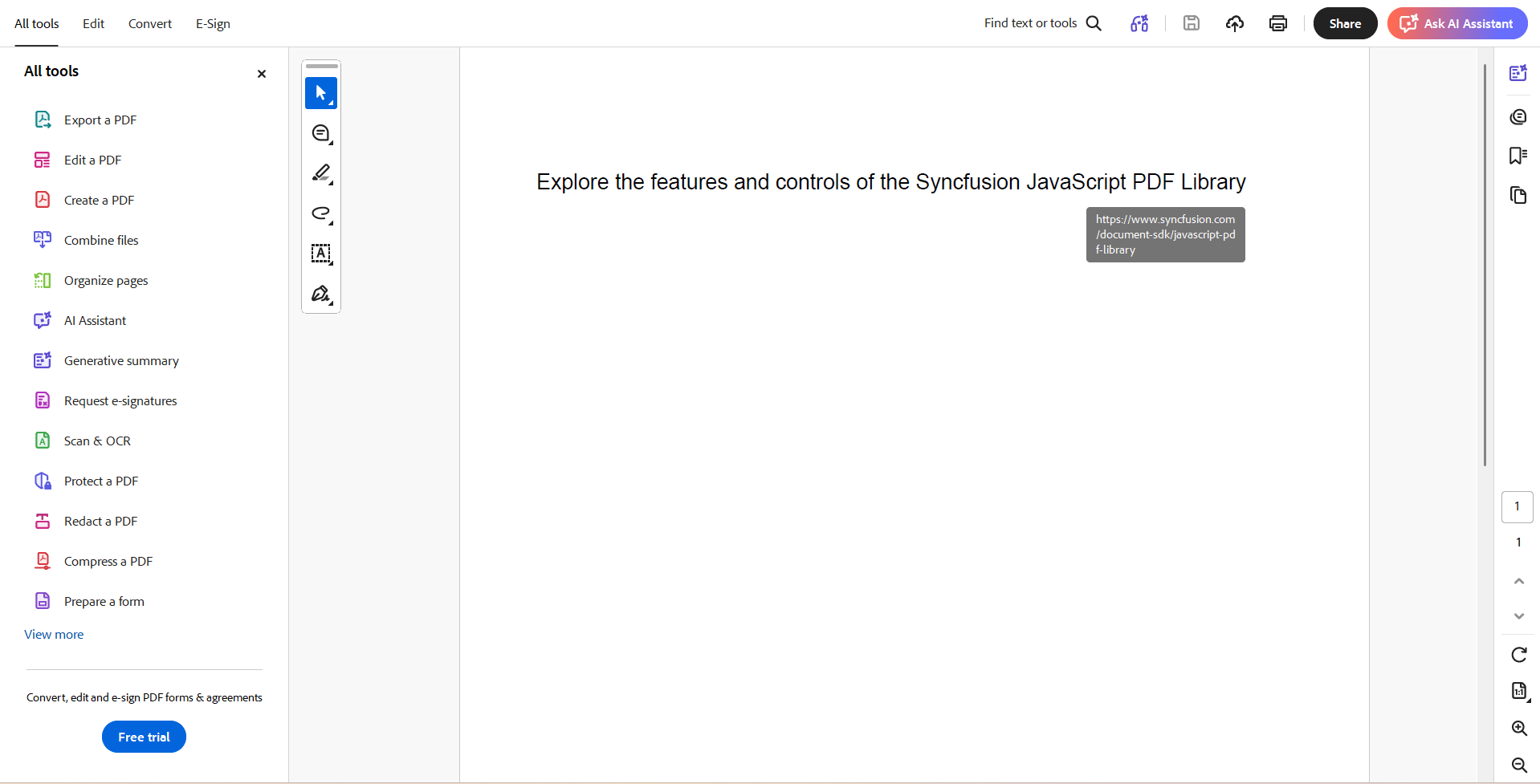
For step‑by‑step setup and advanced scenarios, refer to the Syncfusion JavaScript PDF Library documentation.
With this foundation in place, let’s focus on the best practices that prevent navigation issues before they reach users.
Practice 1: Choose the right hyperlink type for each navigation target
Not all PDF hyperlinks behave the same. Each link type maps to a specific navigation behavior, and using the wrong one can result in inconsistent or broken navigation across PDF viewers.
Common hyperlink types include:
- URI (Web) links
Used for external websites such as documentation, product pages, or support portals. - Internal document links (GoTo)
Navigate within the same PDF, ideal for tables of contents, section jumps, and cross‑references. - External file links (Remote GoTo)
Point to other PDFs or files. These should only be used when access to the target file is guaranteed.
For most documents, URI links and internal document navigation are sufficient. File-based links should be treated as a special case because they depend on file availability.
Here’s how you can do it in code:
// Document base64 string
var data = “JVBERi0xLjQNCiWDkvr……………”

// Load an existing PDF document
var document = new ej.pdf.PdfDocument(data);

// Access the first page
var page = document.getPage(0);

// Access the destination page
var page1 = document.getPage(1);

// Create a new URI annotation
var WebLinkAnnotation = new ej.pdf.PdfUriAnnotation({ x: 125, y: 235, width: 105, height: 15 }, 'https://www.syncfusion.com/');

// Create a new text web link annotation
var documentLinkAnnotation = new ej.pdf.PdfDocumentLinkAnnotation({ x: 90, y: 385, width: 330, height: 20 }, { r: 165, g: 200, b: 135 }, { r: 165, g: 42, b: 42 }, 1);

// Initializes a new instance of the `PdfDestination` class.
var destination = new ej.pdf.PdfDestination(
    page1,
    { x: 20, y: 700, width: 100, height: 50 },
    { zoom: 50, mode: ej.pdf.PdfDestinationMode.fitToPage }
);

// Sets the destination to the document link annotation.
documentLinkAnnotation.destination = destination;

// Add annotation to the page
page.annotations.add(WebLinkAnnotation);
page.annotations.add(documentLinkAnnotation);

// Save the document
document.save('output.pdf');

// Close the document
document.destroy();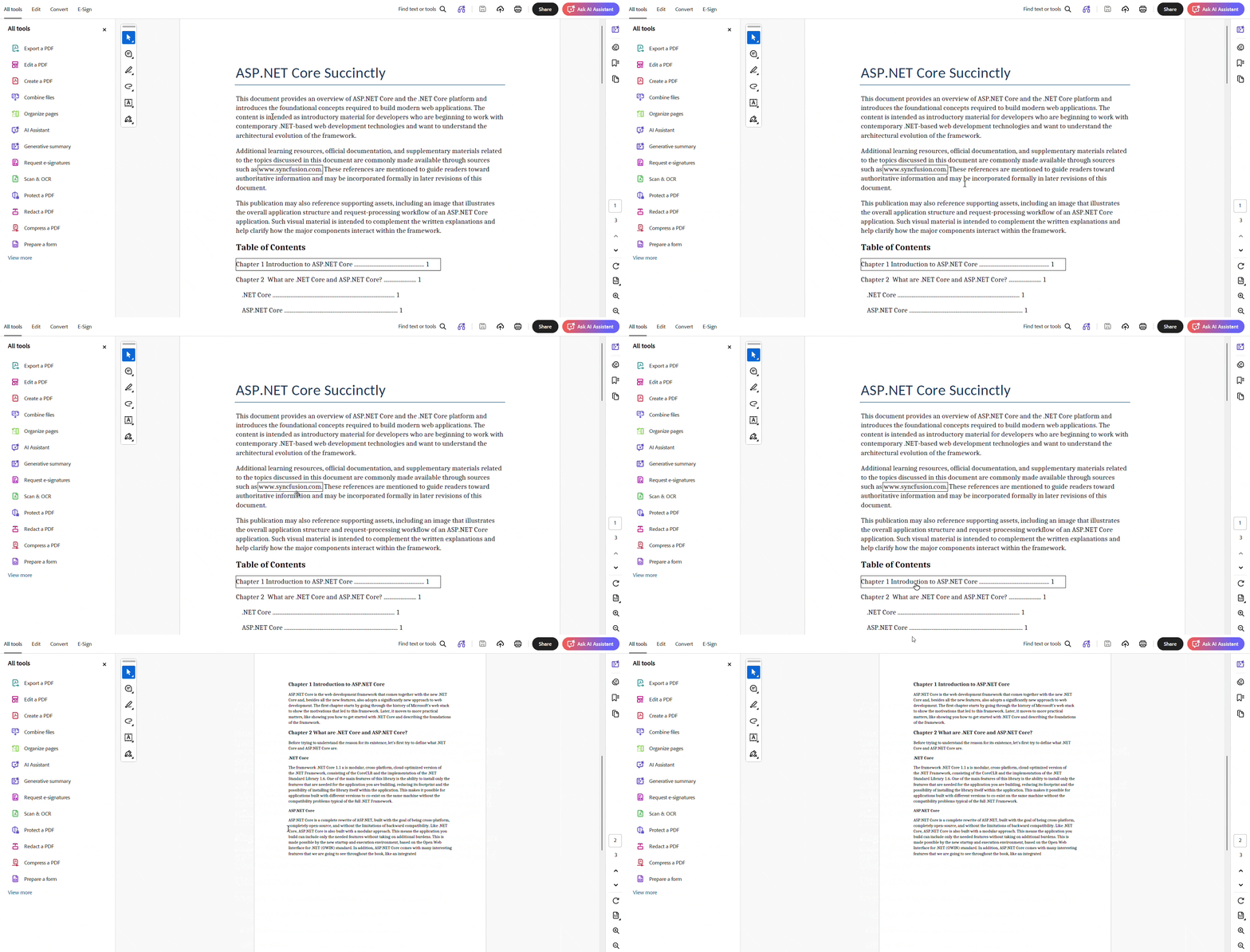
Selecting the correct hyperlink type establishes a solid navigation foundation before styling or validation is addressed.
Practice 2: Write clear, descriptive link text and apply consistent styling
Link text should communicate intent before the user clicks. Generic phrases like “click here” or “read more” provide no useful context, especially in long or technical documents.
Effective PDF hyperlink text should:
- Clearly describe the destination or action
(for example, “View API Reference” instead of “Learn more”) - Use familiar visual cues such as a distinct color or underline
- Maintain sufficient contrast against the background for readability
The code example below creates a styled link using descriptive text and a matching underline.
// Set font
var font = document.embedFont(ej.pdf.PdfFontFamily.helvetica, 14, ej.pdf.PdfFontStyle.regular);

// Set font with Underline
var font2 = document.embedFont(ej.pdf.PdfFontFamily.helvetica, 14, ej.pdf.PdfFontStyle.regular | ej.pdf.PdfFontStyle.underline);

// Draw text
graphics.drawString('Explore the features and controls of the', font, { x: 10, y: 40, width: 800, height: 200 }, new ej.pdf.PdfBrush({ r: 0, g: 0, b: 0 }));

//Draw link text
graphics.drawString('Syncfusion JavaScript PDF Library', font2, { x: 260, y: 40, width: 800, height: 200 }, new ej.pdf.PdfBrush({ r: 0, g: 0, b: 255 }));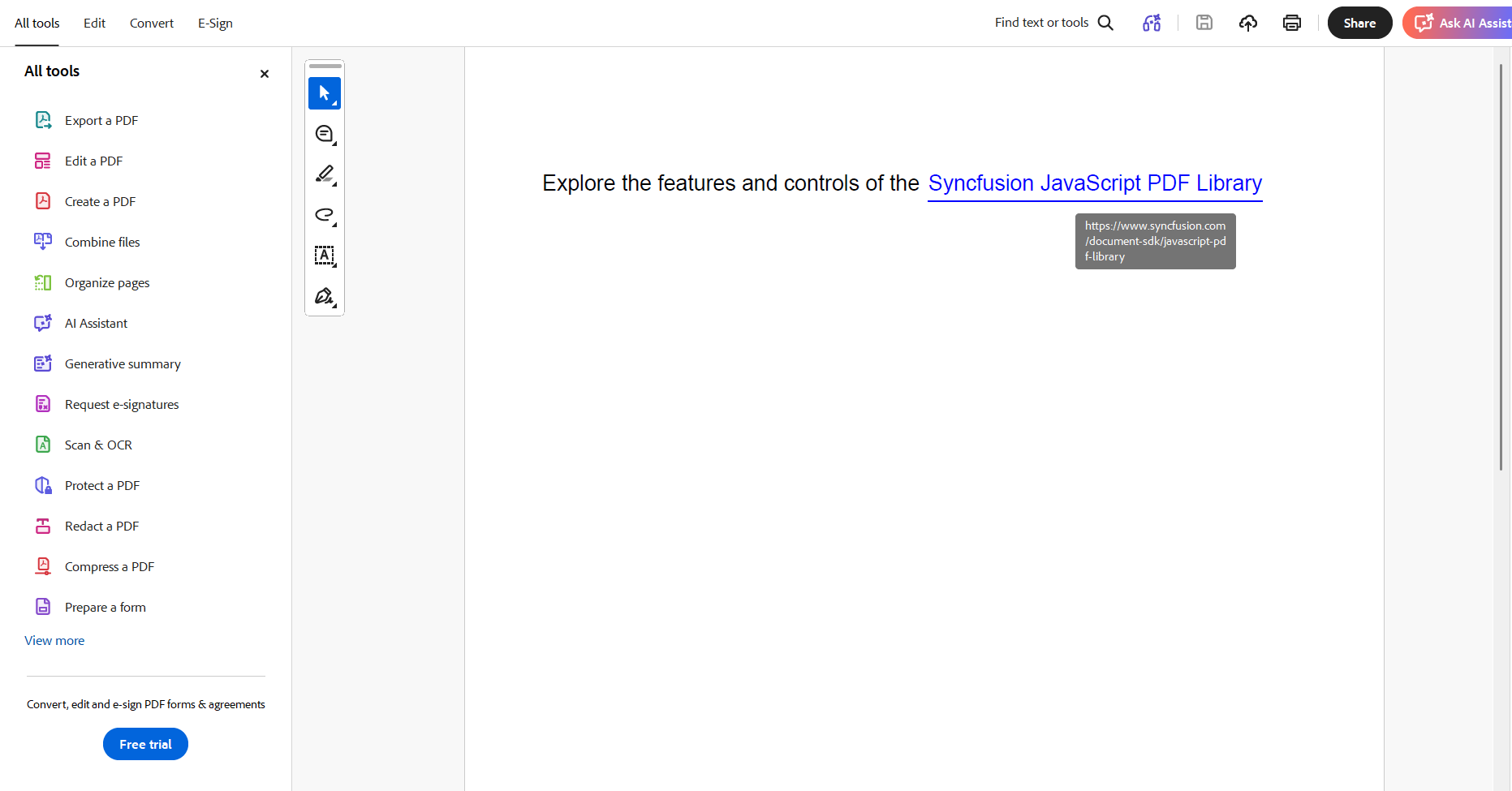
Clear labeling reduces navigation friction and improves document usability. The next practice addresses how to catch those issues at generation time.
Practice 3: Validate and maintain hyperlink integrity at generation time
A hyperlink may look correct visually but still fail if its destination is invalid. This commonly happens when links reference:
- Local or environment‑specific file paths
- Relative URLs that resolve inconsistently
- URLs that have changed since the content was drafted
To maintain reliable navigation:
- Prefer absolute HTTPS URLs for all external links
- Verify destinations programmatically or through automated checks before saving the PDF
- Re‑validate hyperlinks whenever referenced content or URLs change
Catching these problems during PDF generation prevents silent failures and eliminates the need for costly post‑delivery fixes.
Practice 4: Identify and remove broken or incorrect hyperlinks before delivery
As documents evolve, it’s easy for outdated link annotations to remain embedded in the PDF structure. Even a single broken link in a shared document can undermine user trust.
Final pre‑delivery cleanup helps ensure:
- All navigation paths remain functional
- The document feels consistent and polished
- Users never encounter dead ends
The example below shows how to locate and remove a hyperlink from an existing PDF page using its index.
// Access specific annotation from the PDF page using its index. Here we are accessing the 1st link
var link1 = page.annotations.at(0);

// Remove an annotation from the collection
if (link1 instanceof ej.pdf.PdfUriAnnotation) {
    page.annotations.remove(link1);
}
Looking for more control over hyperlink implementation with practical code examples? Refer to the hyperlink documentation and its APIs in the Syncfusion JavaScript PDF Library.
Frequently Asked Questions
Yes. URI links, internal document links, and file links can all be used together without interfering with each other.Can multiple hyperlink types coexist in the same PDF?
Yes. Hyperlinks can be applied to any defined rectangular region, including images or graphical elements. Annotation bounds determine the clickable area.Can hyperlinks be added without visible text?
Yes. Rendering the generated PDF in a browser‑based PDF viewer allows link behavior to be validated without opening an external application.Can hyperlink behavior be tested before distribution?
No. Hyperlinks add minimal metadata and typically do not impact file size or performance.Do hyperlinks affect file size or rendering performance?
Yes. Compression does not remove annotation data, so hyperlinks continue to function after compression.Are hyperlinks preserved after PDF compression?
Conclusion
Thank you for reading! Reliable PDF navigation results from deliberate choices made before the file leaves your environment. Together, these four practices form a single, cohesive workflow:
- Select the correct link type for each navigation scenario
- Use clear, descriptive link text with consistent styling
- Validate destinations during PDF generation
- Remove outdated or broken links before delivery
The Syncfusion JavaScript PDF Library supports the complete hyperlink lifecycle directly in the browser, allowing developers to implement these practices without additional tools or post‑processing.
See hyperlinks, annotations, and PDF generation working together in a live demo.
If you’re a Syncfusion user, you can download the setup from the license and downloads page. Otherwise, you can download a free 30-day trial.
You can also contact us through our support forum, support portal, or feedback portal for queries. We are always happy to assist you!


 No spam, just valuable updates.