 Marissa Keller Outten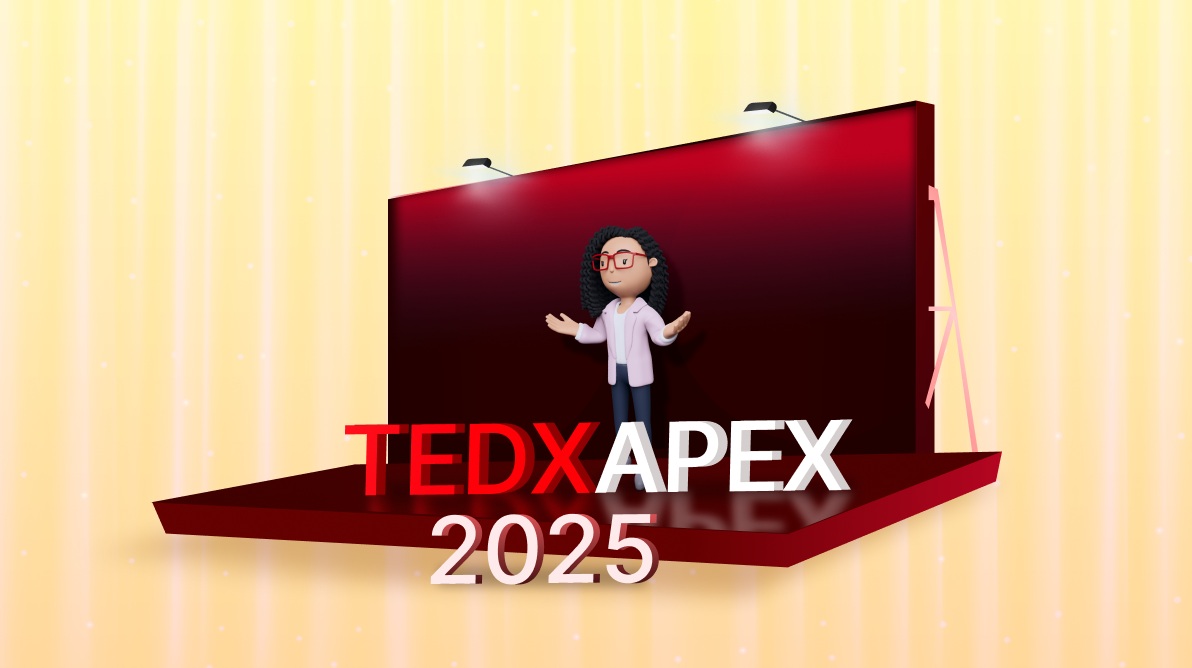
On a gray November afternoon at the SAS campus, just a few miles from the Syncfusion office, TEDxApex curator Eraina Ferguson welcomed us with a reminder that TED is “a place to learn, be human, and be empathetic.” Cary Mayor Jacques Gilbert, gold shoes flashing, joked that TEDxApex was indeed in the town of Cary, not Apex, and with that, we were off. What followed was a day of big ideas braided around one theme: in an age of accelerating technology, the work of being fully human, curious, kind, courageous, matters more than ever.
The brain builds what we practice
Julia Volkman opened with something both simple and radical: our brains are sculpted by repetition and interest. Children’s brains grow dense with connections; then, over time, they prune the clutter to strengthen the pathways that matter. That’s why one size doesn’t fit all in learning, and why interest is learning’s superpower. When we care, practice stops feeling like labor and becomes a loop of joyful repetition. Her challenge to educators, and to all of us: stop teaching against the brain and start designing for it. Project-based, student-led learning doesn’t just raise test scores; it likely shapes more resilient neural architecture.
Dr. Rebecca Troy later echoed this with dyslexia research and stories. Reading isn’t a switch you flip, it’s a network you build. With targeted training, both children and adults with dyslexia can literally rewire the reading brain. The point isn’t to force everyone into uniformity, but to unlock pathways so different kinds of minds can flourish.
Second chances, first principles
Hollan Steen offered a vulnerable counter-narrative: he once assumed people who’d been to prison were “trash,” until he went to prison himself at 19. There, he met intelligence, kindness, and remorse, alongside the harm. An entrepreneur eventually looked past his felonies and gave him a chance. Today, Hollan works in recovery and runs several companies. His request was simple and urgent: create safe spaces where people can say, “I need help.” One in four people wrestles with addiction. Culture can force them into the shadows, or we can leave the porch light on.
Reginald Patterson picked up this thread with a different mask: performative masculinity. Taught to “be tough,” he learned to armor up and disconnect. The cost? Fragile friendships, untreated pain, and statistics we seldom name: male suicide rates four times higher than women’s; men comprising the vast majority of the prison population. “True masculinity isn’t how hard you are; it’s how whole you are.” Reimagining manhood as emotional literacy isn’t just personal healing, it’s public health.
Difference as an advantage
Dayn Conrad, once the “gentle giant” towering over classmates, described the pivot from seeing his height difference as a defect to treating it as a design. When he was a teenager, he had the chance to study abroad in Chile. There he was once again the tallest person in every room, and the lesson crystallized: our differences are the very engines of our possibilities. Growth demands we risk discomfort, step onto unfamiliar stages, and let our awkwardness be the price of admission.
That same invitation to discomfort animated Stephanie Shabazz’s talk on embarrassment. The moment your cheeks burn isn’t proof you’re failing; it’s evidence you’re becoming. Exposure reveals our edges. Expansion demands that we cross them. Empathy grows when we realize everyone else is taking their own trembling steps, too. Meaning lingers long after embarrassment fades.
The war within, and the architecture around us
Former West Point instructor Andy Riise framed “mental fitness” as trainable, like physical conditioning. Picture a bridge: on one end, survival and crisis; on the other, thriving and optimal performance. His four questions, Where am I? Why am I there? What’s one thing to move me toward thriving? What’s one thing I can do to help you thrive? Create a rhythm of self-check and team care. Life, he reminded us, is a team sport.
Raghav Gupta, an AI scientist, showed why willpower alone isn’t enough against the attention economy. Social feeds are engineered to hijack our “scout” brain (novelty) and bypass our “planner” brain (goals). The fix isn’t self-blame; it’s architecture: batch your notifications, mute non-priority pings, move your phone out of the room. When the environment changes, the mind follows. Shift your daily dopamine from “I consumed” to “I created.”
Shasin “POSH” Sukund made the inner architecture personal. After a season of depression, he began training his inner dialogue the way you’d train a large language model: by controlling the input. He sent himself (and eventually thousands of teammates) a daily note of gratitude and positivity. Gratitude reshapes attention and mood. Feed your mind better data, and it will predict and create better days.
AI, kindness, and the measure of “good”
LD Chen, a former manufacturing executive turned stillness practitioner, told of recovering his health by standing still: “When the mud settles, truth appears.” He invited a rebalancing: instead of worshiping “smart,” prize “good.” AI is a mirror; it amplifies what we feed it. If we chase speed and scale without compassion, we’ll scale our worst habits. If we prioritize presence and kindness, we can steer AI toward the human good. Technology should serve us, not shape or replace us.
Candice Thompson, a therapist, widened the lens. After 2020, venture-backed platforms rushed into mental health with the familiar playbook: scalable, always on, friction-free. But therapy rests on different values: expert guidance, a trusted relationship, and time. Recording sessions to autogenerate notes breaks confidentiality; replacing human cadence with app cadence trades safety for convenience. By all means, let tech support care, but let clinicians, not marketers, design the boundaries and offer the patient empathetic care that they learned over many years of studying and clinical practice.
Stories, traps, and flow
Erik Sorenson talked about the “software” we run: childhood messages that become adult limits. A key message he had was this: the story that protects you can also imprison you. His three-step reset recognize the limiting story, test if it’s really true, and rewrite it, turns neuroplasticity into a life skill. “You’ll never rise higher than the limits of your beliefs” isn’t a scold; it’s an invitation to update the code.
Dayvisson Da Silva offered a companion map for careers. If you’re not growing but looping, if you’re productive but drained, if you’re shrinking to fit, those are red flags that you’re trapped. His “untrapped” framework (clarity, communication, visibility) moves you from success without growth to significance with motion. Flow is contagious; one person’s alignment gives others permission to evolve.
Eric Hamilton zoomed out to a future where AI handles the basics. If survival is solved, what’s left? Leveling up. Not in a gamer sense (though the analogy fits), but in a human one: measuring wealth not by what we own but by what we become. The goal line moves from earning to learning, from consumption to creation.
And Cooper Harrison closed with the oldest technology we have: love. Not the perfect images you see on social media, but a practiced state of coherence and care, attune, amplify, transmit. Love isn’t a bypass around pain; it’s how we hold ourselves and each other when pain arrives. In a culture that profits from our insecurity, becoming love is an act of civil resistance.
What I’m taking with me
- Design for the brain, not against it: Interest and repetition are rocket fuel for learning; different minds need different runways.
- Make room for whole humans: Second chances, softer masculinities, and trauma-informed care aren’t luxuries; they’re infrastructure.
- Build better environments, not just better intentions: From attention hygiene to workplace culture, architecture beats willpower.
- Let “good” steer “smart”: AI will magnify our inputs. Choose presence, boundaries, and kindness as defaults.
- Rewrite the story, then move: Update the beliefs that keep you trapped, communicate your direction, and step into visibility.
- Measure life by what you create: Shift your daily dopamine from scroll to craft, from consuming to contributing.
- Lead with love: Coherence is contagious. The world changes when our interactions do.
As the lights brightened and the hall buzzed, the theme that stuck with me was this: humanity isn’t a fixed noun, it’s a practice. We practice it when we stand still long enough for the mud to settle, when we risk embarrassment for something that matters, when we batch our notifications and pick up a pen, when we give someone (including ourselves) another chance. Technology will keep racing forward. Our task is to grow the capacities that make us most ourselves: Attention. Curiosity. Courage. Compassion. Love. In other words, timeless human skills, reimagined for today.



 No spam, just valuable updates.