
 Jegan R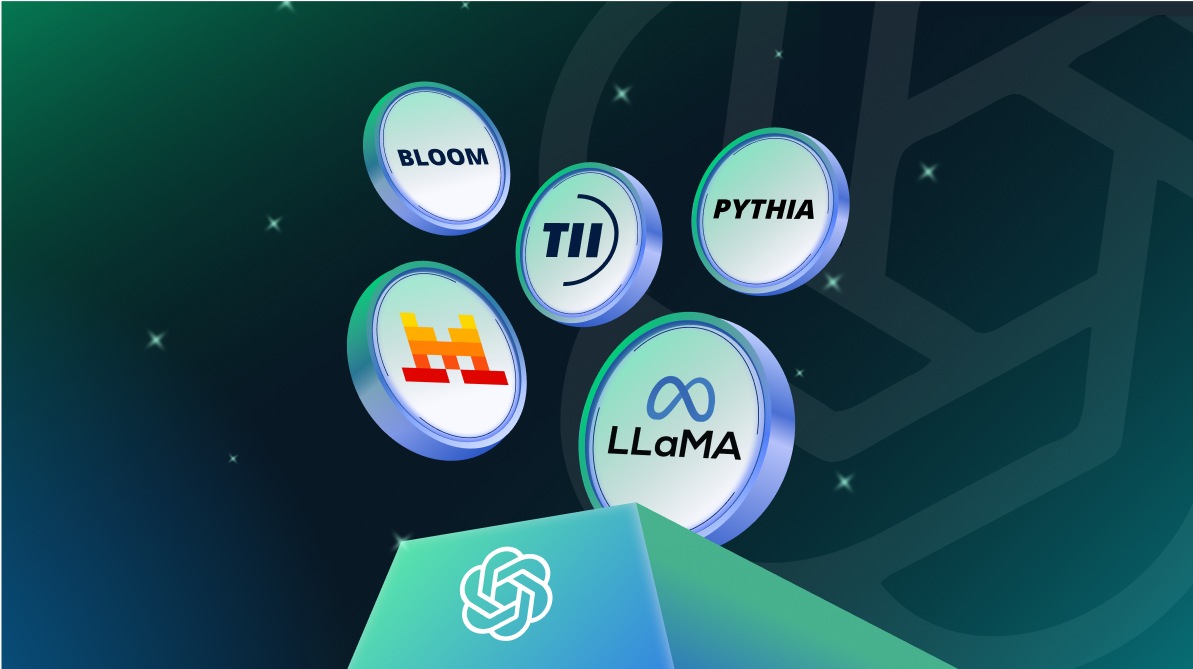
TL;DR: Commercial LLM APIs are costly and restrictive for developers. This guide highlights five open-source LLMs (Llama 3, Mistral, Falcon, Qwen3, DeepSeek-R1) that provide cost-effective, customizable ChatGPT alternatives for 2026 projects.
Tired of being locked into proprietary LLMs like ChatGPT? Developers are increasingly seeking open-source Large Language Models for greater freedom, flexibility, and cost savings. Let’s explore the top 5 open-source LLMs empowering you to build innovative AI apps with complete model control.
Why developers are moving beyond ChatGPT
The AI revolution has a cost problem. While ChatGPT dominates headlines, developers building production applications quickly hit walls: API rate limits, subscription costs that scale brutally, and zero control over the underlying model.
Enter open-source LLMs, the game-changers that give developers what they need: full control, cost predictability, and unlimited customization. These ChatGPT alternatives can run locally, be fine-tuned on your data, and integrated without the constraints of proprietary APIs.
Ready to break free from expensive AI APIs? Let us explore the five most powerful open-source LLMs for developers that are reshaping how we build AI applications in 2026.
1. Llama 3: Meta’s developer-first open-source powerhouse
Meta’s Llama 3 is not just another ChatGPT alternative. It is a developer’s dream. Available in 405B ,8B and 70B parameter variants, Llama 3 delivers GPT level performance while giving you complete control over deployment and customization.
Key developer benefits
- Performance: The 405B model now rivals GPT‑4 on many reasoning, math, and code benchmarks, while the 70B still outperforms GPT‑3.5.
- Cost-effective: No API fees after initial infrastructure investment.
- Customizable: Full fine-tuning capabilities for domain-specific applications.
- Local deployment: Run entirely on your infrastructure.
Commercial License that works
Unlike restrictive proprietary licenses, Llama 3 offers genuine commercial freedom. The updated license allows commercial use with minimal restrictions, making it perfect for startups and enterprises building AI-powered products.
Use cases
- Conversational AI: Creating chatbots and virtual assistants with strong contextual understanding.
- Content generation: Producing high-quality articles, marketing copy, and creative writing.
- Code assistance: Helping developers with code completion, debugging, and documentation.
- Knowledge-based applications: Powering question-answering systems with improved factual accuracy.
To know more about integration options for developers, refer to the official documentation.
The verdict? Llama 3 outperforms GPT-3.5 in reasoning and knowledge tasks, exactly what developers need for most apps.
2. Mistral AI: The efficiency champion among ChatGPT alternatives
French startup Mistral AI proves size isn’t everything. Their 7B parameter model delivers performance comparable to much larger competitors, making it the most efficient ChatGPT alternative for resource-conscious developers.
Why do developers love Mistral?
- Mistral3 family: Includes dense models (3B, 8B, 14B) and Large 3 MoE (675B total parameters, 41B active), all under Apache 0 license.
- Efficiency: Best performance-per-parameter ratio in the market.
- Multilingual: Exceptional European language support.
- Hardware-friendly: Runs smoothly on consumer GPUs.
- Active development: Rapid iteration and community support.
- Multimodal capabilities: Text, image, and structured data support for advanced apps.
Architecture innovation that matters
Mistral’s secret weapon is architectural optimization. Their attention mechanisms and training methodology achieve impressive results with fewer parameters, meaning:
- Lower deployment costs.
- Faster inference times.
- Reduced hardware requirements.
To know more about Mistral AI integration options for developers, refer to the official documentation.
3. Falcon: UAE’s contribution to open-source AI development
The Technology Innovation Institute’s Falcon models offer flexibility that proprietary APIs can’t match. With distinct sizes, developers can optimize their specific hardware and performance requirements.
Falcon model comparison
| Model | Parameters | Ideal use case | Hardware requirement | Recommended deployment |
| Falcon-H1 0.5B | 0.5B | Edge/mobile, low latency | Consumer GPU | Single GPU or edge |
| Falcon-H1 1.5B | 1.5B | Lightweight apps | Mid-tier GPU | Single GPU |
| Falcon-H1 7B | 7B | Development & moderate production | 48GB VRAM | Single GPU |
| Falcon-H1 34B | 34B | Enterprise long-context tasks | 140GB+ VRAM | Multi-GPU setup |
| Falcon 3 Series | 1B–10B | Multimodal generation & inference | Mid-tier GPU | Single GPU |
| Falcon Mamba 7B | 7B (SSM) | Efficient long-sequence generation | 24GB GPU | Single GPU |
| Falcon Arabic 7B | 7B | Arabic-native and bilingual applications | Standard GPU | Single GPU |
| Falcon 40B | 40B | Production-grade tasks | 48GB VRAM | Multi-GPU setup |
| Falcon 180B | 180B | Large-scale enterprise reasoning | 140GB+ VRAM | Distributed clusters |
These varying sizes allow developers to choose a model that fits their specific needs and computational resources.
Multilingual powerhouse for global applications
Falcon’s strength lies in its diverse, high-quality training data. The models excel at:
- Arabic-English bilingual applications.
- Scientific and technical content generation.
- Long-context understanding and coherence.
These strengths make Falcon a valuable tool for specialized applications.
4. Qwen3: The truly multilingual open-source LLM
Qwen3 is Alibaba’s next-generation open-source LLM built for developers who need flexibility, scale, and innovation. It’s designed to handle extended context windows, multilingual tasks, and excels in reasoning and tool usage, making it a strong choice for global applications.
What makes Qwen3 special?
- Model variety: Dense models from 0.6B to 32B parameters, plus Mixture-of-Experts (MoE) variants like Qwen3-235B-A22B (235B total, 22B active).
- Massive context windows: Up to 38K tokens, with Qwen3-Next pushing this to 256K–1M tokens for ultra-long documents.
- Global language support: Covers 119 languages and dialects, perfect for multilingual apps.
- Enhanced reasoning & coding: Improved benchmarks for logic-heavy and developer-focused tasks.
- Open source freedom: Fully open under Apache 2.0 license, no proprietary restrictions.
Use cases
- Enterprise-ready: Perfect for building AI assistants that scale across large organizations.
- Global reach: Supports 119 languages, making it ideal for multilingual SaaS platforms and real-time customer service.
- Handles complexity: Excels at long-context tasks like legal, financial, and technical document analysis.
- Research-friendly: Great for AI-driven analytics and advanced NLP studies.
Qwen3 empowers developers to build sophisticated, multilingual, and context-aware AI solutions without proprietary restrictions.
5. DeepSeek-R1: The reasoning and coding specialist
DeepSeek-R1 is an open-source LLM optimized for reasoning, coding, and multimodal tasks. It’s designed for developers who need precision in problem-solving and advanced AI capabilities.
DeepSeek-R1 is a reasoning-focused model trained using reinforcement learning to encourage chain-of-thought reasoning and self-reflection.
Key highlights
- Model variants: Offers distilled versions ranging from ~1.5B to 70B parameters (e.g., DeepSeek-R1-Distill-Qwen-32B).
- Performance: Achieves competitive results against proprietary reasoning models like OpenAI-o1 on public benchmarks.
- Open access: Releases code and weights for distilled models under permissive licenses (often MIT), with fine-tuning and deployment support.
- Licensing notes: Availability depends on each backbone’s license; full training datasets are not released.
Apps for high-performance AI development
DeepSeek-R1 powers a wide range of advanced apps:
- Complex reasoning engines.
- Code generation and debugging tools.
- AI-driven data analysis and modeling.
- Multimodal apps combining text, images, and structured data.
- Research in AI interpretability and safety.
Why developers love DeepSeek-R1
- Exceptional performance in reasoning benchmarks
- Strong coding capabilities for software development tasks
- Open-weight distribution for full transparency and customization
- Scalable architecture for enterprise and research environments
Use cases
- AI-powered coding assistants: DeepSeek-R1 accelerates development with accurate code completion, refactoring, test generation, and tool-integrated workflows.
- Data-intensive apps: DeepSeek-R1 powers advanced analytics, feature engineering, modeling, and real-time decision support at scale.
- Research platforms: DeepSeek-R1 enables studies of chain-of-thought reasoning, self-reflection, interpretability, and rigorous benchmark evaluation.
- Enterprise AI solutions: DeepSeek-R1 enables robust, scalable, and secure systems with governance, observability, compliance, and high performance in production.
DeepSeek-R1 sets a new standard for open-source models focused on reasoning and technical problem-solving.
Practical implementation guide for open-source LLMs
Hardware requirements and cost analysis
Deploying open-source LLMs presents hardware challenges, as these models can be computationally intensive. However, several optimization techniques can make these models more accessible:
- Quantization: Reducing precision from FP32 (32-bit floating point) to INT8 (8-bit integer) or INT4 can dramatically decrease memory requirements with minimal performance impact. This allows for running larger models on less powerful hardware.
- Model pruning: Removing less important weights to create smaller, faster models. This technique aims to reduce redundancy in the model.
- Knowledge distillation: Training smaller models to mimic the behavior of larger ones. This technique enables a smaller, efficient model to inherit the capabilities of a larger, high-performing one.
- Efficient attention mechanisms: Using optimized implementations like FlashAttention. Attention mechanisms are a core component of transformers, and optimizing them can significantly improve performance.
For local deployment, consumer GPUs with 24GB+ VRAM can run 7B parameter models effectively, while larger models may require multi-GPU setups or cloud resources. For the largest models, distributed computing across multiple machines is often necessary. The specific hardware requirements depend heavily on the model size and the desired performance.
Deployment options
Developers have several options for deploying open-source LLMs, each with its own trade-offs:
| Approach | Pros | Cons | Best For |
| Local GPU server | Full control, no API costs | High upfront investment | High-volume applications |
| Cloud GPU instances | Scalable, pay-as-you-go | Ongoing costs, less control | Variable workloads |
| Managed services | Easy setup, maintenance-free | Limited customization | Quick prototypes |
| Edge deployment | Low latency, high privacy | Limited model sizes | Mobile/IoT applications |
The choice of deployment strategy depends on factors like cost, scalability requirements, latency constraints, and data privacy needs.
Fine-tuning strategies
One of the significant benefits of open-source LLMs is the ability to fine-tune them for specific use cases:
- Full fine-tuning: Updating all model parameters provides the best performance but requires significant computational resources.
- Parameter-efficient fine-tuning (PEFT): Methods like LoRA (Low-Rank Adaptation) that update only a small subset of parameters.
- Instruction tuning: Fine-tuning models to follow specific instruction formats.
- RLHF (Reinforcement Learning from Human Feedback): Aligning models with human preferences.
Privacy and data security considerations
When deploying open-source LLMs:
- Data handling: Be transparent about how user inputs are stored and used.
- Local processing: Consider local deployment for sensitive applications to avoid data transmission.
- Fine-tuning data: Ensure training data for fine-tuning complies with privacy regulations.
- Model security: Protect against prompt injection and other attacks that could compromise the system.
Conclusion: Open source gives you the steering wheel
Thanks for reading! Open-source LLMs are now production‑ready alternatives to proprietary APIs, offering control, cost‑efficiency, and customization. Expect more efficiency, domain‑specialized variants, better tooling, and wider adoption through 2026. Pick the model that fits your use case, budget, and hardware, and iterate fast.
The future of AI development is increasingly open, and these five models represent just the beginning of what promises to be a vibrant and innovative ecosystem.
Unlock the power of AI on your terms! Open-source LLMs like Llama 3, Mistral, Falcon, Qwen3, and DeepSeek-R1 offer unparalleled customization and cost-effectiveness. Dive into the world of open AI, experiment with these models, and share your experiences in the comments below!
Ready to build the next AI-powered innovation? Explore Syncfusion’s complete AI-ready toolkit featuring prebuilt AI-powered UI components, seamless AI integrations, on-demand support, and an AI-driven code editor, empowering you to build smarter, modern apps faster. Start your free trial today!
You can also contact us through our support forum, support portal, or feedback portal. We are always happy to help you!



 No spam, just valuable updates.