 Prabhavathi Kannan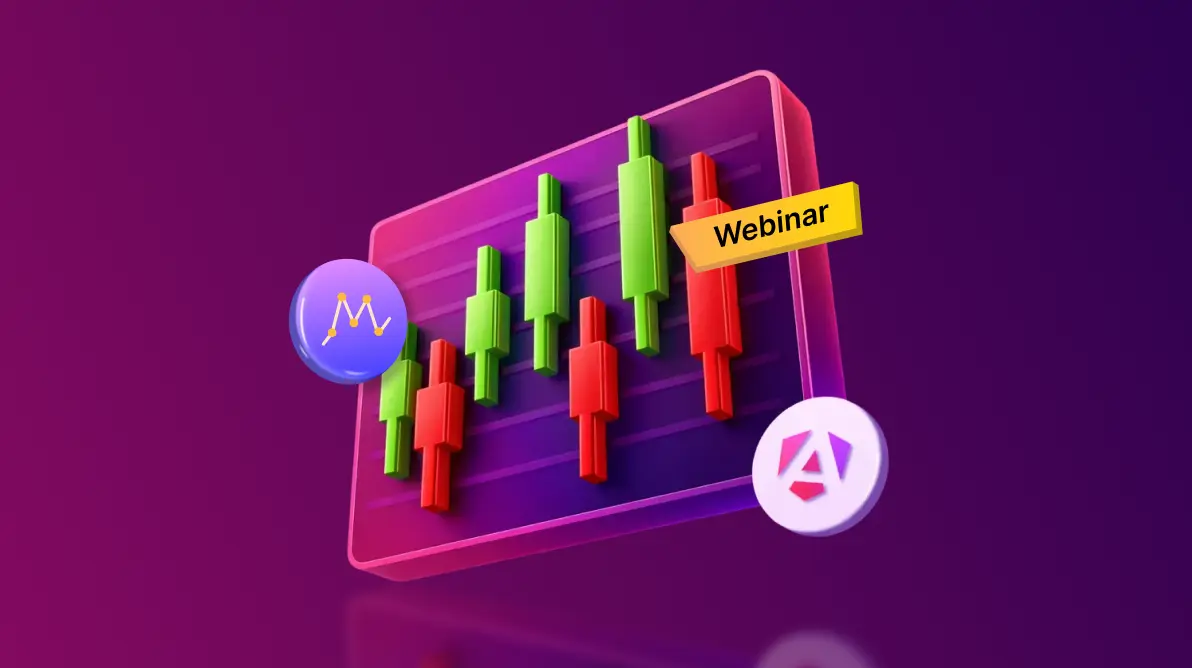
Modern applications demand fast, responsive, and continuously updating data visuals, especially in analytics, finance, monitoring, and dashboards. This webinar explored how Angular developers can build powerful real-time charts using the Syncfusion® Angular Charts component with fully interactive experiences and smooth live updates.
If you missed the webinar or would like to review it, we have posted the recording to our YouTube channel and embedded it below.
Why real-time data visualization matters
Real-time visuals turn fast-changing data into actionable insight. Whether monitoring markets, IoT signals, or application metrics, users need immediate feedback and intuitive interactions. Angular developers can pair robust state management with high-performance charts to deliver responsive dashboards that communicate clearly and update smoothly.
The Syncfusion Angular Charts Component
Syncfusion Angular Charts is a high-performance charting suite with extensive series types, live updates, crosshairs, tooltips, annotations, legends, and responsive layouts. It integrates cleanly with Angular’s change detection, supports theming, and offers the interaction hooks needed for editing points, streaming data, and coordinating multiple charts within a dashboard.
Building a live-updating candlestick stock chart
During the live demo, the webinar covered how to build a candlestick stock chart that updated every second using a safe, controlled interval. It demonstrated streaming live data, applying theme-based styling, enabling tooltips and crosshairs for interactive analysis, and ensuring that continuous updates remained smooth and stable over time. You can see this in action in the Live Stock Data Charts Demo.
Creating an interactive line chart with click-driven updates
The webinar demonstrated how to build an interactive line chart where users could click to add new data points and delete them by selecting existing markers. The session covered translating click coordinates into axis values, keeping the data series sorted for consistent rendering, and animating updates to ensure smooth visual transitions. A working example is available in the Click Add Point Chart Demo.
Additional real-time patterns
Beyond the main demos, the webinar also highlighted several useful real-time charting techniques using existing online samples:
- Continuous spline updates: The session demonstrated smooth, rolling spline curves for live analytics, showing how changing trends can be visualized clearly. This is illustrated in the Updated Spline Demo.
- Dynamic data source refreshing: Online samples were used to illustrate how entire data sets can be refreshed dynamically, ideal for dashboards that update automatically. See the Update Data Source Demo.
- Automatic runtime sorting: Viewers also saw examples of live data that reorders itself predictably through runtime sorting, making it well‑suited for real-time leaderboards. Check the Live Data Sorting Demo.
Time stamps
[00:00] Introduction and session overview
[01:06] What real-time charts are and why they matter
[03:08] Development prerequisites and project setup
[03:38] Creating a real-time candlestick stock chart
[05:20] Configuring chart layout and series binding
[08:18] Generating simulated candlestick stock data
[09:46] Running the live chart and understanding candlestick behavior
[10:28] Adding streaming updates to the chart
[11:07] Crosshair configuration and chart interaction
[12:22] Implementing interval-based live updates
[14:10] Applying themes and visual styling
[16:11] Live candlestick updates in action
[16:51] Second demo: Interactive click-to-add data points
[18:22] Understanding the line chart structure
[20:23] Implementing click events to add or remove data points
[21:56] Live demo of dynamic point insertion and removal
[22:45] Real-time spline updates for analytics
[23:23] Dynamic data source refresh example
[23:41] Runtime sorting for live ranking charts
Q&A
Q: Is there support for bow tie and Sankey diagrams?
A: We already have Sankey Diagrams available in the Blazor platform, showcased in the Blazor Sankey Component page and the Blazor Sankey Demo. Currently, the Sankey Diagram is not available in the Angular platform. We plan to deliver the Sankey Diagram for the Angular, React, and Vue platforms in the Syncfusion Volume 1 release at the end of March 2026. The Sankey Diagram will be available in the Syncfusion Chart by the end of March 2026.
The Bow Tie Diagram is currently not available in Syncfusion. If you need the Bow Tie Diagram, please contact us through a support ticket. We will include support for the Bow Tie Diagram in an upcoming release.
Q: Am currently a Student at Maseno University, taking applied statistics with it. Can I get an online attachment from you?
Q: For dynamic charts, which one is better, Angular or React?
A: Both Angular and React handle dynamic charts effectively, but each offers unique advantages depending on your project’s architecture, performance needs, and development style.
React is best for highly dynamic, performance‑critical Charts
Key advantages
- Faster UI updates due to the Virtual DOM and one‑way data flow.
- Fine-grained performance control through hooks like
useState,useMemo, anduseCallback. - Lightweight framework leading to smaller bundle sizes.
- Optimized re-rendering using
React.memoand selective component updates.
Use case
React is typically preferred for dashboards or applications where chart data updates very frequently.
Angular is best for enterprise-grade applications
Key advantages
- Built-in change detection reduces the need for manual optimization.
- Deep RxJS integration, making real-time data streams easy to manage.
- Two-way data binding, helpful for complex form-driven scenarios involving charts.
- Complete framework out of the box—routing, DI, HTTP, and more.
Considerations
- Zone.js overhead can slow performance with very frequent UI updates.
- More boilerplate compared to React.
- Change detection may trigger unnecessary re-renders unless carefully optimized.
Use case
Angular is often chosen for large-scale, team-driven projects requiring strict structure and long-term maintainability.
Recommendation
Choose React if:
- You have high-frequency updates (live dashboards, streaming charts)
- You prefer smaller bundles and faster rendering.
- Your project is small to medium-sized.
- You want more flexibility and less boilerplate.
Choose Angular if:
- You’re building a large enterprise application.
- Your team prefers strong architecture and enforced patterns.
- You expect moderate-frequency chart updates.
- You rely heavily on RxJS or complex form interactions.
Syncfusion Chart perspective:
Both Angular and React integrations are well-supported. The decision depends more on your team’s skill set, application complexity, and update frequency than on Syncfusion’s charting capabilities.
Q: Is there anything available to collect data directly from IoT devices?
A: No. Syncfusion EJ2 Chart components cannot directly collect or communicate with IoT devices.
They are strictly data visualization components, meaning they only render whatever data you provide to them.
They do not include:
- IoT protocol support (MQTT, AMQP, CoAP, BLE, etc.).
- Direct device communication.
- Telemetry ingestion.
- Real‑time device connectivity.
Q: How to use EJ2 Charts with IoT data?
A: To visualize IoT data in EJ2 Charts, you must first retrieve the data through your own application logic and then supply it to the chart via its dataSource property.
Below is the proper workflow.
- Gather IoT data using your Angular services
You can collect IoT telemetry through any of these methods:
- Using HttpClient (for periodic data fetching)
- Call REST APIs that expose device telemetry.
- Ideal for slower or batch-style updates.
- Using WebSocket or SignalR (for real-time streaming)
- Receive continuous live data pushed from your server.
- Perfect for dashboards with live charts.
- Using MQTT or other IoT protocols via Angular services
- Connect to brokers like Mosquitto, AWS IoT Core, or Azure IoT Hub.
- Use MQTT client libraries inside your service.
- Stream messages to the UI as they arrive.
- Using HttpClient (for periodic data fetching)
Note: Browsers cannot speak IoT protocols natively, so your service/library acts as a bridge.
- Feed the Data into EJ2 Charts
Once your Angular service receives device data, you simply pass it to the chart:
- Bind the latest data array to the chart’s dataSource.
- Update the array whenever new telemetry arrives.
- The chart automatically re-renders with the latest values.
Q: Is it possible to enable AI with charts?
A: Yes, Syncfusion has been integrating AI capabilities into its component suite. Details are available on the Syncfusion AI Overview page.
Here are the key points:
AI features in Syncfusion
- Smart Paste AI: Available across various Syncfusion components to enhance and automate intelligent data entry.
- AI AssistView: A dedicated component for building AI‑powered conversational interfaces inside applications.
- Predictive analytics: AI can be integrated to perform data forecasting, anomaly detection, and trend analysis within charts.
Using AI with Syncfusion Charts
You can integrate AI capabilities with Syncfusion charts by:
- Custom AI integration
Connect your charts to AI services such as Azure AI, OpenAI, etc., for:
- Predictive data analysis.
- Anomaly detection.
- Automated insight generation.
- Natural-language queries against chart data.
- AI-driven data processing
Use AI models to preprocess and enhance raw data before displaying it in Syncfusion charts.

Takeaways
By the end of this session, attendees gained a practical understanding of how to build live, data-driven charts in Angular using Syncfusion’s high-performance charting components. From candlestick streaming and interactive editing to real-time sorting and updates, the webinar delivered practical techniques for building responsive dashboards and analytics applications with minimal code and maximum flexibility.

 No spam, just valuable updates.