
SOLID Principles Succinctly®

CHAPTER 3
Before Starting SOLID
SOLID is a set of design principles, and these principles help a programmer write better code. Table 3 shows what the acronym SOLID stands for.
Table 3: SOLID at a Glance
SOLID | |
S for SRP | Single Responsibility Principle |
O for OCP | Open-Closed Principle |
L for LSP | Liskov Substitution Principle |
I for ISP | Interface Segregation Principle |
D for DIP | Dependency Inversion Principle |
Whenever I address SOLID, some people find it confusing, but that’s okay—at first the principles can indeed be frustrating. Table 4 depicts the most commonly confusing aspects of the principles.
Table 4: Confusing Aspects of SOLID
Confusing Aspects of SOLID | |
Design patterns | Design principles |
Object-oriented programming | Design principles |
Design patterns vs. design principles
In particular, people get confused between design patterns and SOLID principles. Table 5 addresses the most confusing aspects of this work.
Table 5: Design Patterns vs. Design Principles
Design patterns | Design principles |
|---|---|
Are solutions to design problems (we are in the software world, so we’ll consider any software problem). | Are guidelines that tell us how to go with a specific design pattern. |
Are related to the implementation of the actual problem. | Can be applied anywhere, regardless of the specific context, issue, or problem. |
Are high-level concerns while working with solutions to any problem. | Are building blocks and used with patterns to achieve goals or to solve problems. |
Example: Think about a strategy pattern and you are implementing or following principle (check the right-side column of this table). | Example: In the case of a strategy design pattern, we use SOLID as follows—
|
Why coding style matters
I remember in the old days, when I was learning computer programming, I found it difficult to grasp data structure, algorithms, artificial intelligence, computer architecture, and plenty more. In those days, I didn’t take much care with my coding styles. I didn’t worry about what kind of messages I was writing to show user or what kind of messy code I was writing. I hated the tedious work of checking my code with perfect check-in messages.
As I’ve mentioned, I later came to understand how important styles are in coding. In fact, if you are not using any IDE such as Visual Studio, it’s a good idea to create your own coding styles or get a coding style guideline from your senior if you’re working on a team.
While I was doing code review, I could always identify the developer because all developers have their own unique styles of coding.
Note: For C# coders, refer to: https://msdn.microsoft.com/en-us/library/ff926074.aspx.
Object-Oriented Analysis and Design (OOAD)
OOAD is a well-known and popular technical approach to designing and analyzing an application system with the use of object orientation and the modeling of the development life cycle. Let’s look at a pictorial view of OOAD.
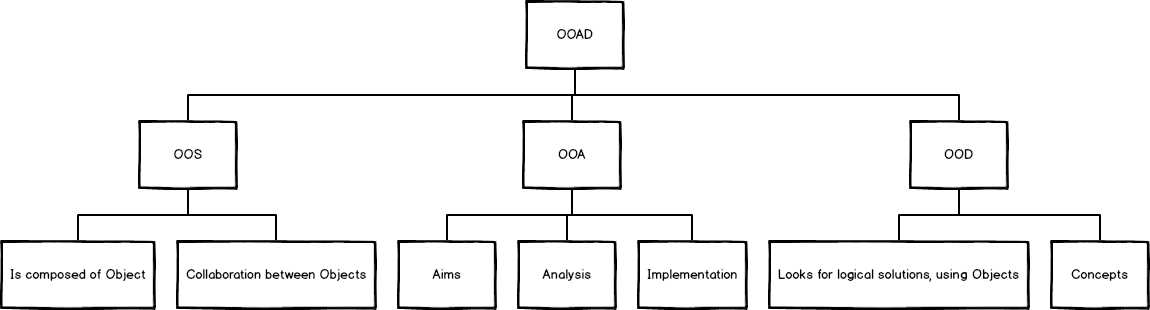
Figure 4: OOAD at a Glance
Note: We are not going into the details of OOAD.
Principles of Object-Oriented Design (OOD)
Object-oriented design principles are not only principles to design with, they are also roadmaps to creating well-mannered design. In the coming chapter, we will learn about SOLID in detail, but for now let’s look at an overview of all 11 principles of OOD in the following table.
Table 6: Principles of OOD
SOLID at a Glance—Referring to Class Design | |
S for SRP | Single Responsibility Principle |
O for OCP | Open-Closed Principle |
L for LSP | Liskov Substitution Principle |
I for ISP | Interface Segregation Principle |
D for DIP | Dependency Inversion Principle |
Cohesion at a Glance—Referring to Packages and Namespaces | |
R for REP | The Release Reuse Equivalency Principle |
C for CCP | The Common Closure Principle |
C for CRP | The Common Reuse Principle |
Coupling at a Glance—Referring to Packages and Namespaces | |
A for ADP | The Acyclic Dependencies Principle |
S for SDP | The Stable Dependencies Principle |
S for SAP | The Stable Abstractions Principle |
The following figure shows another way of understanding the same ideas.
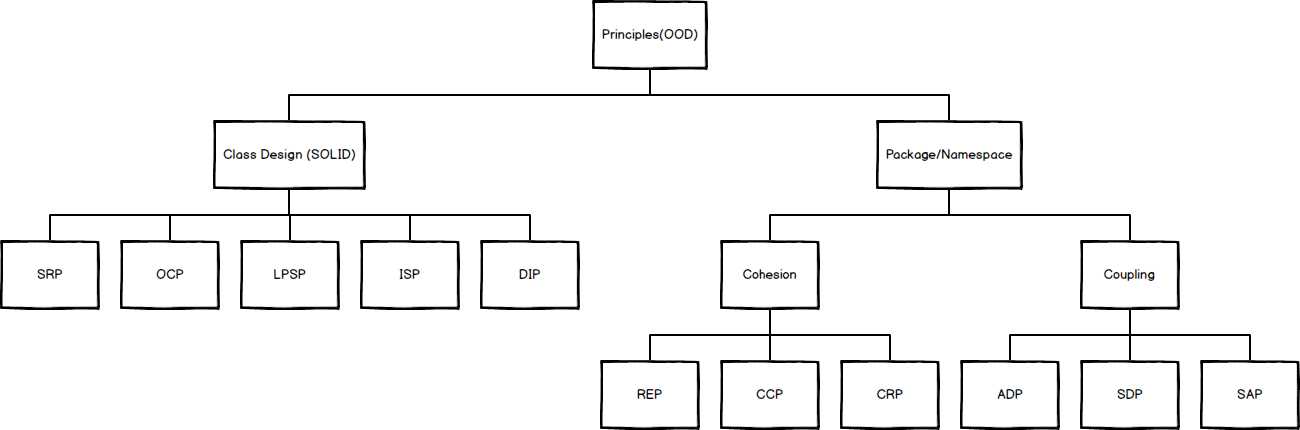
Figure 5: Principles of OOD
We are not going to discuss each and every principle of OOD, but we will go over the last two parts as described by Robert C. Martin before we move forward.
Note: Refer to: http://butunclebob.com/ArticleS.UncleBob.PrinciplesOfOod.
Principles of package and namespace cohesion
While it’s beyond the scope of this e-book to go into great detail here, the principles of cohesion are summarized in Table 5.
Table 7: Principles of Cohesion
The Release Reuse Equivalency Principle | The granule of reuse is the same as the granule of release. Only components that are released through a tracking system can be effectively reused. |
The Common Closure Principle | Classes that change together, belong together. |
The Common Reuse Principle | Classes that aren't reused together should not be grouped together. |
Principles of package and namespace coupling
Again, we won’t go into great detail here, but the principles of package and namespace coupling are summarized in the following table.
Table 8: Principles of Coupling
The Acyclic Dependencies Principle | The dependency structure for released components must be a directed, acyclic graph. There can be no cycles. |
The Stable Dependencies Principle | Dependencies between released categories must run in the direction of stability. The dependee must be more stable than the depender. |
The Stable Abstractions Principle | The more stable a class category is, the more it must consist of abstract classes. A completely stable category should consist of nothing but abstract classes. |
OOP and SOLID
OOP provides a way to write and polish our programs into better shape. These are basic points that guide us in writing a good program.
For great object-oriented designs, we need to think beyond the basics, and SOLID principles provide us a way to achieve great design. Yes, there are certain design patterns that guide us in similar ways, but SOLID exists before these patterns.
So, what is SOLID? We have seen the 11 principles of OOD—those principles are the backbone of our development, design, and analysis of applications or systems. Now, let’s briefly discuss each of the SOLID principles.
SOLID principles at a glance
SOLID principles are neither laws nor rules—they are principles intended to help us to write neat code. By following SOLID principles, our code can be easily extended and maintained.
Single Responsibility Principle
A class should have only one responsibility. Let’s say our class is responsible for saving data. That means it should not also be responsible for retrieving data or any other tasks.
Open-Closed Principle
Once a class has been written, it should not allow anyone to make changes. No one should be able to go back and amend the class code in order to implement new functionalities.
Liskov Substitution Principle
A dependent object should be able to use any object of type parent object.
Interface Segregation Principle
A smaller interface is recommended. If an interface has one method, there will be only one place to change if we need to change the code. However, in the case of interfaces with more methods, there might be more reasons for change.
Dependency Inversion Principle
Put simply, this addresses loose coupling. With the help of DIP, we can write code that does not depend upon concrete classes.


- 1800+ high-performance UI components.
- Includes popular controls such as Grid, Chart, Scheduler, and more.
- 24x5 unlimited support by developers.