
Business Process Flow Mapping Succinctly®

CHAPTER 4
Business Challenges and Risks
Every company experiences similar challenges and risks, just to varying degrees. These challenges and risks are often the reasons for project problems later during the development phase when program managers, software developers, product specialists, and designers create solutions to close business process gaps, which include:
- Alignment of project timeline and goals among executives, managers, and staff.
- Change and re-prioritization.
- Budget.
- Industry compliance.
- Change management.
- Performance management.
Business challenges and risks should be reviewed in order to prevent the development team from incurring changes that will affect the time and cost of the project.
Company alignment and goals
A very common experience, particularly when meetings do not occur or stakeholders are not present, is that the company’s goals change without the project team being notified. Therefore, the goals of the company are no longer aligned with the project.
Although the project team may be engaged and working hard on their project, if communication with company stakeholders does not occur, then the company may forget that the project is underway.
In addition, if a stakeholder does not attend meetings or read communications from the project team, then they become oblivious to the activities that occur and will forget about the project in terms of alignment with the company.
In the best-case scenario, the project can be repurposed and still be used to accomplish the company’s new goals. However, sometimes goal changes can cause projects to be canceled due to funds or the need to focus on other projects.
Even worse is when the goals change, but the functional project team is not aware of the change. In this case, the project continues until the executive team realizes that the project is still in process. The project is then either canceled partially though development, or the company allocates additional time, resources, and money for it to be reworked.
Change and re-prioritizations
Various changes cause development projects to be re-prioritized. Some of these include:
- Department reorganization
- Role changes
- Personnel changes
- Changes in business strategy
If a department is reorganized, the process steps and tasks could fall within different department responsibilities. New department formation requires staff within the new department to become familiar with their new roles; their priority is now to learn how to complete their jobs rather than focus on the project. This delay can cause the project to take longer to define and execute.
Similar to a department reorganization, if roles are changed, the employees need to refamiliarize themselves with their job duties as a first priority. Even when employees have the best intentions to complete their work for the project, if any changes to their roles or responsibilities occur, then often their work is re-prioritized to the point that the project becomes deprioritized.
When personnel changes occur, such as employees leaving the company, even if solid documentation exists, there is often a loss of knowledge of their experience and process changes, which can cause any lessons learned to be overlooked.
If the company’s business strategy changes, even if there is transparent communication from senior executives, the departments will struggle with the way they used to do things and how they think they should do their work to align with the new strategy. This can cause employees not to understand how existing projects fit into the new strategy, as well as believe that new projects that are aligned with the new strategy make more sense. Therefore, existing projects become deprioritized as employees are eager to keep up with the new company direction.
Budget
The project team can spend time designing the most efficient and effective ideal future state, but if the company decides that the benefit of that process does not outweigh the associated costs, then the project team may be restricted to only a phase or single iteration of their intentions. Sometimes the benefit does outweigh the cost, but either the project team is unable to illustrate that to the company, or the company simply cannot spare the funds from its budget.
Without regular oversight and management, development time quickly becomes costly. If development time is used without oversight, it can exceed the company’s budget. Without a clear picture of what has been completed and which parts of the project are remaining, the project could be halted.
Additionally, if the company has a different business opportunity and decides it needs to spend funds elsewhere, it may halt or decrease money allocated to the project.
In addition to development and resource time, the project team may need to purchase tools for their new system to maximize efficiency. These could be tools for communication, chat management, web plugins, or other add-ons.
Technology and systems can be costly, so the choice to invest in technology to support a project would need to be approved through the company’s appropriate channels. Any technology that is needed to support the project should be considered and disclosed at the beginning of the project with the stakeholders.
If these tools are not outlined in the beginning of the project, it could cause budget problems further down the line. An important tip is to lay out the proposed budget for the project in the beginning so that the team is aligned on expectations. To prevent budget overrun, the budget should have regular oversight as part of the project plan and be included in any project updates.
Industry compliance
While there are common ethical and process standards for business, different industries have their own compliance standards. For example, a toy company might need to meet the guidelines for a Children’s Product Certificate, an aircraft designer might need to comply with the Federal Aviation Administration program, and a credit card processor might need to comply with the Payment Card Industry Data Security Standard. Members of the project team need to check with their internal compliance team to ensure that the future ideal state and the methods used in development will meet industry compliance standards.
A process map may appear to be in compliance to members of the project team, not raising any red flags, but without a review from a member of the company who is experienced in industry compliance, the results could be disastrous. Even if the process map appears to comply, the development team could use a technical method to solve a certain issue that results in compliance violation.
Someone who understands industry compliance, and understands the possible risks involved by developing the project, needs to be on the project team initially as a stakeholder to avoid any re-work.
Skill
Just like each person in finance, operations, and customer service has their own special skills, so do those in development and project management. If the correct people who have the desired skillsets are not involved in the project, then the project team has opened itself up to risk. The project could be either completed inefficiently or simply not completed.
Ideally, each person in the company has the skills necessary for their role (and if not, then that is more of a hiring problem than a project problem!). A project should consist of a mix of different development roles so that it can benefit from that mix of skillsets.
Change management
The project manager needs to closely review and control change management. Failure to handle change management will result in lower morale and decreased commitment of the team members, directly relating to performance on the project. People often have a tough time with change, and their response can be detrimental to the project.
As reviewed previously in this book, transparent communication is a huge contributor to effective change management. The project team needs to receive regular updates, and they should also be able to report their progress to the company on a periodic basis. This helps team members and company employees feel invested in the project’s completion and success.
Performance management
All the previous items are contributing factors to staff morale and motivation. The members who make up the project team may initially be excited and happy to create the project and design documents for the new processes.
As the project carries on, though, these emotions begin to fade as the team members continue with their regular work duties in tandem with their new project. If the team experiences frustration completing their regular duties because of their time commitment to the project, then their motivation for the project decreases.
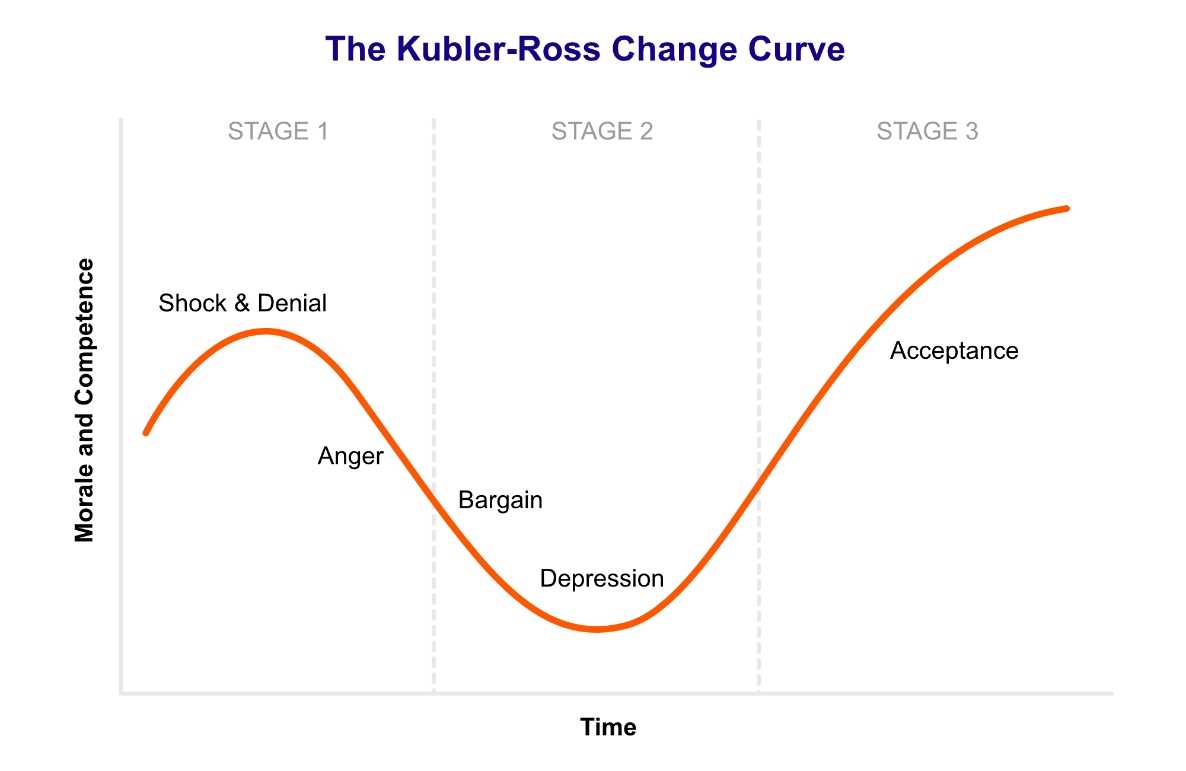
Figure 3: Kubler-Ross Curve
The Kubler-Ross Change Curve, shown in Figure 3, shows how people react to extreme change through the stages of shock, denial, anger, depression, acceptance, and integration. While this was originally developed to show the stages of emotion for terminally ill patients, it actually applies to any type of significant change.[8]
If team members are pressured to add more work to their plate without realization, support, or acknowledgement from upper management, then their morale will decrease, and they will begin to resent the project and no longer prioritize project meetings or have any desire to reach the project milestones.
It is important for management to identify how the employees are reacting to the project by using the Kubler-Ross Change Curve as their guide. This will help them manage the employees and their performance through the change.
Management can help employees’ performance by:
- Communicating intentionally about the project.
- Listening to employee concerns without being dismissive.
- Training on new processes and techniques.
- Remaining positive.
- Celebrating success.


- 1800+ high-performance UI components.
- Includes popular controls such as Grid, Chart, Scheduler, and more.
- 24x5 unlimited support by developers.