
Beyond Public Speaking for Geeks Succinctly®

CHAPTER 8
Troublesome Situations and How to Handle Them
Most of the questions I receive are “How do you handle this situation?” Let’s look at the most common situations and how to handle them, and let’s also look at some strange ones I’ve encountered in my 20-year speaking career.
Understanding and managing expectations
What are your expectations when attending a session? Most of the time, we attend a session without clear expectations. Sometimes we like the speaker, sometimes we like the topic, sometimes we have a free slot between one session and another in a long conference.
Expectations are important, both for the speaker and for attendees. If you arrive early in the room and there’s time, try to ask people already there what their expectations are. Try to understand why they’re in the room. People can have unconscious expectations, and they can judge your session based on those.
At the end of the session, try to understand if your session met some or most of the audience’s expectations, and what you can improve in the next one.
What to do with interruptions, questions
You are the star of the session. People are there for your session and for the value that you’re giving them.
Normally, people don’t like people who keep interrupting a session, even when they ask relevant questions. You should listen to your instincts and decide if you have time to explore the questions that you’re receiving, or if it’s better that you defer all the questions to the end of the session.
If the questions are relevant, take note of them, especially if you will deliver the session again in the future. You can incorporate some or most of the questions into your presentation material.
If you feel that the people who keep interrupting are there just to disturb the session, you can involve the rest of the audience to understand if they agree with them. Normally, they won’t, and that will solve the problem most of the time. If they agree with the heckler, you’ve a problem.
People don’t ask any questions
Sometimes you prepare for an interactive session, and nobody asks anything.
There can be multiple reasons for that:
- Cultural reasons: attendees from certain cultures ask very few questions in public, despite speaker insistence.
- Different seniority: junior people don’t want to show that they don’t know something, and some senior people are afraid of asking questions for the same reason.
- Audience hesitation: sometimes you just need to break the ice. Start with some warm-up questions, easy ones, that everybody can answer.
If people never answer, despite your efforts, stop asking for questions. Find other ways to interact with them. Anonymous polls can be a solution in most cases, both for in-person and virtual sessions. There are many easy apps and websites that you can use.
Can you do it in another language and vice versa?
It can happen that you prepare a session in your native language, and then people ask you to do the session in another one. Most of the time, especially in some European countries, people ask you to do your session in English, while you prepared it in your language.
Of course, you can always say, “No, I’m sorry.” But most of the time, if you really know the session, and if you have a good knowledge of the other language, you can try to do it. First, ask other attendees if it’s a problem if you do the session in the other language.
People who asked you to switch languages won’t care if you don’t know how to express something, since they know that you’re making a strong effort to deliver that session.
Note: Working for an American company, and sometimes being asked to do sessions in English also when in Italy, is the reason that I’ve created my slides in English for years, even if they’re for an Italian audience.
It can also happen that you’ve prepared your session in one of your second languages, and then you see that everyone in the audience speaks your native language. What can you do? If there’s only one session in that time slot, and it’s not the first one, you can ask people if they want you to switch languages.
If there are many sessions concurrently, if the event is online, or if the session is the first one, keep using the language that you agreed on with the organizers. People won’t like that you change language a second time just because people who arrive late complain about the language.
How to talk in front of thousands of people
Talking in front of thousands of people is normally easy because you cannot see them!
Joking aside, what scares a lot of speakers is knowing that the venue is huge, seeing it empty, or seeing it while it is filling. But in most cases, when you’re on the stage with all the lights, you cannot see most of the people.

Figure 41: Thousands of people attending Microsoft Build conference (source: Microsoft).
I usually find a row in the middle of the room and focus my eye contact on that row, moving slowly and trying to cover the space in a natural way. All the people in my line of sight will feel the eye contact.
If the talk is also recorded, always discuss your position with the camera operators, where it is better for you to present, and how far you can move. Remember to move slowly, since the video amplifies every movement.
Note: The most difficult part of talking in front of thousands of people is not doing it, it’s all the work and preparation that gets you there.
Hardware failures and other technical problems
It doesn’t matter if you’re speaking in front of thousands of people or just a few when you have a hardware (or another technical) problem. It’s not easy to stay calm and deliver the session.
At in-person events, a PC can be broken, the video cable adapter doesn’t work correctly, the video cable is too long and the PC keeps losing sync with the projector, electricity can be out for the whole block, etc. In virtual presentations, you can have problems connecting to the server, being authenticated as a speaker and not as an attendee, network problems, etc.
In all of these cases, you should try to understand the problem and then decide if you can fix it in a few minutes, you need help from a technician, or you can do the presentation without technology.
Doing a presentation without proper slides and demos can be intimidating, but if you have good stories, you can do it, perhaps with the help of a good old whiteboard.
Tip: I normally have the presentation on my PC, on OneDrive, on a USB stick, and published privately on SlideShare, but sometimes that wasn’t enough. If you need a connection to the internet to do your demos, consider recording them in advance, and use the video if needed. The best way to do it is to talk live on top of the video, so you can also pause it and add relevant information if needed. Recording a video and talking while playing it is also useful when you need a complex hardware setup or you’re doing demos that require exact timings or other kinds of difficult configurations.
In every case, stay calm. The worst thing that could happen is the session is canceled and probably postponed to a later date. Or you will record it and publish it online after the conference.
People sleeping in the first rows, or with the webcam turned on
There are three reasons people sleep in the first rows, or in front of the webcam:
- You’re incredibly boring, monotone, and your slides are dull. It’s better to do a lot of dry runs and improve your stage presence and content for next time.
- You’re speaking after lunch, late in the afternoon or evening, or early in the morning. Get over it.
- They’re tired, perhaps the night before they didn’t sleep enough. Again, get over it.
Note: Normally, if they sleep in the last rows, or with the webcam turned off, it’s out of sight, out of mind. 😉
Sometimes speakers get upset because people leave the session and then come back later, leaving the door open, disturbing other attendees, or leaving the webcam on in front of an empty room. Don’t be too severe; people have urgencies. If they come back, it means that your session is interesting.
Tip: If you’re an attendee of a virtual session or a conference call, and your software allows you to use a custom background, you can do a stupid trick in order to leave the room without people noticing. Just take a screenshot of you in front of the camera and use it as a virtual background. Then try to sneak away as fast as possible, leaving your avatar attending the session.
Handling microphones
Most speakers aren’t comfortable with a microphone. They always ask, “can you hear me without the microphone?” and if people say “no,” their session will suffer.
Some speakers hate handheld microphones because they’re not used to handling them, their body language is affected, and the sessions are not as they expect. I always suggest doing dry runs with a small bottle of water to get used to it and improve the impacted body language.
Handheld microphones can be bad when you need to do a demo and you don’t have a microphone holder. In this case, you can ask some friends to help you during the demos, perhaps joking with them about their important role in the session.
Some speakers hate lavalier microphones[2], the small ones with a clip, like the ones used in television. Lavalier microphones can be problematic with some clothing, especially for women. If you need to present with a lavalier, you need a place on your clothes to which to attach it. Try to remove badges, necklaces, and other things that can bump into the microphone and make a lot of noise. In every case, you should try to hide the cables under your clothes to avoid tearing them.
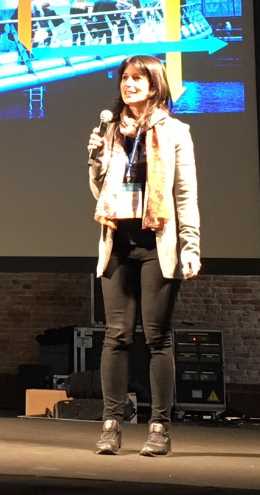
Figure 42: My friend and colleague, Erica, after winning her battle with a handheld microphone.
If your session has a demo, you should remove all your bracelets and wristbands, because they could make annoying noises while typing if you keep the microphone near the keyboard.
What to do when two (or more) speakers have different seniority
Multiple-speaker presentations can be interesting, but sometimes they can also lead to problems and bad behaviors.
Here are some examples:
- One speaker takes control of the session and never gives the ball back to the other one.
- One speaker receives a tricky question, and the other speaker interrupts and answers the question without waiting for the first one.
- An attendee addresses a question to the wrong speaker, instead of the one who talked about the topic.
- One speaker explains something wrong (a topic or an answer) and the other speaker harshly speaks over them to correct what was said.
There are two ways to solve all these problems. The first one is when the senior speaker does some of the behaviors without malice. This can be easily solved using multiple dry runs, so the two speakers can sync. They can decide who can handle certain topics, they can simulate mistakes, or they can play different roles.
If there’s no time for dry runs, it’s much better to cut the session into two separate parts and let each speaker do one.
The second way to solve most of those problems is discussed in the next section, given that the two problems are similar.
Mansplaining
Mansplaining (one of the words of the year 2010 for the New York Times) means:
The act of explaining something to someone in a way that suggests that they are stupid; used especially when a man explains something to a woman that she already understands.
Mansplaining is not normally a personal attack, but it describes a cultural behavior. It has evolved from its original meaning and now is also used when a man uses a patronizing tone when explaining to anyone, irrespective of the age or gender of the recipients.
Mansplaining can be seen when two speakers are presenting (as mentioned in the previous section), and one keeps explaining the meaning of the other’s words. It can also be seen between a speaker and audience members, or in a social media interaction. Typical cases of mansplaining are attendees or readers who try to explain research or an article to the woman who wrote it.
There are many ways to fight mansplaining, considering that, as we already said, it’s usually not a personal attack:
- “The Hip Check”: a small verbal nudge to send a message like, “Let me discuss my background a little bit, before discussing your comment…”
- Humor: humor can be enormously powerful but remember to smile while delivering it.
- Redirect: instead of listening to the mansplaining comment, a woman can redirect the flow to another woman, asking for her opinion.
- Loud voice: sometimes a meeting becomes a race in which every man is shouting. A woman should find her loud voice and use it, to be heard.
- Call out: did you try all the other techniques, and nothing worked? Explicitly calling out the behavior can be the only way to stop it.
What happens if you take a break from speaking?
A lot of speakers, famous and not so famous, sometimes disappear and stop giving presentations. Perhaps they changed roles, perhaps they changed their lives, sometimes they simply took a pause, and they never come back to the scene.
This is why some speakers never take a break. They fear that they’ll never be invited again to speak; they fear that their speaking career could end because of the break.
Taking a break sometimes can be useful, not only when you’re experiencing speaker’s burnout (as described in the previous chapter), and shouldn’t be a permanent condition. Sometimes you’ve changed roles and you don’t have meaningful things to say for a while, because you need to study new material, you need practical experience, and so on.
Let people know that you’re taking a break from speaking in public, stay active (if you can) in the communities, and document your journey in the new field.
And then, when you’re ready to come back, try sending proposals again, start from meetups or small communities, talk with your contacts and friends, and let them know you’re back.
It could take some time, but if you were a respected speaker before the break, people will be happy to have you again on stage.
Keep running
The best suggestion I’ve ever received in my public speaking career is to “keep running” even if I realize I have a problem with the session.
It’s like Wile E. Coyote, who starts falling only when he realizes he is running in midair and stops doing it.
Of course, some people will notice that you have a problem, that a demo is not working, or that you missed something from the slides. But most people won’t notice anything, or won’t care, because they’re absorbed in the flow of your stories.
If a demo doesn’t work, don’t insist, unless it’s the most important part of the session, and you know how to fix it. You can say, “let’s try to see if we can make it work in the next minute” and ask for the public’s help. Most of the time it’s a typo, and they can see it and you can’t.
To keep running is important, but always pay attention to dead ends. Sometimes it’s better to admit the problem, take a deep breath, drink some water, and restart.

Figure 43: A mural of Wile E. Coyote on a wall of the Rotch Library at MIT (source Wikipedia).
How to talk when the stakes are high
As a geek, I’ve delivered many kinds of sessions with a lot of different audiences, from deep technical people to the CxOs of big companies.
The session that required the most preparation was a different kind: I officiated the wedding of two great friends of mine.

Figure 44: The author while officiating the wedding.
In this case, I couldn’t rely on technology: no PowerPoint, no props, no timer, nothing.
I used good old paper, with a BIG FONT and the most important parts highlighted.
You cannot rely on memory in this case. You should read most of the text and the official formulas with a clear voice, and you cannot improvise.
The last suggestion is to know your space. Don’t move too much (you’ll look awful in the video) and find a place to leave your notes when not using them.
And, as always in this kind of situation, don’t forget to smile and try not to cry!
Some concluding thoughts
Every situation has its own rules
Virtual sessions, small meetings, large meetings, live events, TV shows, podcasts; each situation is different and has its own rules. You should adapt your style to the media, and you should learn from the best in that field.
Should public speaking be taught in school?
Short answer: YES!
Public speaking is not a soft skill. It’s a superpower that can be taught. The sooner you start, the easier it will be!
Of course, you cannot teach a two-day workshop to fourth- or fifth-grade children, but you can teach them the basics about delivering value, and about telling a short story. Then you can improve on that every two or three years, until university…and more!
Public speaking should be continuously improved
You cannot stop studying public speaking. New media, new expectations, new career goals, etc., require different public speaking techniques. Always look for updated books, articles, blog posts, and videos. Don’t blindly trust old materials.


- 1800+ high-performance UI components.
- Includes popular controls such as Grid, Chart, Scheduler, and more.
- 24x5 unlimited support by developers.