
Beyond Public Speaking for Geeks Succinctly®

CHAPTER 7
Impostor Syndrome and Other Difficult Phenomena Related to Public Speaking
I know a lot of people who could be excellent speakers, but they think they don’t belong there. One reason can be impostor syndrome, in which there is constant doubt about one’s accomplishments.
People with impostor syndrome will never feel 100% confident when giving a presentation, but there are many ways to work around it and obtain excellent results.
Note: Impostor syndrome, burnout, etc., can lead to depression and other serious problems. If you feel that you need help, don’t be afraid to search for a professional who can work with you to help solve these issues. The suggestions in this chapter are not meant to substitute professional help.
Impostor syndrome
Impostor syndrome, also known as impostor phenomenon from a 1978 article that introduced the concept for the first time, is a psychological condition in which one doubts one’s accomplishments and fears that others will see them as fraudulent.
People with impostor syndrome suffer from anxiety, fear of failure, and dissatisfaction with life, among other things.
Described at the beginning as a condition that was mostly found in high-achieving women, it was then studied in many demographics, including all genders, people with different occupations (from students to top-level managers), and completely different cultures.
Note: One difference between women and men is that women commonly face impostor syndrome in regard to performance, with a perception of ability and power guided by outperforming others, while men mostly fear being unsuccessful, or not good enough by themselves, without comparison to others.
Impostor syndrome can occur in people who never suffered from it before when something new happens in their work or academic environment; when there are new social interactions or new relationships (not only romantic ones); when there are comparisons made by colleagues or family members; or when there’s a new manager or changes in the status quo. These are only examples, but it has been estimated that nearly 70% of all people will experience impostor syndrome at least once in their life.
Note: Impostor syndrome is an experience that occurs in an individual, and it isn’t considered a mental disorder.
Symptoms
Anxiety and stress are the most common symptoms, but sometimes impostor syndrome can lead to depression.
Never underestimate depression and other symptoms. The suggestions in this book are useful but cannot substitute for a trained professional.
There are many behaviors that can be explained with impostor syndrome (not all of them are present in a single person):
- Perfectionism (setting high performance standards, sometimes impossible to achieve, together with critical self-evaluation) is coupled with the fear that colleagues and managers expect too much from them:
- Overworking and sometimes burnout are two common results, due to searching for perfection.
- Belief that failures are theirs, but successes are due to outside factors:
- When people praise them, they tend to discount or completely ignore those compliments.
- They tend to stay under the radar. They avoid asking for a raise, avoid new opportunities and tasks for the fear of failure:
- They are usually dissatisfied with their current job, but they don’t do anything to change it.
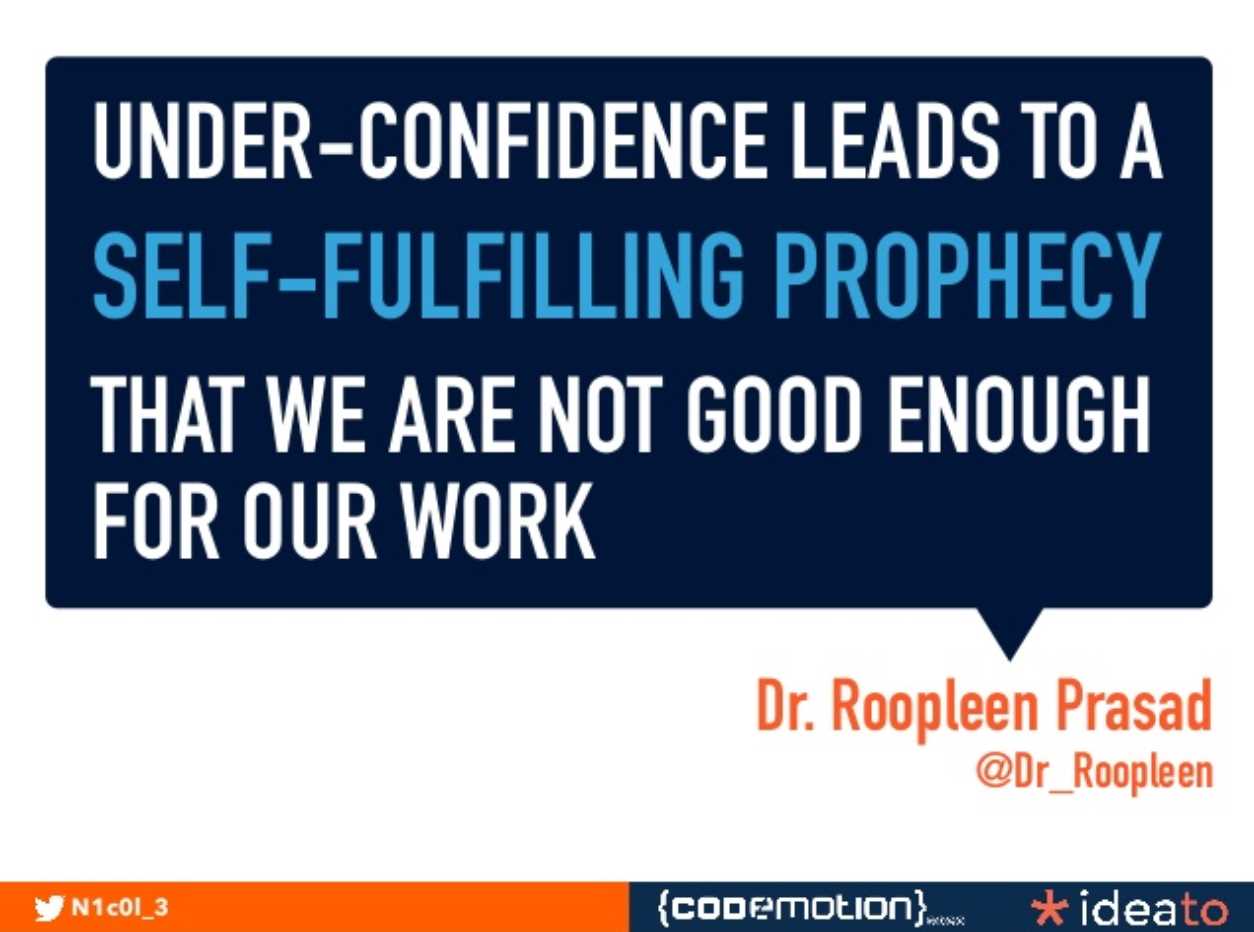
Figure 38: Slide from Nicole Bartolini's presentation at Codemotion Rome about anxiety and impostor syndrome.
Note: Impostor syndrome is not only a confidence problem, and overconfidence is not a solution, like we’ll see in the Dunning-Kruger effect section.
Impostor cycle
The impostor cycle is one of the reasons why impostor syndrome is difficult to interrupt. Every event serves as a reinforcement of the previous ones, and with every cycle, negative feelings are increased.
Figure 39: Impostor cycle.
Looking at the impostor cycle, it’s easy to understand why impostor syndrome is so subtle: success does not mean happiness, and every achievement increases fear, stress, anxiety, and self-doubt.
How to handle impostor syndrome
Most people who have symptoms of impostor syndrome don’t even know about its existence. They just feel inadequate.
Knowing about the syndrome, and talking about it with a friend, a mentor, or a family member, or searching for professional help, is a huge step to fight it.
There are several types of people with impostor syndrome, but most of their behaviors are related to the search for perfection. Perfection is impossible, and we must accept that nobody is perfect, because we are all humans.
Instead of searching for perfection, you should start documenting accomplishments. Keep a written diary of personal achievements and celebrate them accordingly.
Every time you have a negative thought, you should challenge it with the help of your diary. Or by trying to relive moments of success or talking with someone and seeking honest feedback.
Is the Dunning-Kruger effect the opposite of impostor syndrome?
The Dunning-Kruger effect is often thought of as the opposite of the impostor syndrome. The Dunning-Kruger effect is a cognitive bias in which people with low ability at a task overestimate their ability, because they cannot recognize their limits.
Escaping the Dunning-Kruger effect requires being able to listen to negative feedback and study and practice a topic until it can be taught. It requires time.
Sometimes, some good dry runs can help speakers focus sessions on only the parts they can master. Find good mentors and let them judge whether you’re really a jack of all trades, or if you’re setting yourself up for a disaster.
Note: While most people think that the Dunning-Kruger effect is the opposite of impostor syndrome, other people think that self-serving bias could be a better option. People with self-serving bias tend to credit success to their own abilities, while their failures could be ascribed only to external sources.
Actor-observer asymmetry can explain why certain people are good judges when evaluating others and tend to be completely wrong when evaluating themselves.

Figure 40: Impostor syndrome vs. overconfidence is a bad way to frame the problem (source: https://medium.com/counter-intuition/impostor-syndrome-is-not-just-a-confidence-problem-dea670e59f6e).
Social envy
As we saw in Chapter 6, social media is important to improve a speaker’s personal branding, to increase the probability of being accepted or invited to speak at conferences, courses, etc.
Social media can also lead to social envy, a problematic form of social competition.
In the past, people mostly compared themselves to people they knew personally. It was difficult to compare themselves with people they saw in magazines or on TV.
Today, social media is normally used to share positive things about life, work, achievements, etc., and people can follow nearly everybody. These two facts can lead to social competition with other people, sometimes unconsciously.
Social competition, like many other kinds of competition, can be positive when your desire to obtain something is increased by the fact that somebody like you has achieved it.
Social competition can become social envy when it has negative effects on your life and on your relations with other people.
Social envy is bad for two reasons:
- Usually, people forget or ignore that other people normally post about good things on social media. Behind a prize, a certification, a promotion, an accepted paper, or speaking proposal at a prestigious conference, etc., there could be dozens of failed tries, a lot of hard work, and sometimes the luck of being at the right place at the right time.
- It can lead to bad behaviors toward other people, and since the speaking community is not so huge, those behaviors could also backfire.
Social envy can be avoided by thinking that the challenge is always and only with ourselves. Instead of suffering for other people’s successes, we can try to understand what led to their successes, how they were selected, etc. Most the time, successful speakers can become our mentors, or at least, find some time to help us find our path.
Tip: Try to get inspiration from the best speakers. If their talk is accepted at a conference, study its format, understand why it was selected, and work on your reputation. If the CfP is still open, try to send something that you feel is missing from the draft agenda. If the CfP is closed, try to reach the organizers with your ideas, perhaps there’s still a place for something. Most conferences are changing and try new formats, like a series of virtual sessions before the main event, or a hands-on lab, and you can be part of that. If it’s too late to apply this year, mark your calendar, and be sure to propose something next year.
Note: It took me many years to see my “Public Speaking for Geeks” session accepted by an international conference. I had to work on my brand, and on the proposal, because it wasn’t good enough to be accepted abroad. In the end, persistence paid off.
Speaker’s burnout
Burnout is a serious condition that can be sometimes confused with impostor syndrome.
Burnout is a state of prolonged exhaustion—physical, mental, and emotional—coupled with excessive stress. Burnout can reduce people’s work and personal effectiveness, decrease ability to make good decisions, and lead to lack of interest in many fields, including important ones.
Note: Burnout can lead to illness, depression, and other problems, like cardiovascular disease, and should be treated by professionals.
Speaker’s burnout can be caused by excessive travel, prolonged class hours, lack of sleep, bad evaluations, and in times of forced remote work, lack of boundaries between work and personal life and excessive zoom fatigue.
Here are some suggestions to prevent or try to cure burnout:
- Avoid zoom fatigue, reduce unnecessary calls, find other ways to communicate with your team and manager, and use remote presentation tools only to do virtual sessions.
- Take time off, and if you’re sick, don’t work, especially from home. Sometimes you need to stop presenting (in-person or virtually) for some days (or months) to recover from speaker’s burnout.
- Talk with your manager, or with your team. Let them know that you need help. Perhaps they can do a course with you, or they can find a solution and distribute part of your presentations to the rest of the team. Hiding your situation can lead to longer time off.
- Self-care and compassion. Speaker’s burnout can happen to anyone, especially in these rough times. Don’t judge yourself, and if some of your team members need help, please show them compassion and empathy.
- Understand why you burned out, perhaps with the help of a therapist.
Other suggestions include eating healthier, setting boundaries between work and personal life, turning off notifications to reduce interruptions, sleeping more, and dedicating some time to joyful activities.
Burnout can happen also if the pandemic has totally reduced your speaking engagements.


- 1800+ high-performance UI components.
- Includes popular controls such as Grid, Chart, Scheduler, and more.
- 24x5 unlimited support by developers.