 Arunachalam Kandasamy Raja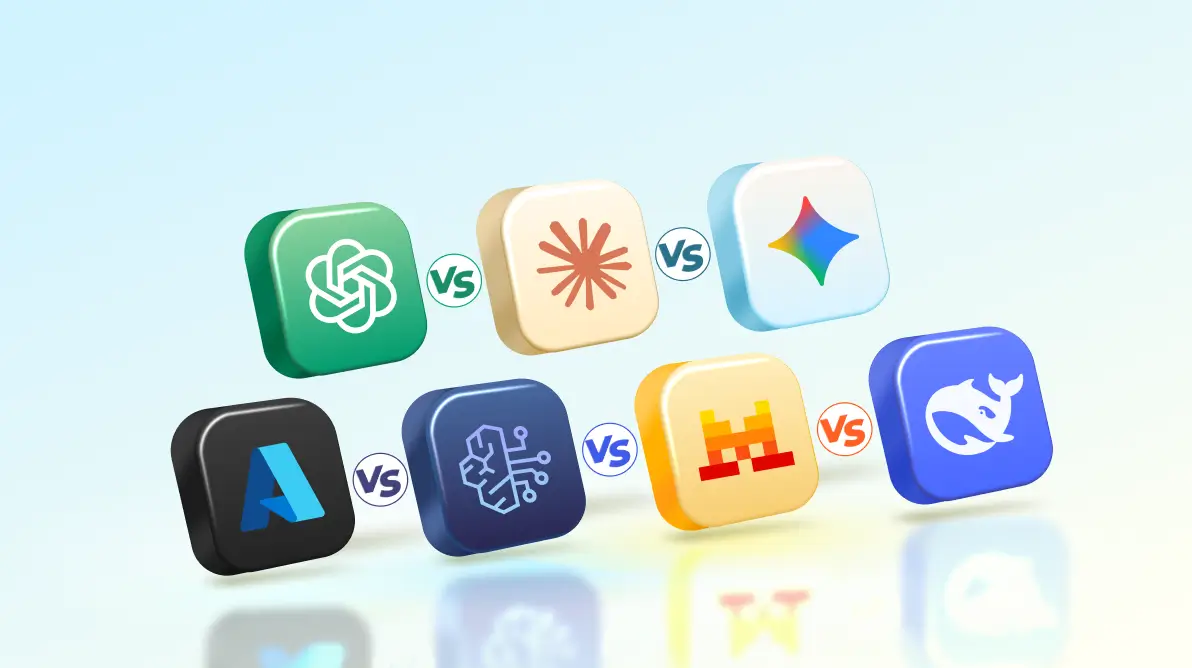
TL;DR: Choosing an LLM API in 2026 isn’t about “the best model”; it’s about the best fit for your workload. OpenAI and Claude lead in agentic workflows and developer speed, Gemini dominates multimodal long-context tasks, Azure OpenAI and AWS Bedrock excel in regulated enterprise environments, Mistral offers an EU-friendly open-weight path, and DeepSeek wins on ultra-low cost with OpenAI-compatible APIs.
The LLM API market in 2026 is no longer the “wild west”, but it still changes fast enough that last year’s comparison posts age out quickly. Most major providers now ship new model families every few months. 1M-token context is common across flagships. And agentic features (tool calling, computer use, multi-step workflows) are now expected, not “nice to have.”
So what actually separates a good architectural choice from a painful one?
Not marketing. The difference shows up in the boring-but-critical details: latency under load, pricing at scale, SDK quality, compliance posture, rate limits, and deprecation timelines.
This guide compares the top 7 LLM APIs of 2026 with production reality in mind.
The real developer pain (what hits in production)
Teams rarely fail because they picked the “wrong” model. They fail because the platform’s operational details don’t match their workload.
Common pain points:
- Onboarding friction: SDK maturity and example depth decide whether “Hello, world” takes 10 minutes or half a day.
- Architecture trade‑offs: Do you rely on
1M‑token promptsor build a slim RAG layer? Your choice impacts latency, token spend, and maintainability. - Latency-sensitive apps: Streaming
TTFTmatters more than rawTPS; caching helps TTFT, not generation speed. - Cost unpredictability: Learn the batch API and prompt caching knobs or pay
40–60%more than you need. - Vendor lock-in: Proprietary caching keys, computer‑use runtimes, quota models can become hard dependencies; abstract early.
- Production reliability: Watch rate limits, region availability, and model deprecation windows; build for churn.
What’s changed in 2026
The AI API landscape shifted fast this year. Three big changes reshaped developer choices:
- 1M+ context windows became normal
All major vendors now support~1M tokens. Long-context workflows (codebases, legal docs, video transcripts) are finally mainstream.
- Agentic capabilities matured
Computer use, multi-step tool calls, and structured reasoning are no longer experimental. Some providers are still ahead here (notably Claude and OpenAI), while others are still catching up.
- Cost spread widened dramatically
DeepSeek disrupted pricing at the bottom end. Azure and Bedrock increased their enterprise tooling. OpenAI and Anthropic improved caching and batch options, making large contexts cheaper in practice.
Net result: In 2026, teams choose based on workflow + constraints, not just raw model quality.
How we evaluated the top LLM APIs
Most comparisons lead with context window size. That’s like reviewing a car by describing cup holders. Here are the factors that genuinely affect production decisions:
| Factor | Why It Matters |
Latency (TTFT / TPS) | Time-to-first-token and tokens-per-second. Critical for real-time UX. |
| Pricing model | Per-token vs provisioned vs batch. The right model can cut costs by 40-60%. |
| Context window (Verified) | Accuracy can degrade at the upper end. |
| SDK ecosystem | Official SDKs, community wrappers, and OpenAI API compatibility. |
| Agentic/tool-calling Maturity | Multi-step tool use and computer use for autonomous agent apps. A primary selection criterion in 2026 for agentic workloads. |
| Context caching | Prompt/input caching (available in Anthropic and OpenAI) reuses repeated system-prompt tokens across requests, significantly reducing cost and latency at scale. |
| Structured outputs | Maturity in JSON mode, function calling, and tool use varies significantly. |
| Multimodal support | Ability to process text, images, audio, and video (varies widely). |
| Enterprise compliance | SOC 2, HIPAA, GDPR, and data residency options. |
| Privacy & data use | Whether API data is used for training by default, or if there are opt-out mechanics. |
| Rate limits & quotas | TPM/RPM limits at your billing tier. |
| Batch API support | Async batch processing can cut costs by ~50% for offline workloads. |
| Fine-tuning availability | Not every provider offers it. Hard blocker for domain-specific use cases. |
| Model Deprecation Policy | How long do versions stay supported after a new release? |
Top LLM APIs in 2026: Comparison table
The table below reflects publicly documented information as of March 2026. Treat pricing and model versions as directionally accurate and always confirm against the provider’s current pricing page before making architectural commitments.
Table 1: Core specifications
| Platform | Flagship model | Context windows (tokens) | Pricing model | Latency (TTFT / TPS) |
| OpenAI API | GPT-5.4 / GPT-5.3 Instant | 1M | Per-token + Input caching + Batch | <250 ms / 77 TPS |
| Anthropic | Claude Opus 4.6 / Sonnet 4.6 | 1M | Per-token + Input caching + Batch | <300 ms / 65 TPS |
| Google Gemini | Gemini 2.5 Pro / Flash (GA) | 1M+ | Per-token | <180 ms / 101 TPS |
| Azure OpenAI | GPT-5.4 series (hosted) | 1M (same as OpenAI; region availability varies) | Per-token + PTU + Batch | <280 ms / 70 TPS |
| AWS Bedrock | Claude 4.6, Llama, Mistral+ | Model-dependent | Per-token + Provisioned | Varies by model and region |
| Mistral AI | Mistral Large 3 | 256K | Per-token | <220 ms / 85 TPS |
| DeepSeek | DeepSeek V3/R1 | 128K | Per-token (ultra-low) + Cached input discounts | <150 ms / 110+ TPS |
Table 2: Developer and enterprise experience
| Platform | Agentic Maturity | Multimodal | SDK Ecosystem | Enterprise Compliance |
| OpenAI API | High | Text + Image + Audio | Excellent | Medium |
| Anthropic | Very High | Text + Image (Vision) | Excellent | Medium |
| Google Gemini | Moderate-High | Text + Image + Video + Audio | Good (Vertex AI) | High |
| Azure OpenAI | High | Text + Image + Audio | Excellent | Very High |
| AWS Bedrock | Model-dependent | Model-dependent | Good (AWS SDK / Boto3) | Very High |
| Mistral AI | Low-Moderate | Text + Vision | Good | Medium |
| DeepSeek | Low | Text only | Fair (OAI-compatible) | Low |
Provider-by-provider analysis
What follows is not a rehash of the marketing pages. Each section leads with the honest version, including the pain points you’ll hit before you discover them yourself.
1. OpenAI API
Models: GPT-5.4 · GPT-5.3 Instant · GPT-5.4 Thinking / GPT-5.4 Pro (reasoning)
Best for: developers who want the deepest ecosystem, strongest reasoning models, and fastest time-to-initiation for new projects.
Why choose OpenAI
- The broadest ecosystem (every library supports it first).
GPT‑5.4family offers top-tier reasoning and tool use.- Fine‑tuning and Batch APIs are mature and well-documented.
- Prompt caching significantly cuts the cost for large system prompts.
Where it struggles
- Often the highest pricing among frontier models.
- Strongest enterprise compliance requires Azure OpenAI rather than direct API.
- Rate limits on lower tiers can surprise fast-scaling teams.
Use when: you want a safe default that will never slow down your development workflow.
2. Anthropic Claude
Models: Claude Sonnet 4.6 · Claude Opus 4.6
Best for: agentic workflows, code assistants, and complex instruction-following.
Why choose Claude
- Best-in-class coding abilities and multi-file reasoning.
- Production-ready computer‑use capabilities.
1M-tokencontext with high retrieval accuracy.- Prompt caching is extremely effective for long system prompts.
Where it struggles
- No fine‑tuning via the public API.
- Smaller ecosystem vs OpenAI.
- Enterprise compliance often runs through AWS Bedrock in practice.
Use when: you’re building agents or code copilots where reliability matters more than model variety.
3. Google Gemini
Models: Gemini 2.5 Pro · Gemini 2.5 Flash (GA) · Gemini 3.1 Pro (Preview)
Best for: long-context multimodal workloads (video/audio/docs at scale).
Why choose Gemini
1M+context with native video/audio support.- Flash variants are ideal for high-throughput, low-cost workloads.
- Vertex AI integrates fine-tuning, storage, auth, and deployment into one stack.
Note: Gemini 3.1 Pro is preview (February 2026). Gemini 3.1 Flash-Lite entered developer preview (March 2026). For stable production workloads, Gemini 2.5 Pro and Flash remain the recommended GA models.
Where it struggles
- Vertex AI adds operational overhead if you’re not already on Google Cloud.
- The standalone Gemini API is simple, but migration to production paths is non-trivial.
- Retrieval quality at extreme context limits varies by workload.
Use when: your inputs aren’t just text, think codebases, PDFs, videos, or multi-source documents.
4. Azure OpenAI
Models: GPT-5.4 series (hosted on Azure)
Best for: enterprises that need private networking, compliance certification, auditability, and minimal legal friction.
Why choose Azure OpenAI
- Strong enterprise posture:
SOC2,HIPAA,GDPR, data residency, andVNETisolation. - Provisioned Throughput Units (PTU) guarantee consistent latency.
- Seamless integration with Azure Active Directory, Azure Monitor, and the broader Microsoft ecosystem.
Where it struggles
- Region-by-region quota management becomes operational overhead.
- Performance throttling happens earlier than developers expect.
Use when: compliance, networking, and predictability matter more than model diversity.
5. AWS Bedrock
Models: Claude 4.6 · Llama 4 series · Mistral · Amazon Titan
Best for: AWS-native teams that want multiple model families to be supported by a single API.
Why choose Bedrock
- Unified API across multiple model families (
Claude/Mistral/Llama/Titan, etc.). - Deep AWS integration:
IAM(access control),CloudWatch(monitoring),VPC(private networking), andS3(storage). - Provisioned capacity options for production SLAs.
Where it struggles
- Model availability varies heavily by region.
- Region–model mismatches are a common source of production errors.
Use when: you’re already deep in AWS and want the simplest path to enterprise AI adoption.
6. Mistral AI
Models: Mistral Large 3 · Mistral Nemo · Codestral
Best for: teams that need cost-efficiency, multilingual strength, and an eventual path to self‑hosting.
Why choose Mistral
- Competitive pricing and strong performance for its tier.
- Open‑weight availability gives you an exit ramp from vendor lock‑in.
- Codestral is highly capable for code completions.
Where it struggles
- Less mature reasoning and agentic features.
- Limited multimodal capabilities compared to Gemini or GPT.
Use when: you want EU-friendly deployment + future on-prem optionality.
7. DeepSeek
Models: DeepSeek V3 · DeepSeek R1
Best for: high-volume workloads where price matters more than compliance.
Why choose DeepSeek
5–10×cheaper than most frontier alternatives.- Strong coding performance for the cost.
- Full OpenAI API compatibility reduces migration fixes.
Where it struggles
- Limited enterprise certifications.
- Reasoning consistency varies by task type.
Use when: building large-scale, low-cost automation or offline workloads.
Red flags to catch before production
The things that bite teams hardest are rarely performance benchmarks. They’re the details buried in Terms of Service pages and quota dashboards that nobody reads until something breaks.
- Training data opt-outs
Some providers use API traffic to improve models unless you explicitly opt out. Confirm data‑use rules and comply with your privacy requirements. - Model deprecation timelines
If you rely on a specific model for fine‑tuning or deterministic output, verify support windows and migration guarantees. - Rate limits at your billing tier
Marketing numbers usually reflect enterprise plans. Standard tiers often have much lowerTPM/RPMceilings. Stress‑test at your actual quota limits to understand throttling behavior before deployment. - Context window vs. context quality
Large context doesn’t guarantee stable retrieval. Benchmark at the real lengths you’ll run in production. - Proprietary feature lock-in
Prompt caching keys, tool runtimes, and quota models can become dependencies. If portability is a concern, isolate them behind an internal interface.
Real-world scenarios: Decision framework
Frequent model deprecations and mandatory retirement cycles across OpenAI, Azure OpenAI, and Anthropic make provider churn inevitable, so using an abstraction layer can, in practice, reduce migration risk without being explicitly documented as a vendor requirement.
- The startup MVP
Short timeline, small team, limited infra overhead. Prioritize documentation, examples, and ecosystem support. OpenAI or Anthropic are typically the best fit here, offering excellent developer velocity, tooling, and community support.
- Enterprise financial or regulated workloads
Security reviews, auditability, data residency, and private networking outweigh small differences in model quality. In these cases,Azure OpenAI or AWS Bedrockare the safer choices due to their deep enterprise integrations, compliance certifications, and native cloud governance features.
- Agentic software engineering tools
Requires strong instruction‑following, long context handling, and robust computer‑use capabilities for autonomous coding cycles.Anthropic Claudestands out in this scenario, particularly for long‑running agent workflows and complex reasoning over large contexts.
- High‑volume batch processing
Cost per token is the primary constraint for tasks like large‑scale classification or synthetic data creation. Here,DeepSeek V3/R1orbatch APIs from OpenAIorAnthropicoffer the most economical path while maintaining acceptable model quality.
Frequently Asked Questions
In 2026, many production apps use a router/orchestrator approach. Route simple tasks to cheaper models (DeepSeek, Gemini Flash) and reserve complex reasoning/agentic tasks for Should I build multi-model or stick to one provider?
GPT-5.4 or Claude 4.6. This reduces lock-in and controls cost.
Use long-context when you need deep reasoning across a single large corpus (codebase, legal case file). Use RAG when you need freshness and cost efficiency across a dynamic knowledge base. Many teams use hybrid patterns.How do I choose between long-context and RAG?
Use Batch APIs for offline tasks, and lean heavily on prompt caching for large, repeated system prompts. Structure prompts so stable instructions come first to maximize cached-token benefits.What’s the best way to manage costs for scaling agentic apps?
No. Long context and RAG solve different problems. Long context can still suffer “lost in the middle” degradation. RAG remains strong for dynamic knowledge, governance, and cost control. Hybrid often wins.Is RAG obsolete because of 1M–10M token contexts?
Yes. Many teams use multi-provider setups to reduce outage risk, lock-in, cost volatility, and performance inconsistencies.Do multi-provider strategies reduce risk?
Conclusion
Thank you for reading! In 2026, most frontier models are “good enough” that architecture and operations decide success: routing, caching, batch processing, guardrails, and migration planning.
Pick the platform that helps you ship fastest for your workload. Keep your stack flexible. And validate decisions with real quota limits, real latency, and real prompts, not just benchmark charts.
Which scenario best matches your use case? Let us know your thoughts in the comments.
 No spam, just valuable updates.