Syncfusion React Diagram—Enterprise Architecture Overview
Enterprise diagram components are widely used in modern business applications for visualizing workflows, process automation, organizational structures, system architectures, and network relationships. As application complexity increases, diagram components must sustain high performance, support secure data interactions, enable flexible integration, and maintain a consistent user experience across large and complex diagram structures.
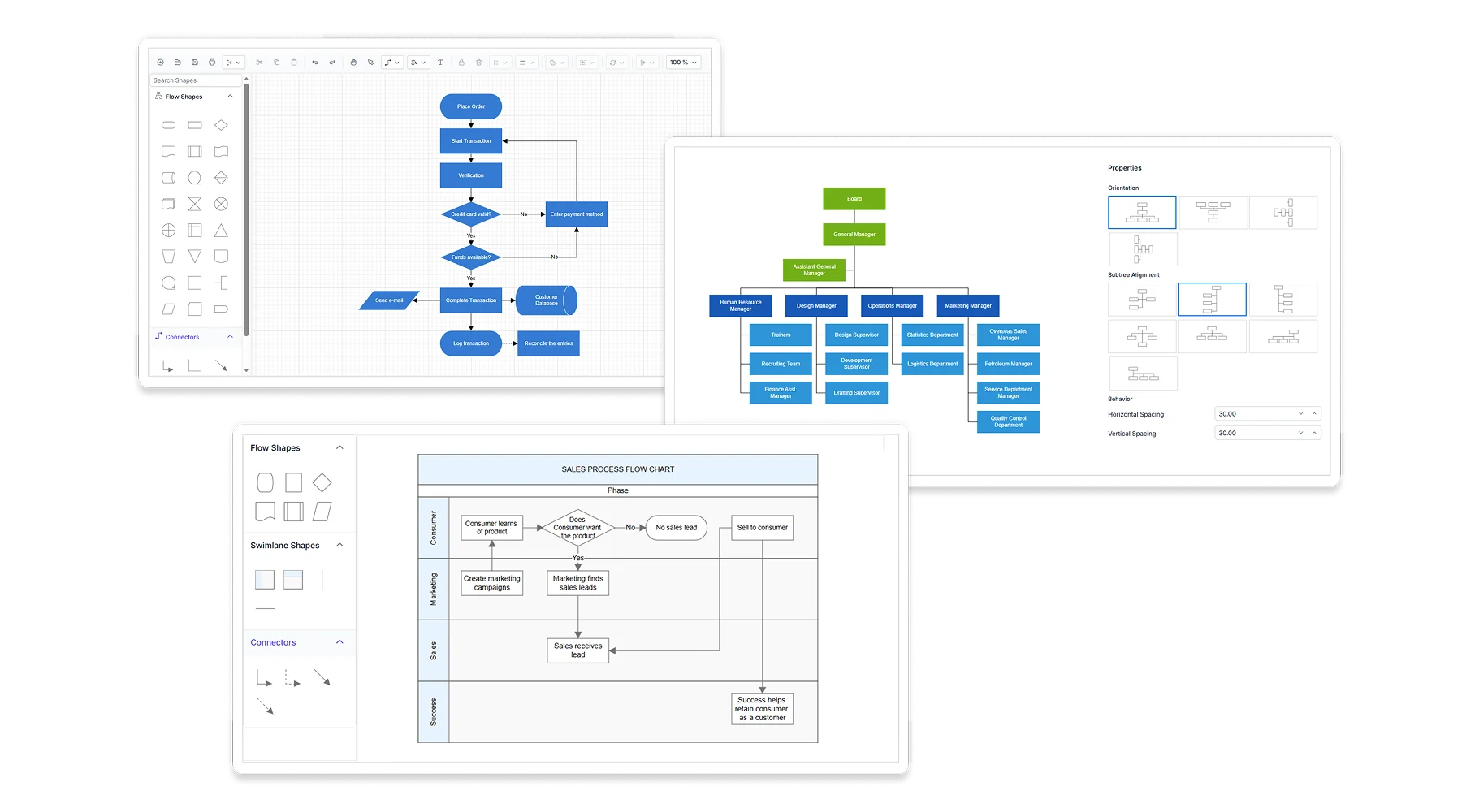
The Syncfusion React Diagram is designed to meet these enterprise requirements. It provides scalable rendering architecture; efficient handling of nodes and connectors; and flexible integration patterns for local remote data sources. The component supports advanced interaction scenarios, including drag-and drop editing, resizing, rotation, zooming, panning, automatic layout generation, and data binding. It also offers structured diagram capabilities such as grouping, containers, and swim lanes. It supports BPMN, UML, and custom diagram types. Additionally, it includes built in accessibility, localization, responsive behavior, and export serialization capabilities to help organizations meet enterprise usability, compliance, reporting requirements.
The following sections document the Diagram component’s architecture, supported integration patterns, scalability characteristics, and verified behavioral characteristics to assist decision-makers in evaluating the component for enterprise adoption.
AI and extensibility
The Diagram component allows AI-assisted features, such as text-to-flowchart, text-to-mind map, and text-to-UML sequence diagram sequence diagram conversion, to be integrated at the application layer. The Diagram component itself does not ship with an AI runtime or call any external AI service; AI capabilities are wired in by the application and routed through the application's own back end or model endpoints. AI features inherit the same data-flow boundaries as the Diagram component.
Typical enterprise usage scenarios
The Diagram component is commonly used in applications where complex relationships, workflows, and hierarchical structures must be visualized, edited, and managed at scale.
Examples include:
- Business-process modeling and workflow automation systems.
- System architecture and network topology visualization tools.
- Organizational hierarchy and reporting structure applications.
- Software design and modeling tools (UML, BPMN, flowcharts).
- Visual workflow builders and low-code application designers.
In these environments, the Diagram component acts as both a visualization layer and an interactive editing interface, requiring predictable performance and reliable interaction behavior for complex diagram structures. Each scenario places different demands on the Diagram component: workflow systems require dynamic layout and real-time updates; architecture diagrams require efficient handling of large node and connector sets; organizational views require hierarchical layouts and data-driven rendering; design tools require precision editing, customization, and extensibility.
Architectural capabilities
The Syncfusion React Diagram provides a compact set of architectural capabilities for enterprise applications:
- SVG-based rendering architecture with efficient management of nodes and connectors to handle large and complex diagram structures while maintaining predictable performance.
- Support for multiple layout algorithms (hierarchical, organizational, radial, mind map) to arrange diagram elements automatically based on predefined structural rules.
- Data binding for local and remote sources, enabling diagrams to be generated dynamically from structured data models and external APIs.
- Incremental and targeted update support for nodes and connectors, allowing changes such as add, remove, and update operations without full diagram re-rendering.
- A rich interaction model, including drag-and-drop, resizing, rotating, connector editing, zooming, and panning, with event hooks for validation, customization, and application-level logic.
- Symbol palette integration for reusable shapes and connectors. Drag-and-drop diagram construction and extensibility through custom palettes.
- Structured diagram support, including grouping, containers, ports, and swim lanes, for building domain-specific visual models such as workflows and business processes.
- Support for industry-standard diagram types, including BPMN, UML, flowcharts, and mind maps, within a unified component API.
- Serialization and deserialization of the diagram state in JSON format, enabling persistence, versioning, and back-end synchronization of diagram data.
- Exporting and printing support (PNG, JPEG, SVG) for diagram snapshots and reporting workflows.
- Accessibility and internationalization support (WCAG compliance, ARIA roles, RTL, and localization).
- Template-based rendering for nodes, connectors, annotations, tooltips, and palettes, which allows for the domain-specific customization of diagram visuals and interactions.