Security and Compliance
The Syncfusion React Data Grid runs entirely in the browser as a client-side UI component and does not introduce a vendor-managed runtime or persistent service. Security controls such as authentication, authorization, validation, masking, export policy, and audit recording are responsibilities of the host application and backend. The sections below summarize component behavior, application responsibilities, and verification references.
Security responsibility matrix
The Data Grid component occupies a defined, bounded position in the application's security model. The matrix below clarifies which protections are built into the component and which must be implemented by the host application.
Security architecture overview
Within a typical web application architecture, the Data Grid resides in the browser as part of the client-side UI layer. The component receives data that has already been processed by the application's API layer and renders it within the user interface. Any operations that require data modification or retrieval are performed through the application's backend services.
User interactions generated in the Data Grid, such as editing, filtering, sorting, or export actions, are emitted as events and handled by the application's business logic.
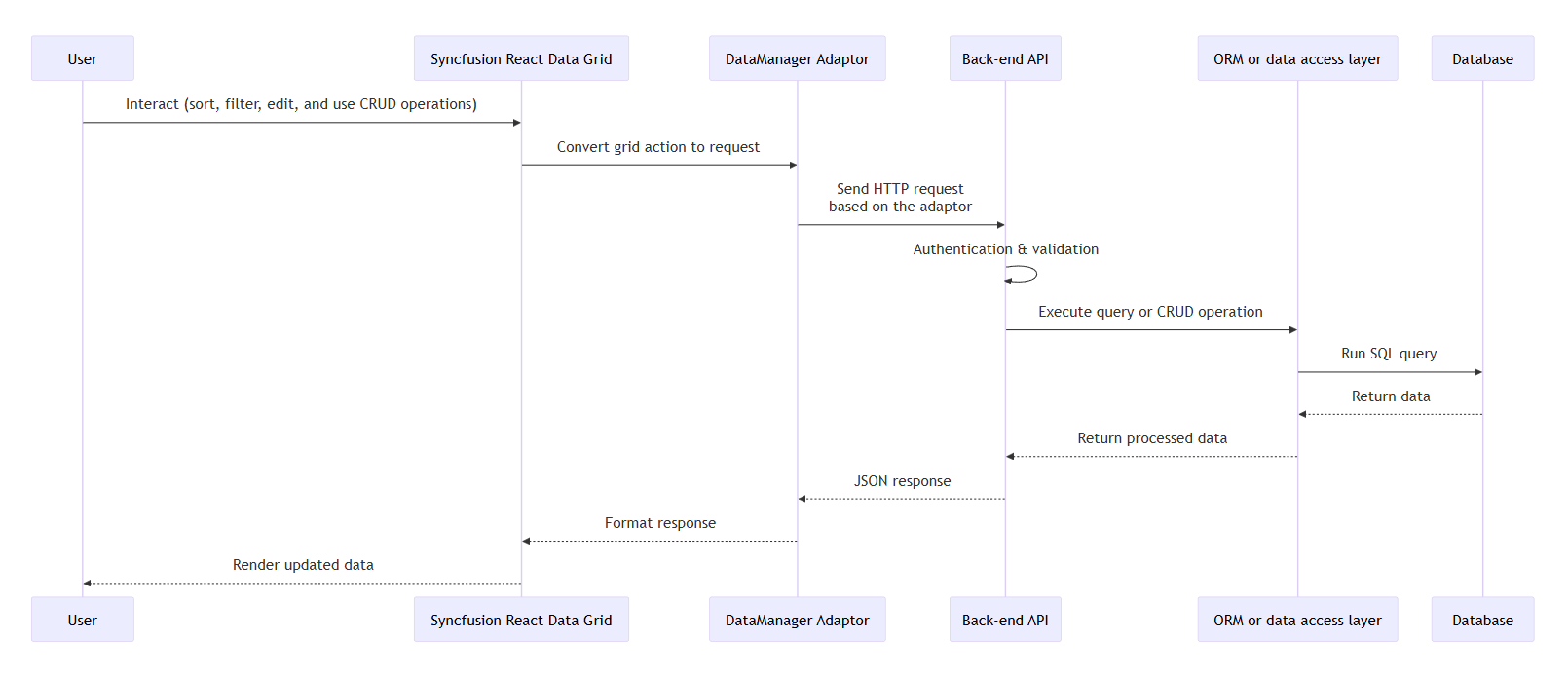
Data flow and network behavior
All data interactions performed by the Data Grid are executed through the application's existing API endpoints. When the Data Grid loads data, submits edits, or performs server-side operations such as paging or filtering, the requests are sent through the application's standard HTTP communication layer.
The Data Grid itself does not introduce a separate networking mechanism. It uses the same request flow that the application already uses for other API interactions. Because of this, Data Grid traffic follows the same routing rules, security policies, and monitoring controls that are configured for the rest of the application.
Network control ownership
- API routing and endpoint exposure are defined by the application’s backend services.
- Request that authentication and headers be attached by the application before the request is sent.
- Backend services apply server-side validation and enforce access control rules.
- Network security controls like WAF, reverse proxy, gateway policies are implemented at the organization's infrastructure boundary
OWASP Security Responsibility Context
The Data Grid considers OWASP security risk areas that are relevant to a client-side data rendering component. The table below highlights the applicable risk categories and the system layer responsible for addressing them.
Authentication and authorization integration
The Data Grid functions as a presentation component and does not perform credential validation, permission evaluation, or session management. Authentication and authorization controls are implemented by the host application and backend services. The Data Grid exposes configuration options and interaction events that allow the application to enforce its security policies.
Deployment security characteristics
The Data Grid's deployment security properties are fixed at the architectural level — they are not configuration options that can be disabled or misconfigured.
Compliance certifications
Syncfusion holds active, independently audited compliance certifications relevant to enterprise and regulated‑industry procurement. These certifications document the vendor’s security, privacy, and operational controls, are verified by third‑party auditors, and serve as formal evidence for organizations conducting vendor evaluation and procurement.
Vulnerability management
Syncfusion maintains a vulnerability management process that identifies, remediates, and communicates security fixes to customers. Security fixes are delivered through standard product releases and supported by a responsible disclosure process for reporting potential vulnerabilities.
Explore our blog on achieve regulatory compliance to understand how Syncfusion components maintain compliance standards.
Export security
Export functionality in the Data Grid is controlled by the application layer. The Data Grid provides export capabilities, while the application is responsible for enforcing permissions, access control, and data masking policies for exported content.
Security assurance statements
The following statements describe security characteristics of the Data Grid and related vendor security practices. These statements can be verified through the methods listed below.