
Axis Features
Unlimited Data Series
The Chart control has been optimized to handle very large sets of data.
feature image
Large Number Of Data Series in a Chart
Unlimited Data Points
Users can add an unlimited number of data points to a chart series. The Chart control is optimized to handle such huge sets of data.
feature image
Unlimited Data Points in a Series
Chart Wizard
The Chart control has a powerful wizard that helps with the visual design of a chart during design time.
feature image
Chart Wizard During Design Time
Zooming and Scrolling
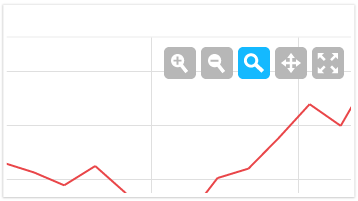
With the built-in zoom and scroll features of the Chart control, you can provide users with great flexibility. Users can simply click and drag an area of the chart to zoom in.
Once the image is magnified, scroll bars appear to let users view areas beyond the boundaries of the displayed image. Optionally, you can hide these scroll bars and use the Zoom Out button to let users revert to the original image view.
feature image
Zoomed Chart with Scroll Bars
Panning for Zoomed Chart
The Chart control supports panning in a chart when users zoom in on it.
feature image
Panning Support
Smart Labels
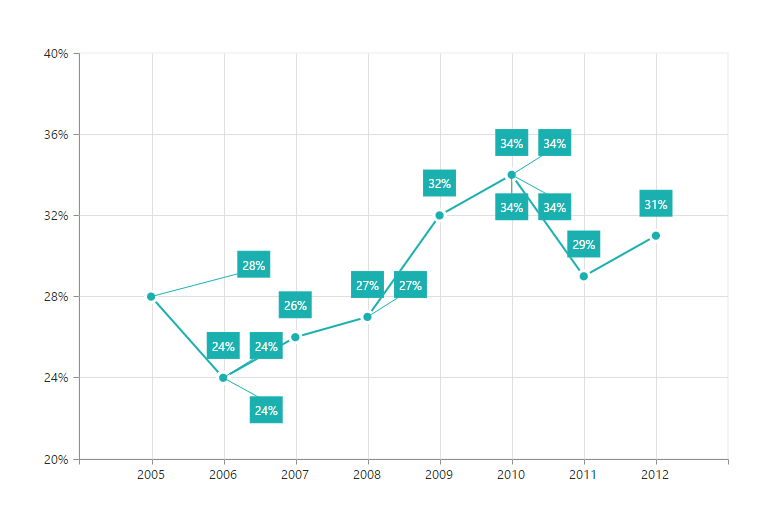
Smart Label is a built-in optimization technique that prevents data point labels from overlapping when rendered with data points on a chart. The advantage of using smart labels is illustrated in the following image.
feature image
Smart Labels
Template Support
You can standardize the style and appearance of the charts you create in design time as well as during run time in a template, and apply the same style to a new chart by loading the template.
feature image
Load Template during Design Time
AJAX Support
The Chart control supports automatic data refreshing at specified time intervals using callbacks.
Default Data Population
The simplest approach to data population is to populate a chart series with specific data points as illustrated in the following code sample.
feature image
Default Data Point Population
Data Binding to DataSet
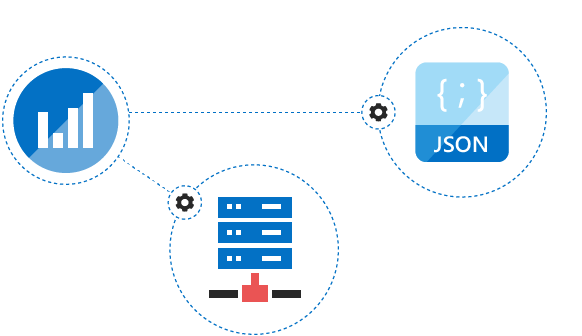
Essential Chart makes it very easy to bind a data set containing data point values to a chart series. Use the built-in ChartDataBindModel class to set up this binding. An illustration of this feature is provided in the following image.
feature image
Data Binding to a Data Set
Axis Label Binding
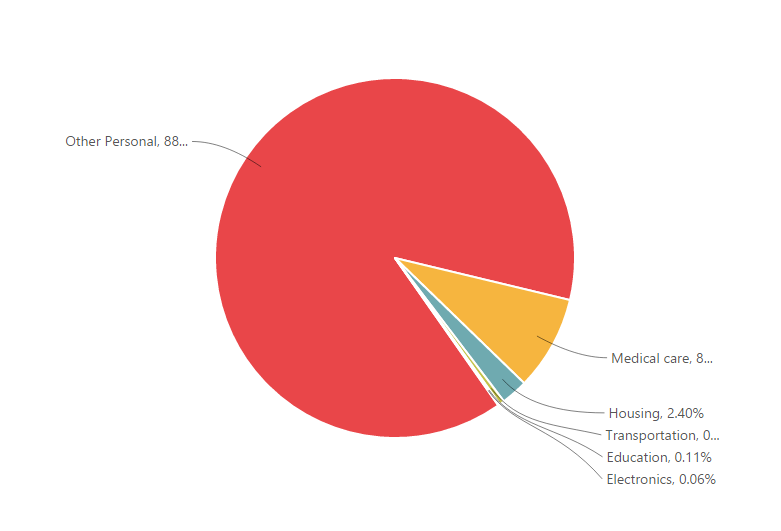
Essential Chart supports binding axis labels to pie, funnel, and pyramid charts. This feature displays data-bound labels in charts.
feature image
Axis Label Binding
Custom Data Model
Essential Chart simplifies the implementation of a custom data model using a simple data model interface. Use this method to encapsulate your data retrieval code within a scalable scope.
When dealing with large amounts of data, custom data models perform better than the manual population of a chart series.
Indexed and non-indexed model interfaces are illustrated in the following images.
feature image
Non-Indexed Model
feature image
Indexed Model
Excel Import-Export
Essential Chart for ASP.NET utilizes Essential XlsIO to read and import data from Microsoft Excel to Essential Chart.
Simple Excel data, containing values as illustrated in the following image, can be loaded using the Microsoft Jet OLEDB data provider.
feature image
Data Imported from MS Excel
Similarly, you can also export data from Essential Chart to Microsoft Excel.
LINQ Support
Essential Chart now supports binding to LINQ query results. Use LINQ to create different views of your data that are concise and optimal. Bind to LINQ query results and view your data using many different chart types.
Binding a LINQ query result to a chart and the resultant display are illustrated in the following image.
feature image
Binding LINQ Query Result and Resultant Display
Area Charts
Simple Area Chart
A simple area chart shades the area under a curve formed by the data points in a series. Multiple series result in overlapped areas. This chart type is used to display the trends of values over time or categories.
feature image
Simple Area Chart
Range Area Chart
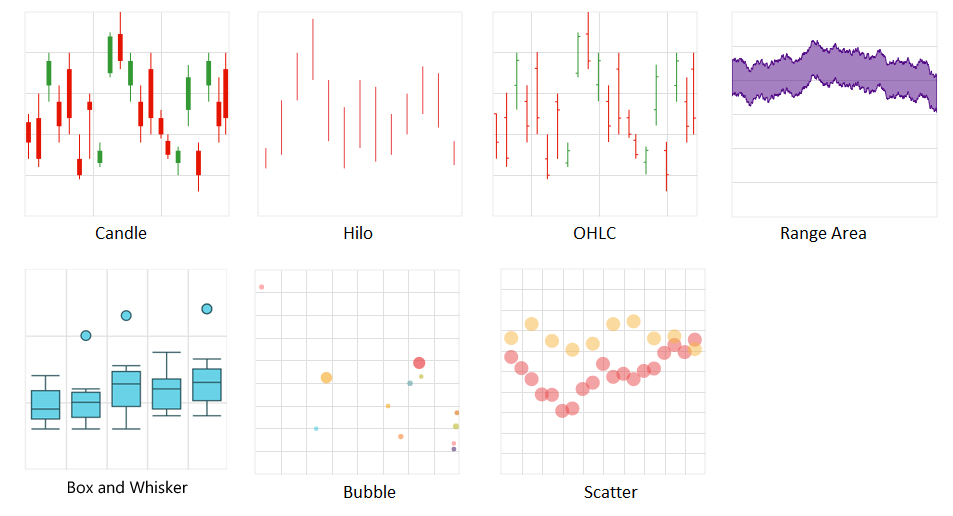
A range area chart is a variation of a simple area chart that lets you plot bands of data on a chart, such as Bollinger bands and weather patterns. Each point on the chart is specified by two individual y values.
feature image
Range Area Chart
Spline Area Chart
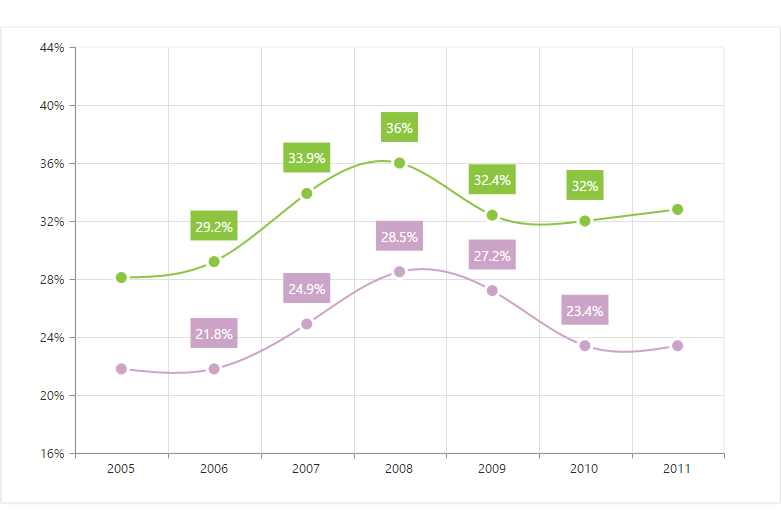
A spline area chart is an area chart with a smooth spline curve connecting the chart points.
feature image
Spline Area Chart
Stacked Area Chart
Stacked area charts are area charts with y-coordinate values stacked over one another in order by series. Chart data can be viewed as a sum of series parts in this chart type.
feature image
Stacked Area Chart
Percent Stacked Area Chart
The percent stacked area chart displays stacked areas under different series curves as a percentage of the total stacked element. Hence, the y-axis will always be displayed within the range "0–100". This chart type is best suited for depicting the relative contribution of data points.
feature image
Percent Stacked Area Chart
Step Area chart
Step area charts are similar to regular area charts where, instead of a straight line tracing the shortest path between points, the values are connected by continuous vertical and horizontal lines forming a step-like progression.
feature image
Step Area Chart
Bar Charts
Simple Bar Chart
A bar chart is the simplest and most versatile of all statistical diagrams. It compares values across categories and is ideal to highlight variations in an item value over time using horizontal bars. Points from adjacent series are drawn as bars next to each other.
feature image
Simple Bar Chart
Stacked Bar Chart
Stacked bar charts are bar charts with y values stacked over one another in the series order. Chart data can be viewed as the sum of series parts when using the stacked bar chart.
feature image
Stacked Bar Chart
Stacked Group Chart
Stacked group charts allow users to group a series with another series using the group name in a stacking chart. This way the grouped series will be shown as a separate stacking.
feature image
Stacked Group Bar Chart
Percent Stacked Bar Chart
Percent stacked bar charts display stacked bars for different series as a percentage of the total stacked element. Hence, the x-axis will always be displayed with the range "0–100". This chart type is best suited for depicting the relative contribution of data points.
feature image
Percent Stacked Bar Chart
Gantt Chart
Frequently used in project management, a Gantt chart provides a graphical illustration of a schedule to help plan, coordinate, and track specific tasks of a project.
Key features:
Provides a graphical representation of the duration of the task against the progression of time. Each task takes up one row. The expected time requirement for each task is represented by a horizontal bar whose left and right ends mark the beginning and completion date of the task. Another bar usually rendered behind the above mentioned bar is used to represent the progression of the task. Tasks may run in a sequential, parallel, or overlapped fashion.
feature image
Gantt Chart
Histogram Chart
A histogram is a bar (column) chart of a frequency distribution in which the width of a bar is proportional to the variable class and the height of a bar is proportional to the class frequency. The categories (bars) are generally non-overlapping intervals of the variable, and must be continuous. In addition, this chart has the capability to display a normal distribution curve.
feature image
Histogram Chart
Tornado Chart
A tornado chart is a bar chart which shows the variability of an output with respect to different inputs. Variability is displayed using relative lengths of bars across a range. Tornado charts are mainly used in sensitivity analysis and shows how different random factors can influence the prognostic outcome of a variable.
feature image
Tornado Chart
Column Charts
Column charts are the most commonly used charts, where the data points are displayed by vertical bars. They are similar to bar charts, except that the bars are vertical and not horizontal.
Key features:
Used for comparing the frequency, count, total, or average of data in different categories. Ideal for showing the variations in the value of an item over time. Points from adjacent series are drawn as bars next to each other. Column charts can be drawn in three modes: default width mode, fixed width mode, and relative width mode.
feature image
Column Chart Drawn in Default Width Mode
feature image
Column Chart Drawn in Fixed Width Mode
feature image
Relative Width Mode—0.75 px
Error bars are supported to indicate the degree of uncertainty in plotted data through the use of a bar that indicates an "error range." There are plenty of symbol options available to be rendered on the error bars.
feature image
Error Bars in a Column Chart
Stacked Column Chart
Data points from different series are rendered one over the other in a stacked column chart. They are very useful for indicating the cumulative effect of multiple series values.
feature image
Stacked Column Chart
Stacked Group Chart
Stacked group charts allow users to group a series with another series using the group name in a stacking chart. This way the grouped series will be shown as a separate stacking.
feature image
Stacked Group Chart
100% Stacked Column Chart
In a 100% stacked column chart, the cumulative proportion of each stacked element always totals 100. This type of chart is great to visualize the relative contribution of each series values to the whole.
feature image
100% Stacked Column Chart
Column Range Chart
In a column range chart, there are two y-coordinate values in each data point, indicating the high and low of the data range as columns.
feature image
Column Range Chart
Line Charts
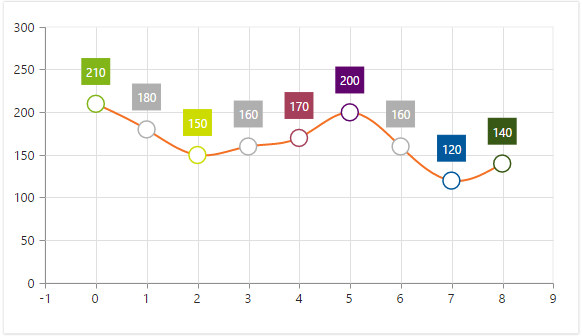
Line charts refer to charts where the data points on a plot are joined using straight or curved 2-D or 3-D lines. These charts are ideal to represent time-dependent data that reveal trends at equal intervals.
feature image
3-D Line Chart
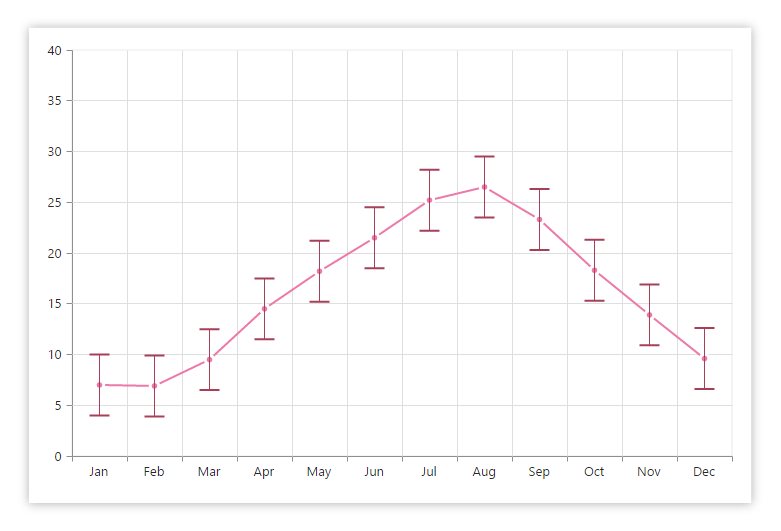
Error bars, which are used to indicate the level of uncertainty in plotted data points, are also available in line charts.
feature image
Error Bars in a Line Chart
Spline Chart
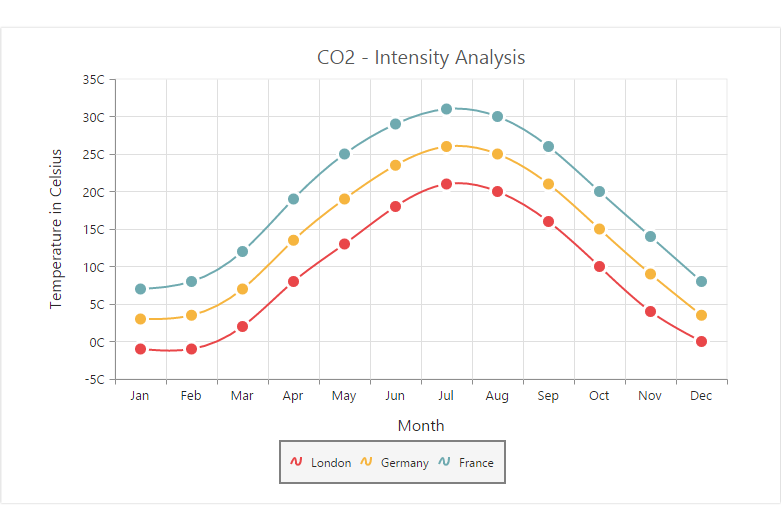
A spline chart is a line chart with a smoothed line connecting the data points.
feature image
Spline Chart
Step Line Chart
Step line charts use horizontal and vertical lines to connect data points, resulting in a step-like progression.
feature image
Step Line Chart
Rotated Spline Chart
A rotated spline chart is a spline chart rotated 90 degrees. It is useful for visualizing how far data points deviate from a median value.
feature image
Rotated Spline Chart
Financial Charts
The following charts are commonly used to view financial data such as data involving stock prices.
Candle Chart
The high and low values are represented by the wick of a candle in a candle chart. The candle represents opening and closing values. The body of the candle is often colored based on the relationship between the opening value and the closing value.
feature image
Candle Chart Summarizing Stock Price for Each Day
Box-and-Whisker Chart
A box-and-whisker chart represents data ranges as boxes, marks, or a combination of the two.
Key features:
A solid "box" is drawn whose top and bottom edges correspond to the quartiles of a data set, and the mark inside it is the median value. The two "whiskers" attached to the ends of a box represent the overall range of the data. Comparing several box-and-whisker chart series helps in spotting distribution differences.
feature image
Box-and-Whisker Chart
Box-and-Whisker Chart with Percentiles
The Chart control supports specifying the values for whiskers as percentages. The ends of the whiskers are specified by the value of the Series1.ConfigItems.BoxAndWhiskerItem.Percentile property.
feature image
Box-and-Whisker Chart with Percentiles
High-Low Chart
As the name suggests, high-low charts are used to view the high and low values of a stock during a day.
feature image
High-Low Chart Depicting Stock Price Summary
HiLo Open-Close Chart
This chart type indicates the high, low, open, and close values of a stock during a day. This helps view the range in which a stock is traded during the day along with opening and closing values.
feature image
High-Low Open and Close Values Chart
Kagi Chart
A Kagi chart consists of a series of vertical lines connected by short horizontal lines. The thickness and direction of the vertical lines depends on a stock's price. This chart is ideal for clearly illustrating price movement; that is why it is one of the many charts that investors use to make informed decisions about stocks.
Key features:
The thick lines indicate that demand exceeds supply, and thin lines indicate supply exceeds demand. As long as prices continue to move in the same direction, the vertical line keeps growing. If there is a reversal in price values that exceeds a specified "reversal amount," a new Kagi line is drawn in a new column. When the line color is orange, it indicates "demand exceeds supply", and the market is trending up. When line is blue, it indicates "supply exceeds demand", and the market is trending down. The higher the bars go, the stronger the trend.
feature image
Kagi Chart
Point and Figure Chart
Point and figure charts are used to identify support levels, resistance levels and chart patterns.
Key features:
This chart ignores time as a variable and concentrates solely on movement in price. A column of Xs or Os may take one day or several weeks to complete. By convention, the first X in a column is plotted one box above the last O in the previous column.The first O in a column is plotted one box below the highest X. The Xs represent an upward trend and the Os represent a downward trend.
feature image
Point and Figure Chart
Renko Chart
Renko charts are excellent in projecting support and resistance levels.
Key features:
Bricks of equal size are drawn to represent a specified value. A brick is drawn in the direction of the prior price move, but only if the price moves by a minimum amount. If prices change by a predetermined amount or more, a new brick is drawn. If prices change by less than the determined amount, the new price is ignored.
feature image
Renko Chart
Three Line Break Chart
A three line break chart is similar to a point and figure chart with the following additional features.
Displays a series of vertical boxes ("lines") that are based on changes in prices. Ignores time as a factor. Depicts rising and falling lines of varying heights. Each new line occupies a new column. Using closing prices (or highs and lows), a new rising line is drawn if the previous high is exceeded, and a new falling line is drawn if the closing price is less than the previous low.
feature image
Three Line Break Chart
Stock and Volume Chart
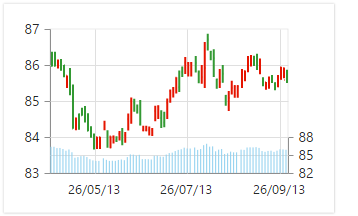
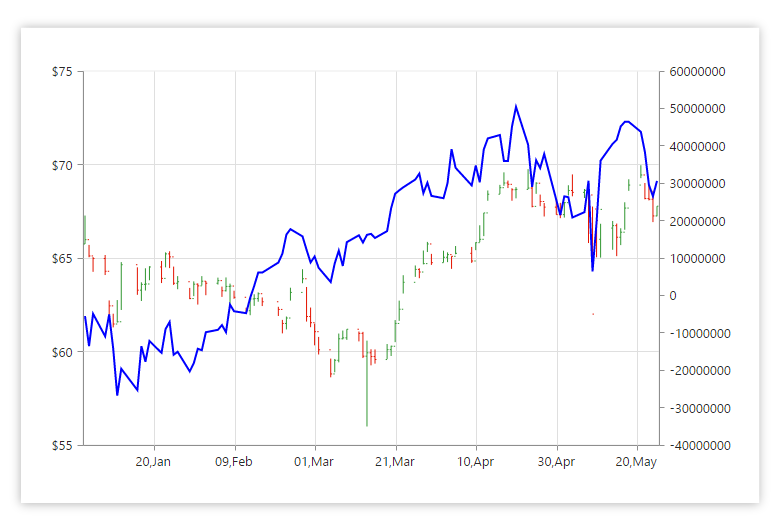
Stock and volume charts can be created using a line chart for stock price (or a high-low chart as shown below), and a column chart for volume data. The multiple axes support aids in the creation of such charts.
feature image
Stock and Volume Chart
In the previous chart, the moving average for the stock chart is calculated over a period of three days.
Pie and Doughnut Charts
Pie Chart
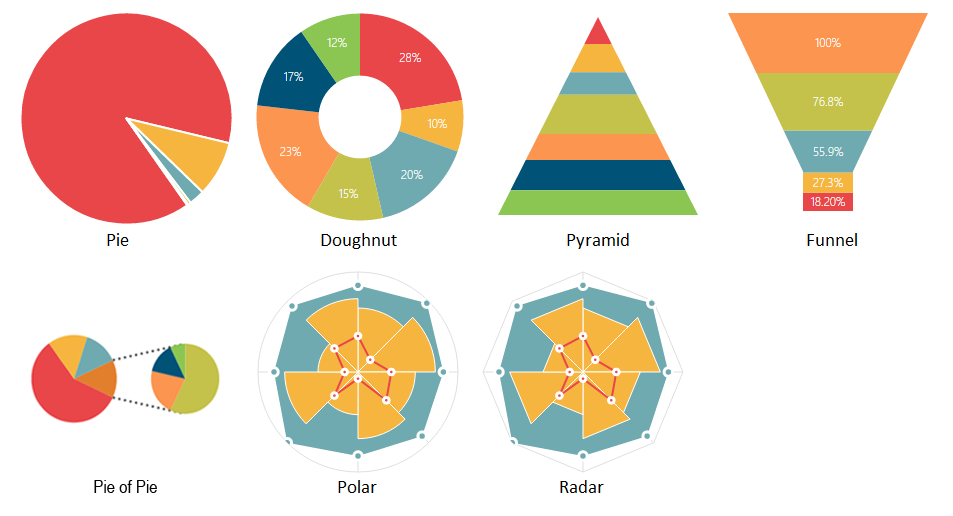
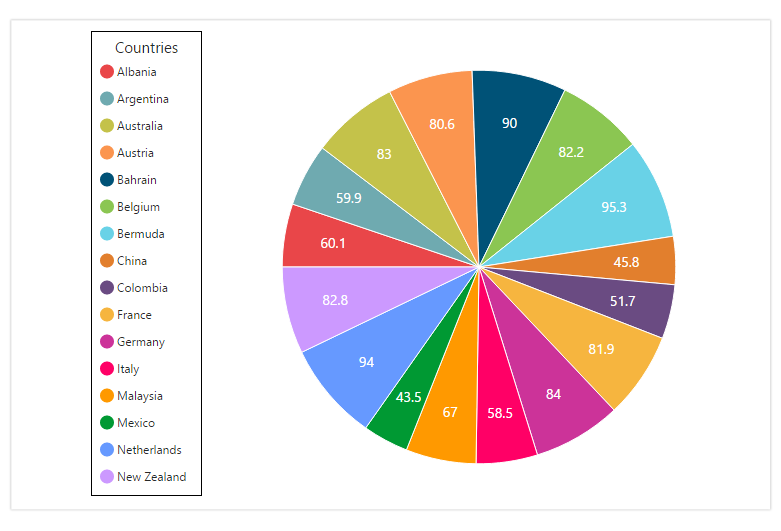
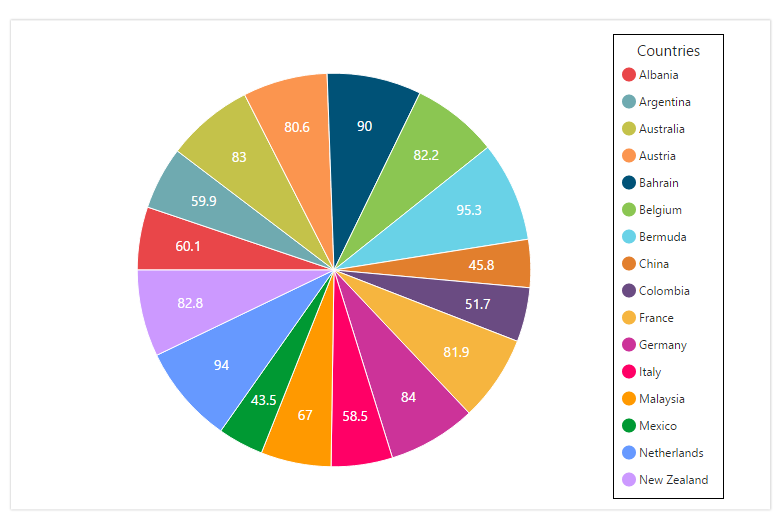
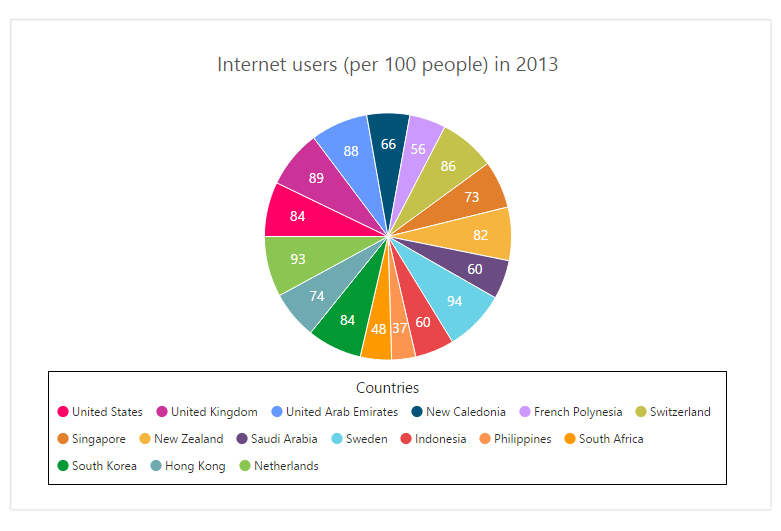
A pie chart is ideal for displaying percentages in a fractional format of proportionate values.
Key features:
Plots y-coordinate values in one series as fractional parts of a circle. The data point value determines the portion of the pie that is taken up by the point. Displays only one data series at a time. Can be used to display only nominal (categorical, qualitative) data. Each data item in a chart has a unique color or pattern and is represented in the chart legend. Supports bevel, round, inside, outside, and custom chart types.
feature image
Pie Chart
Doughnut Chart
A doughnut chart is a pie chart with a vacant center. The size of the data in the doughnut chart corresponds to the doughnut coefficient, which determines the relation of the inner and outer radii. This chart is best suited for presenting data in proportions.
feature image
Doughnut Chart Displaying Proportionate Data
Bubble and Scatter Charts
Bubble Chart
A bubble chart is an extension of the scatter chart, with each data point represented by a circular bubble and the area of the bubble rendered in proportion to the value of a third variable. It is commonly used to represent financial data.
feature image
Bubble Chart
Scatter Chart
A simple plot of x and y values along two axes can be created using scatter charts.
Key features:
Data points are not joined together.Data points can be highlighted using built-in shapes or custom images.Numerical data, both discrete and continuous, can be displayed.Generally used to plot scientific data.
feature image
Scatter Chart
Connected Scatter Chart
Connected scatter charts are a plot of x- and y-coordinate values along two axes where the points are connected using lines or splines. The points can be customized using shapes or images to make them easily identifiable.
feature image
Connected Scatter Line Chart
feature image
Connected Scatter Spline Chart
Accumulation Charts
Accumulation charts are typically single-series charts that represent data in percentages and do not utilize axes.
Funnel Chart
A funnel chart is a type of accumulation chart in which the height of the funnel segment corresponds to the y value of a point in a series.
Funnel charts are often used to represent stages in a sales process and display the potential revenue for each stage.
Alternatively, the y value can also be made to correspond to the width of the segment.
feature image
Funnel Chart—Circular Base
feature image
3-D Funnel Chart—Square Base
Pyramid Chart
A pyramid chart is another type of accumulation chart that is triangular in shape. Similar to a funnel chart, the height of a segment is proportional to the y value of the corresponding point.
Note that the base of the pyramid can be square or circular.
feature image
Pyramid Chart—Circular Base
feature image
3-D Pyramid Chart—Square Base
Circular Charts
Polar Chart
A polar chart is a circular graph where data is displayed in terms of values and angles.
Key features:
Provides the option to perform a visual comparison between several quantitative or qualitative aspects of a situation. When charts are drawn for several situations using the same axes (poles), a visual comparison between the situations can be made. The x-coordinate value of the data point is used to set the angle. The y-coordinate value defines the distance from the center of the graph.
feature image
Polar Chart
Radar Chart
A radar chart is a clock-face form of a line chart.
Key features:
Compares the aggregate values of the data series. Represents each data series as a line around a central point. Provides a graphical display of the difference between actual and ideal performance. Useful for defining performance, and identifying strengths and weaknesses.
feature image
Radar Chart
Inversed Polar and Radar Chart
Essential Chart supports inversed radar and polar charts. This feature is used to render the polar and radar charts in a clockwise direction.
feature image
Inversed Polar Chart
feature image
Inversed Radar Chart
Combination Charts
A combination chart uses two or more chart types to emphasize that the chart contains different kinds of information. Note that:
Only chart types that are compatible with each other may be combined in the same chart area.Combining different chart types on the same chart lets users display complicated data.
feature image
Combination Chart
Sparkline Charts
This feature presents variations of data in a very condensed fashion. A sparkline does not contain an axis scale and is intended to give a high-level overview of data. The purpose of a sparkline is to quickly see data range differences between high density data.
feature image
Sparkline Charts within a Grid Column
Heat Map Chart
Heat Map Chart
A heat map chart is a graphical representation of data where the values taken by a variable in a two-dimensional map are represented as colors.
feature image
Heat Map Chart
3-D Mode
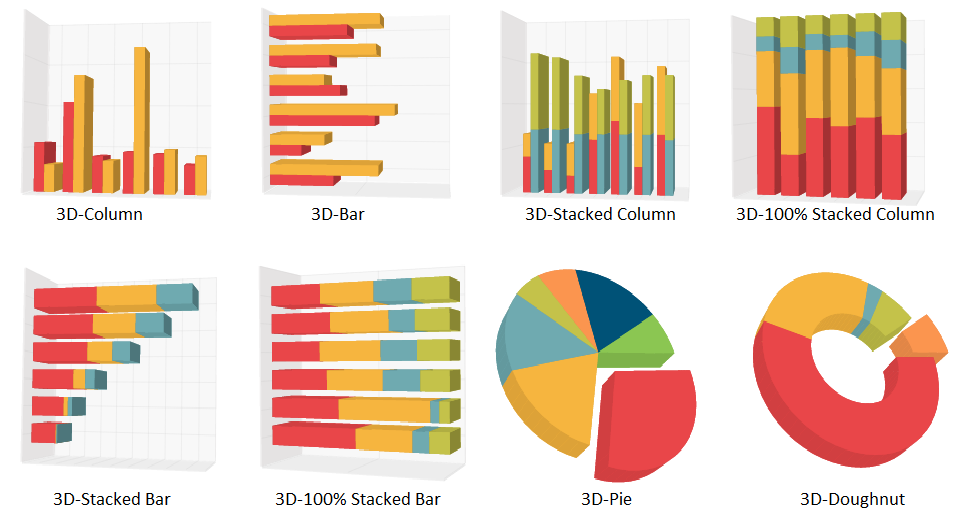
Essential Chart supports 3-D mode for all chart types except polar and radar.
feature image
3-D Stacked Bar Chart
The depth of the z-axis can be customized using the Depth property.
feature image
3–D Column Chart with Custom Depth Value
The Real Mode option displays a chart in a 3–D plane. Users can also use the Rotation or Tilt properties to rotate the control through code.
feature image
Stacked Chart in 3-D Real Mode
Clustered Mode
Essential Chart provides support for a clustered view in 3-D modes. This effect shows the z-axis data extended in the third dimension as clusters are displayed in the foreground.
feature image
3-D Bar Chart—Plane Mode
feature image
3-D Bar Chart—Clustered Mode
feature image
3-D Column Chart—Plane Mode
feature image
3-D Column Chart—Clustered Mode
Spacing Effect
Spacing Between Data Series
Spacing helps customize the space between columns to give the chart an uncluttered look.
Increased spacing between columns automatically reduces the column widths of a column.
feature image
No Space Between Data Series
feature image
Spacing Between Data Series (50%)
Spacing between Data Series in 3-D Mode
There is also support to control the spacing between data series in 3-D mode. Spacing is set as a percentage value of the z-axis depth of a column.
feature image
Spacing Between Data Series—3-D Mode
Anti-Aliasing
Essential Chart supports rendering a chart in different ways using the SmoothingMode property in the Chart control. The default option is anti-alias. Anti-aliasing smoothes the jagged lines of the graphical output.
feature image
Anti-Aliasing
Alpha Blending
Alpha blending aids in making a series visible through another as illustrated in the following image.
feature image
Alpha Blending
Built-in Skins
Essential Chart for ASP.NET contains 14 different types of built-in skins that easily customize its appearance. The Skins property allows you to apply predefined skins to the control, giving you numerous customization options.
feature image
Office 2007 Blue Skin
feature image
Office 2007 Black Skin
feature image
Office 2007 Silver Skin
feature image
Vista Skin
feature image
Almond Skin
feature image
Blend Skin
feature image
Blueberry Skin
feature image
Marble Skin
feature image
Midnight Skin
feature image
Monochrome Skin
feature image
Olive Skin
feature image
Sandune Skin
feature image
Turquoise Skin
feature image
VS 2010 Skin
Chart Background
The layout and background of the Chart control can be customized.
feature image
Chart with Customized Layout and Background
Chart Interior
You can render professional-looking charts with gradient colors in the chart interior and other chart areas.
feature image
Customized Chart Interior
Chart Border
Essential Chart supports 13 different border styles. The interior style and the size of the chart border can also be customized.
feature image
Chart Border Appearances
Series Border
Border customization options are also available for the data points in a chart data series.
feature image
Customized Data Point Borders
Chart Font
Customized fonts can be rendered for all text appearing in a chart.
feature image
Chart with Custom Font
Color Palette
Default color palettes are applied on chart data points unless custom colors are specified for the data series.
These built-in palettes offer a rich set of colors to render professional-looking charts.
feature image
Chart with Default Color Palette
Custom Palettes
Essential Chart also lets you define and add custom color palettes.
feature image
Chart with Custom Non-Gradient Color Palette
Shadow Effect
Shadow effects can be applied to a chart area and data series. The shadow effect is illustrated in the following chart image.
feature image
Chart Area and Data Series with Shadow Effect
Data Point Symbol
Symbols can be associated with each data series to highlight its data points.
Customization options are available for symbol size and color.
feature image
Chart with Data Point Symbols—Star and Triangle
There is also an option to specify custom symbols in place of the built-in symbols.
feature image
Chart with Custom Data Point Symbols
Localization
Essential Chart supports full localization that displays the text and formats used by the chart to reflect the current locale of the application.
feature image
Chart showing localized strings
Multiple Pies
Essential Chart supports the display of multiple pie charts in one chart area for easier presentation and analysis of chart data.
feature image
Essential Chart with Multiple Pies
Gridlines
Horizontal and vertical gridlines can be included in a chart to bring clarity to its data points.
The appearance of gridlines can be customized as illustrated in the following image.
feature image
Chart Gridlines
Axis Line Type
The appearance of the x- and y-axis lines can be customized to fit your needs. The style, width, and color of these lines can be defined.
feature image
Chart Axis Lines
Axis Ticks
Essential Chart supports major and minor axis tick marks on the chart axes. The appearance of a tick mark can be customized by changing its color, height, and width.
The number of minor axis tick marks between the major axis tick marks can also be specified.
feature image
Chart Axis Tick Marks
Axis Label Customization
Axis label text can be custom defined by specifying the size, color, and font of the label text in the Chart control.
feature image
Customized Axis Label Text
Axis Label Orientation
The orientation of axis labels can be rotated to any specific angle. This is useful when labels are long and might overlap.
feature image
Rotated Axis Labels
Essential Chart can be configured to automatically rotate labels to avoid overlapping.
feature image
Automatically Rotated Axis Labels
Axis Custom Origin
Essential Chart allows you to set a custom plotting start value. Data points can be plotted about any specific x- or y-axis value, or a data point.
feature image
Chart with Plotting Origin at Y=68
Axis Strip Line
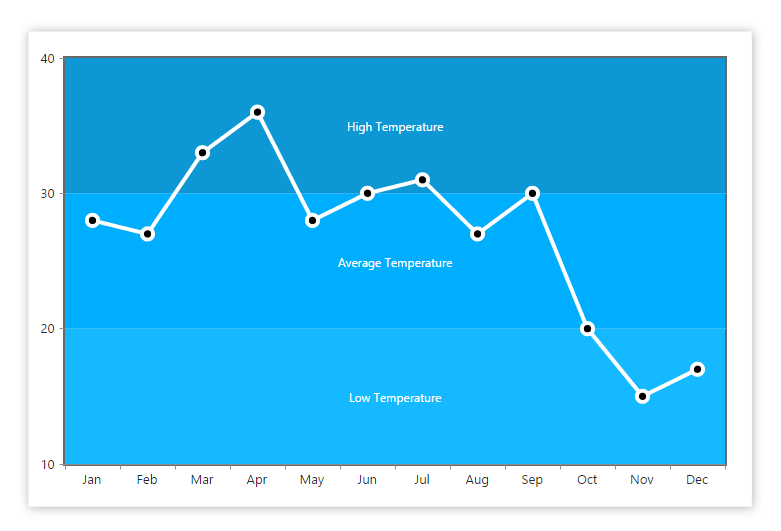
Strip lines are bands that can be drawn horizontally or vertically on a chart background to highlight certain regions. These strip lines can also be repeated (to mark weekends, for example).
feature image
Vertical Strip Line
feature image
Horizontal Strip Line
The Chart control now supports setting a fixed width for striplines irrespective of the axis range. The default value of the FixedWidth property is 0.
feature image
Fixed-Width Strip Line
Automatic Range Scaling
The Chart control has an automatic range scaling engine that can compute the best possible range for a given set of values.
feature image
Automatic range calculations are also configurable. You can configure a range to start with "0" and also set the preferred number of intervals.
Automatic ranges can also be calculated for date values. The range intervals are calculated to be in increments of easily understandable date segments, such as weeks, months, years, and so on.
feature image
Axis Custom Range
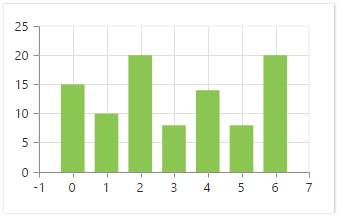
Essential Chart lets you specify a custom range and its scale for an axis if the automatically calculated range scale is undesirable. You can manually set the range as well as the intervals for an axis.
In the following image, a custom x-axis range with a minimum value of "0", a maximum value of "6", an interval of "1", and a custom y-axis range with a minimum value of "-100", a maximum value of "600", and an interval of "100" is illustrated.
feature image
Customized Axis Range and Scale
Custom Polar-Axis Range
A polar chart is a circular graph in which data is displayed in terms of values and angles. Essential Chart lets you specify any custom range, instead of 0–360 degree range values for the axes of the polar chart. You can set the range as well as intervals for an axis.
A custom polar axis range with a minimum value of "0", a maximum value of "12", and an interval of "1" has been illustrated in the following image.
feature image
Polar Chart with Customized Axis Range
Opposed Axis
Essential Chart supports opposite chart axes positions. A chart's axes can be positioned opposite of the default axes positions. This is useful in creating RTL charts or charts with negative values.
feature image
Chart with Opposed X- and Y-Axis
This feature is useful when working with multiple axes, where the secondary axis can be positioned opposite of the primary axis.
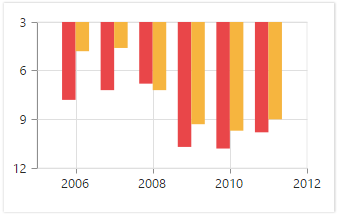
Inverted Axis
Any chart axis range can be reversed and the data for this axis will be plotted in the opposite direction. A chart with inverted axes is shown in the following illustration. The range is rendered:
Top-to-bottom on the y-axis and right-to-left on the x-axis
feature image
Chart with Inverted Axes
Secondary Axis
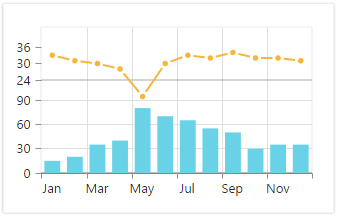
Essential Chart supports multiple axes. You can add a secondary axis and position it next to or below the primary axis.
These options are illustrated in the following images.
feature image
Stacking Layout
feature image
Side-by-Side Layout
You can also position this secondary axis opposite the primary axis as illustrated in the following image.
feature image
Chart with Multiple Y-Axes
The Chart control supports displaying ellipses at the end of axis titles when the title text exceeds the axis boundaries. This feature can be implemented in both primary and secondary axes.
feature image
Chart Axes Titles that Extend beyond Axes Ranges
Logarithmic Axis
Essential Chart supports logarithmic axes. The data type of any series that is plotted in achart can be set to logarithmic. Both the axes of the Chart control can be customized to display logarithmic values.
Custom logarithmic axis ranges can also be specified for the chart.
feature image
Logarithmic Axis in a Chart
Scale Break
Scale breaks help in accommodating outlying data into the display while also clearly displaying normal values. Scale breaks can be applied automatically or manually.
feature image
Chart without Scale Break
feature image
Inserted Code for Manual Scale Break
feature image
Chart with Manually Inserted Scale Break
feature image
Inserted Code for Automatic Scale Break
feature image
Chart with Automatically Inserted Scale Break
Multiple Axis Layout
Essential Chart supports a combination of both stacking and side-by-side chart axes layouts when multiple axes are used. Multiple axes allow for greater control and flexibility when dealing with large amounts of data.
The multiple axes layout feature is illustrated in the following image.
feature image
Multiple Axis Layout
Chart Axis Labels
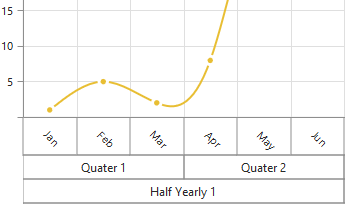
Chart axis labels can be grouped as desired, and the grouping label's text, color, font, and other related information can also be customized.
feature image
Grouped Axis Labels
Custom Polar Axis
Essential Chart now supports the customization of solid circle lines in polar and radar charts. The Pens property for primary x- and y-axes is used to set the style of the solid circles.
feature image
Chart with Customized Polar Axis.
Axis label ToolTips
You can add ToolTips to the chart axis labels.
feature image
Customized Chart Axis Label ToolTips
Docking and Alignment
Essential Chart allows users to dock a data legend anywhere within the chart area.
feature image
Docked Data Legends—Left, Top, and Bottom
The data legend can also be aligned near, center, or far on the docked side.
feature image
Aligned Data Legends—Near, Center, and Far
The chart legend can also be set to float so that the user can drag the legend at run time.
feature image
Chart Legend in Float State
Border Style
Essential Chart provides options to customize the border style of the data legend.
feature image
Solid Data Legend Border
feature image
Dashed Data Legend Border
feature image
Dotted Data Legend Border
feature image
Dash-Dot Data Legend Border
feature image
Dash-Dot-Dot Data Legend Border
Title Font and Color
The data legend can have a custom title with custom font style, size, and color.
feature image
Data Legend with Title
Representation Type
Essential Chart provides a number of representation types for the data legend.
feature image
Representation Type—Circle
feature image
Representation Type—Cross
feature image
Representation Type—Diamond
feature image
Representation Type—Hexagon
feature image
Representation Type—Triangle
feature image
Representation Type—Line
feature image
Representation Type—Pentagon
feature image
Representation Type—Rectangle
feature image
Representation Type—Straight Line
feature image
Representation Type—Triangle
feature image
Representation Type—Series Image
Visible Check Box
The check box feature in the data legend lets users show or hide a series during run time by simply checking the the data series to be displayed.
feature image
Scatter Chart with a Hidden Series
Background Image
There is also support to add a custom background image to the data legend.
feature image
Chart Legend with Background Image
Item Alignment
Item text in the chart legend can be aligned near, center, or far within the data legend bounds.
feature image
Data Legend Item Alignment
Multiple Chart Legends
Essential Chart supports displaying multiple chart legends with custom legend items that can be associated with any chart series.
feature image
Essential Chart with Multiple Legends
Title Font Customization
A chart's title can be customized with specified font style, color, and size.
feature image
Custom Chart Title
Title Position
Essential Chart lets you position a chart's title to any of the four sides of a chart.
feature image
Different Title Positions
Title Alignment
Essential Chart allows users to align the chart title near, center, or far from the side that it is rendered.
feature image
Title Alignment
Multiple Chart Titles
Essential Chart supports displaying multiple chart titles. Multiple custom chart titles can be added to a chart. The Titles collection supports numerous docking styles, including floating, left, right, bottom, or top for each title.
feature image
Chart with Multiple Titles
AutoHighlight
The data points on a chart can be automatically highlighted on mouseover. The highlight color for such elements can be customized.
feature image
Automatically Highlighted Column
Drag-and-Drop Data Point
Using mouse events fired by a chart, you can drag a data point to any new location on the chart.
feature image
Drag-and-Drop Data Point
Interactive Cursor
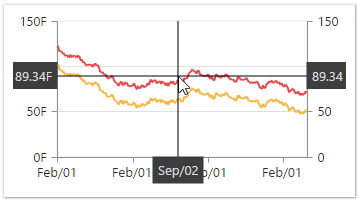
The interactive cursor feature lets you position a cursor on a specific data point in a series. The x and y coordinates of this point can be read using the horizontal and vertical lines that pass through the data point and intersect with the x- and y-axis respectively. These lines can be dragged and positioned on any specific data point.
You can also use the UP ARROW and DOWN ARROW keys to move the horizontal cursor, and the LEFT ARROW and RIGHT ARROW keys to move the vertical cursor.
feature image
Chart with Interactive Cursor
Toolbar
A built-in toolbar is available for the Chart control, which can be displayed during run time.
feature image
Chart Toolbar at Run Time
Context Menu
Built-in context menus can be implemented in the Chart control.
feature image
Changing Legend Alignment Using a Context Menu
Essential Chart now allows users to set the navigation links with series points and legend items.
feature image
Chart with Navigation Links.
Client-Side Events
Plenty of client-side events are available, like MouseDown, MouseUp, MouseMove, MouseClick, and MouseDoubleClick, to help improve user interaction capabilities.
::adCenter::